

Choreographer: Baru Madiljin
In November 1871, four ships left Japan heading home to the Ryukyu Islands. Blown off course and hit by a typhoon, two ships made it home, one was lost, and the fourth was shipwrecked on the coast of Taiwan. 66 people made it to shore, but there was a massacre; the native Paiwan people killed 54 of their number. The incident became a precipitating element in Japanese aggression towards the island, with repercussions across the decades.
This defining and painful chapter in Taiwanese history may be the inspiration behind choreographer Baru Madiljin’s new work Bulabulay man?, the title of which is South Paiwan for “How are you?”. But this feels less about warfare than it does about connection to the elements, of how humanity’s harsh life is subservient to the wind and the sea.
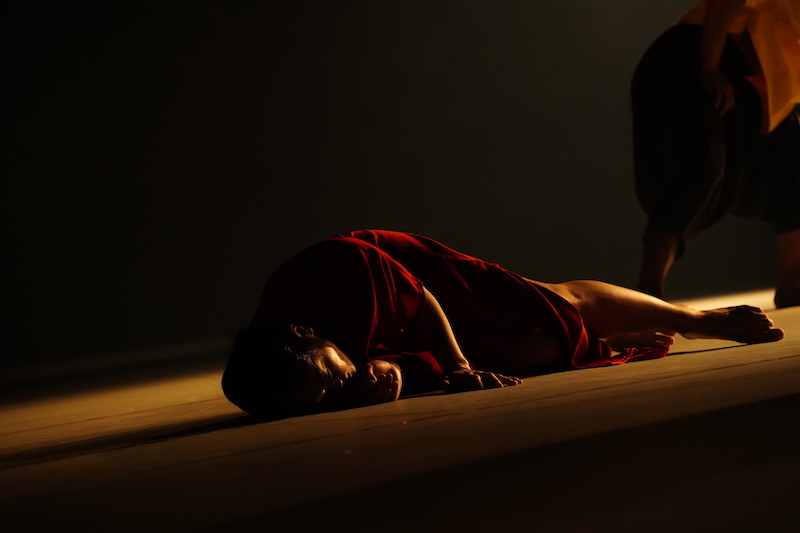
After a subdued opening in which a red-clad dancer is dragged along the stage, entangled in a stream of knotted scarlet rope, attention focuses on the sea. Video projections of undulating oceans back a quintet of dancers who together form a boat and its passengers. With the aid of a long wooden branch – straight enough to act as a mast for one dancer to ascend as lookout, curved enough to become the ship’s prow or the crest of a crashing wave – we quickly gain the sense of a company whose collective strength is dwarfed by nature.
As the piece progresses, the dancers all sing traditional songs, typically with one verse sung by one of the company’s three men and the other four dancers echoing the same back. The voices are all surprisingly strong, no mean feat when the singing is performed in conjunction with physical exertion. Whether standing upright or bending over with a fellow performer standing on one’s back, the force and conviction of the singing never wavers.
That balance of modern contemporary aesthetic and a connection to tradition feels especially important. As the centuries pass, discerning the truth about historical events becomes increasingly complex, but there is a sense of tribal memories battling for place in the dancers’ minds.
Stronger even than that, there is a sense of caring. “How are you?” is a phrase that has many connotations, but at its most honest, it is a form of seeking connection, and that is the primary sense one feels when experiencing the piece. As the dancers are buffeted by wind and water – feelings emphasised by a soundtrack dominated by low drones, peppered with splashes of electronica – one member will separate from the herd, only to be drawn back into the safety of the collective.
For all its contemporary stylings, there also feels a strong connection with the past. In the hour-long piece’s final movement, the quintet join hands, performing a group dance that has its origins in indigenous tradition. The people may be buffeted by nature, have been damaged by historical injustice and war, but the compassion of emotional connection always survives.
Runs until 22 October 2025.
Dance Umbrella continues until 31 October.
