

Writer: Michael Abbensetts with additional material by Trish Cooke
Director: Lynette Linton
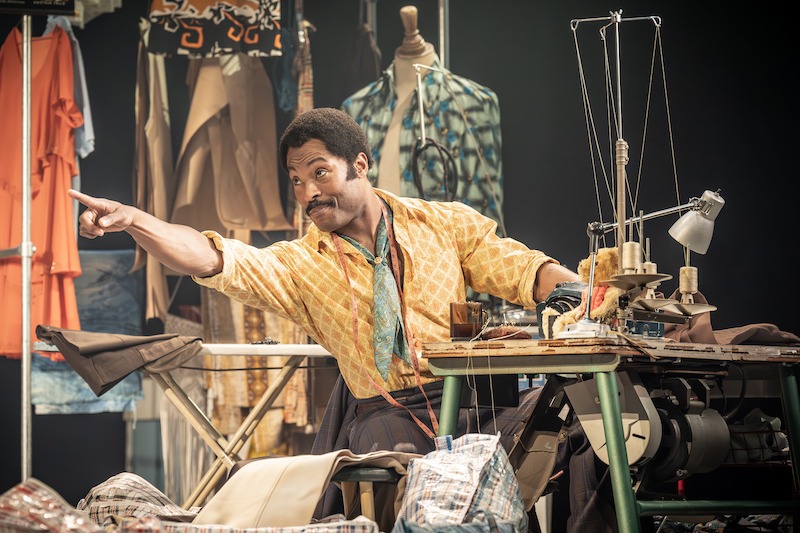
Arinzé Kene blazes in a role that literally seems tailor-made for him. In virtually every scene in a show that runs for almost two hours sans interval, Kene plays a Guyanese tailor who is trying to buy his own shop in a hostile London of the 1970s. Originally presented at Hampstead’s New End Theatre in 1978, Michael Abbensetts’ Alterations has been given a brush down with the help of the Black Plays Archives, an organisation that seeks to catalogue plays by Black British, African and Caribbean playwrights.
Abbensetts is an almost forgotten playwright now, even though his debut play was presented at the Royal Court in 1973 and his drama series Empire Road was a hit on BBC2 at the end of that decade. On the strength of this revival of Alterations, let’s hope that other plays by Abbensetts are produced. With complex portrayals of Guyanese people living In Britain, Abbensetts’ work charts a history of immigration that rarely is seen on British stages.
That’s not to say that Alterations doesn’t feel a little creaky in places. Taking place over two days, its structure is old-fashioned in that big events and momentous decisions all take place in the same two days. Kene’s Walker wants to buy the building where he has set up his alterations business. If he can manage to shorten the leg length on an ‘epidemic of trousers’ for tailor Mr Nat he will have enough money to pay off the landlord. Walker dreams of having his own tailor shop, providing the trendiest clothes for the man-about-town. “Trousers Is In”, he wants to call it.
Helping him sew the trousers is his trusty friend Buster (Gershwyn Eustache Jnr), whose wife is about to have a baby and the untrustworthy Horace (Karl Collins), whose acts of sabotage are well-known. And then there’s van driver Courtney (Raphel Famotibe) who has to lug the laundry bags of clothes over to Mr Nat in Soho. As they furiously alter the trouser legs, the men discuss why they left Guyana for Britain and what they imagine their futures to be.
While Walker wants his shop, the flamboyant Horace wants to become an actor and hoofs it to the Barbican to see the Royal Shakespeare Company. It’s obvious from the reactions of the other characters that this ambition to tread the boards is just another unfulfilled desire in a list of many. However, when Walker’s wife Darlene (a tremendous Cherrelle Skeete) arrives, it becomes clear that Horace is better at playing the ladies than he would ever be playing Hamlet.
Buster may seem like an undeveloped character, saying little, but we discover that this silence is a strategy he uses to get along in racist Britain. The younger Courtney accuses him of being afraid to frequent the local pubs because of the men there talking about the Race Issue. Courtney, on the other hand, wants to get on in life, but cannot find a better job in a period of high unemployment.
But this is Walker’s play, his business. And Kene manages to make Walker a likeable character even though he shouts at his staff and cheats on his wife. Walker is committed to becoming a self-made man, even if that man is to be a lonely, unloved and unloving one. He wants to be a respectable man of business but that means he must leave family and friends behind. It’s a dilemma that has been faced by the Jewish Mr Nat (a strong performance by Colin Mace) who tells Walker about his own struggle to make it in an inhospitable city. That Walker is making the right decision is suggested by the salute that is given to him by one young Black man who appears to be from our own time.
Frankie Bradshaw’s costume design is gorgeous and detailed, but her set, a revolving stage scattered with clothes racks and sewing machines, is too slight for the Lyttleton. The characters seem too small and far away in a play that is intimate and compact. Fortunately, everyone’s acting, especially that of Kene, fills the space with laughs, hopes and disappointments that aren’t too distant from our own age.
Runs until 5 April 2025
