

Writer: William Shakespeare
Director: Jamie Lloyd
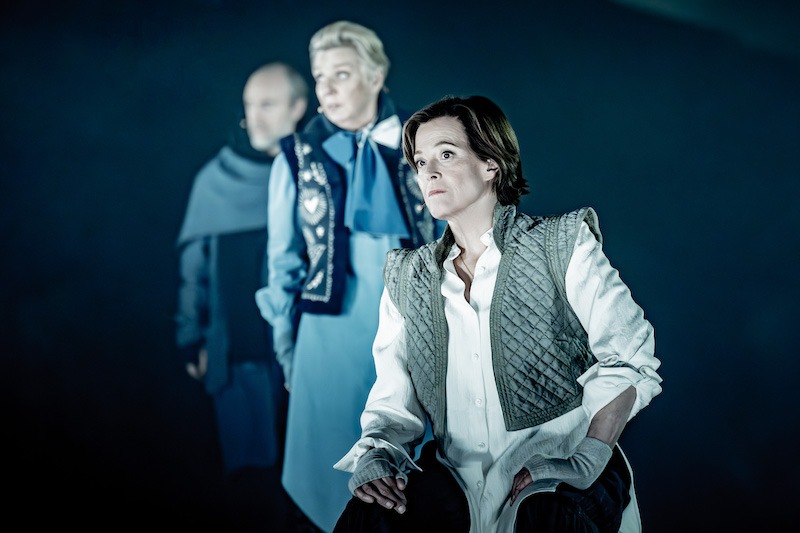
Jamie Lloyd’s Tempest starts well. As the sounds of the shipwreck she’s ordered boom, Prospero sits on a stool staring out into the audience, a blue sheet billowing behind her. But as Prospero, Sigourney Weaver rarely wavers from this stance, mostly looking out into the stalls even when her character is talking to another. Her Prospero lacks drive, power and charisma.
When she isn’t sitting, Weaver stands rigidly, her arms always down by her sides. She hardly uses her hands at all, meaning that the sense of Prospero must be in her words themselves and only in the words. Therefore, it’s a shame that Weaver’s microphone appears to be positioned too close to her mouth, as some lines are almost unintelligible on the deep stage of Drury Lane. Other productions have imagined Prospero as a madman, a tyrant or a kindly old man in his dotage, but Weaver plays the usurped Duchess of Milan as a patient, rational mother. You half wish she wielded a gun, Alien-style. It’s a surprise that she exercises so much authority over Ariel and Caliban.
But dressed like a gimp in a rubber corset, it seems that Caliban favours his enslavement, getting some perverse joy from being servant to Prospero’s cool dominatrix, a literal bootlicking attitude that he later confers on Stephano. Forbes Masson gives it all he’s got, but his Caliban is so pathetic no one would ever root for him.
Ariel fares a little better, but against the sounds of the island, Mason Alexander Park’s words are not always clear. Like Caliban, there’s something too obsequious in the way Ariel submits to Prospero’s demands However, Park, who shines in the otherwise depthless movie National Anthem, sings well, luring the shipwrecked voyagers deeper into the isle.
With Caliban presented as an S/M slave, any examination of Prospero as a coloniser is lost, so Lloyd’s focus seems to lie in the presentation of power dynamics. Of course, we have the pairings of Prospero/Ariel, Prospero/Caliban, Caliban/Stephano and Prospero/Antonio, but the forthcoming union between Miranda and Ferdinand is also staged as a contract where one party holds dominance over the other. As Miranda, Mara Huf’s West Coast American accent gives the character a brashy confidence that is sometimes at odds with Shakespeare’s lines. James Phoon’s Ferdinand comes across as the perfect English gentleman.
The comedy, as always, is provided by the antics of Stephano (Jason Barnett) and Trinculo (Mathew Horne in full-on Shane Richie mode), but they struggle to get the laughs until late on in the play. With this Tempest arriving in panto season, the slapstick humour appears too broad. Likewise, when Prospero finishes the play with her soliloquy, it’s reminiscent of the Good Fairy wrapping up the proceedings with a comfortable moral message. All Weaver needs is a wand, although in all likelihood it would only hang immobile in her immobile hands.
Really, only Selina Cadell as a gender-swapped Gonzalo comes out of this Tempest totally unscathed. Delivering her lines with ease, her Gonzalo may not be as tiresome as other iterations of the faithful servant, but she commands Soutra Gilmour’s dark stage with grace.
With The Tempest being one of the bard’s final plays, there is a sense of an ending as Prospero promises to burn all her books. With such a star as Weaver playing the lead at the age of 75, perhaps this role acts as a swansong, too. And despite this production’s flaws, the audience reacts kindly to Prospero’s adieu.
Runs until 1 February 2025
