

Writer: Jez Butterworth
Director: Ben Grafton
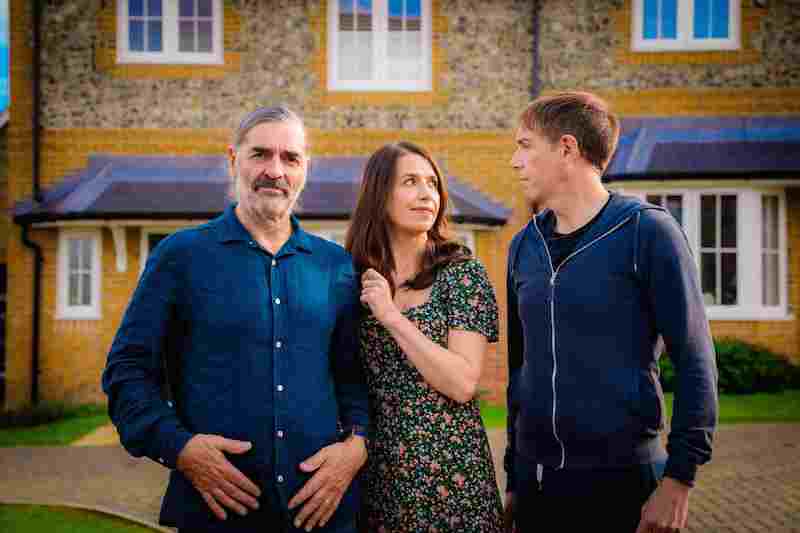
Things fall apart in Drama Impact’s rendition of Jez Butterworth’s Parlour Song: suburban wastelands and the feeble minds that inhabit it alike. The play explores violence and unease sitting beneath the surface of suburban milieu. Ned, a demolitionist, confides in his friend and neighbour Dale about his recent troubles: his insomnia, the disappearance of his many, many belongings, and suspicion toward his beautiful wife, Joy. Dale, who takes up a narrator sort of role, is left to oversee this breakdown and make sense of it as it implicates his suburban, cookie-cutter life.
The play itself is written in a way that gnaws at you. Rather than typical suburbia being treated as a foil for the breakdown that Ned has, it is regarded as something fundamentally unnatural in its own right. The uncanny similarity between Ned and Dale’s houses goes as far as the cracks on their windows, and their homes are exactly like those that redevelop the land Ned has blown up. The play also doesn’t hesitate to remind the audience that suburbs are often formed through the senseless destruction of the natural world.
A quarter into the play, Dale asks the audience, “What is Ned?” This is not a question for the audience to provide an answer for, but a segue into his assessment – “on the flat, he’s volatile.” The other two characters around him frequently write off Ned as having a propensity for insanity, and the play invites us to determine on what grounds that insanity lies. David Houston-Lock has just the right fry in his voice, sufficient mania in his eyes, and portrays the right amount of eccentricity to depict a man who was always a bit of a loon but is tumbling off the edge.
Paul Boichat gives off the impression of someone who has also been burdened by the oppression of suburbia, whose only distinction between him and Ned is the grace by which he handles it. And Joanna Nevin makes for an exceptionally ambivalent Joy. Her expression is often unreadable, or readable, in many different ways: irate, uncaring, disappointed, yet also utterly complacent. While limited peaks into her internal world leave room for sexist characterisations of her actions, the nostalgic moments of the play add depth to her grief, and the play’s violent progression gives meaning to her withdrawal.
The production is small in scale but quite creative as a result. The central prop, a wooden frame, takes on many shapes throughout the play: the dining room table caught between the stilted conversation of a broken couple; the bed atop which salacious Scrabble games past and present are played; the cage that traps Ned initially but which also comes down on Joy. Watching the actors organise it into these shapes contributes to the audience’s experience of a blurred reality.
Reading back the text of Butterworth’s initial script, there are stylistic elements that are omitted that would have contributed to a greater understanding of some narrative elements. The audience would have a stronger sense of the intimacy between Dale and Joy, for instance, if they got to see the words formed in their Scrabble game, which Butterworth writes into the text. If Ned were to have cufflinks to hold to the light in his dream, the audience might be able to better access what his disappearing clutter means to him, and that understanding would frame the violence that ensues afterwards. (It’s also kind of shocking to hear Joy say Ned has long been bald when Houston-Luck has all his hair.)
Most audience members aren’t in a position to miss these elements, though, and the cast and creative team alike have done well to provide a captivating, if a bit scrappy, rendition of Butterworth’s early career work.
Runs until 30 November 2024
