

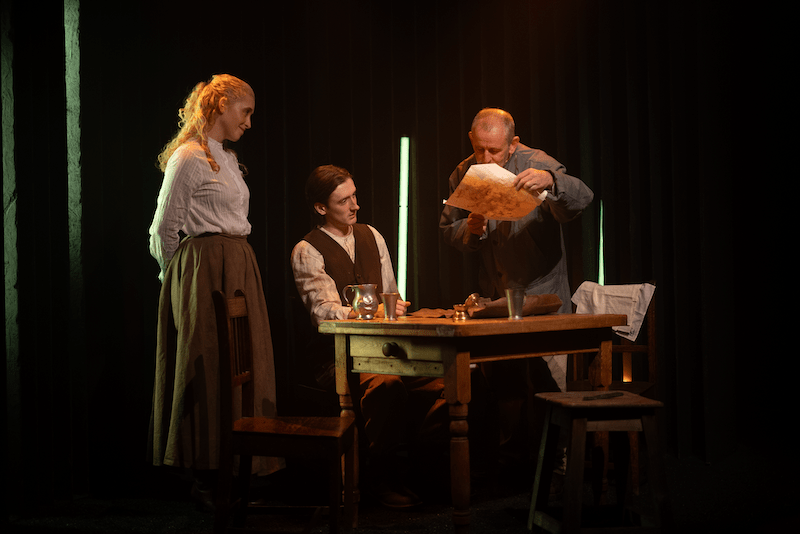
Writer: Jon Berry
Director: Jac Ifan Moore
Tachwedd/ drops us at a farmhouse in or around Bethesda, North Wales, where four tales across three centuries are united by the land beneath their feet. The land here is everything; it holds the memories, and the people consume the land. The tales try to encompass everything about the people who have lived here, from their grief, their absences, their desires, and their fears.
Tragedy abounds, and there are few sparks of love. There is money and power and gender inequality. There is the English; the reverberation of the English colonisers vibrates through every century. There is myth and there is banal reality. Put simply, there is an awful lot to try and fit into two hours. Tachwedd has so much that is exciting about it, and it has been staged with passion and imagination, but it would say so much more if it tried to say so much less.
The aspects of myth and mystery are used as interludes and are sprinkled with great effect both in Jon Berry’s script and in Jac Ifan Moore’s staging choices. Particularly the choice to have black granules stand in for the land, for food, and for petrol. It creates a stronger tie between the land itself and the industry that, at first, brings opportunity to the area and later signifies its downfall.
Frequent reference is made to the coal mining industry in South Wales, and Tachwedd speaks both to the unity of Welsh experience, but more importantly, to the critical disparity in prosperity between North and South. Contrasting this tangible theme is the ever-present myth of the boar, made all the more readable to the audience by distinct lighting and sound design by James Harvey and Joseff Harris, respectively.
The use of myth juxtaposed with the gritty reality of financial inequity is executed in Berry’s script in perfectly measured doses. However, the script is caught between a grand family tragedy where the land itself is a primary antagonist, à la Portia Coughlan, and a whistlestop tour through every challenge of rural working life in the last three centuries. Where this is at its most fascinating is in the two more recent tales: one of laid-off factory workers who become inspired by the cause of the IRA across the Irish Sea; the other, of a successful English accented writer profiting from her Welsh sister’s suicide. In spreading the plots so thin, both end up receiving comparatively short scenes in which the ethical conundrums present in both are rattled through at surface level. The underlying theme of the effect of English colonialism in Wales is fascinating and could use more stage time.
There are scenes where Bedwyr Bowen, Saran Morgan, Carri Munn, and Glyn Pritchard all shine, particularly as Idwal, Madlen, Ffion, and Gwyn, respectively. However, with four main roles each, there are some weaker scenes where different characters portrayed by the same actor feel less distinct. Much like the script itself, the actors in Tachwedd feel like they have been spread slightly too thin.
Runs until 2 November 2024
