

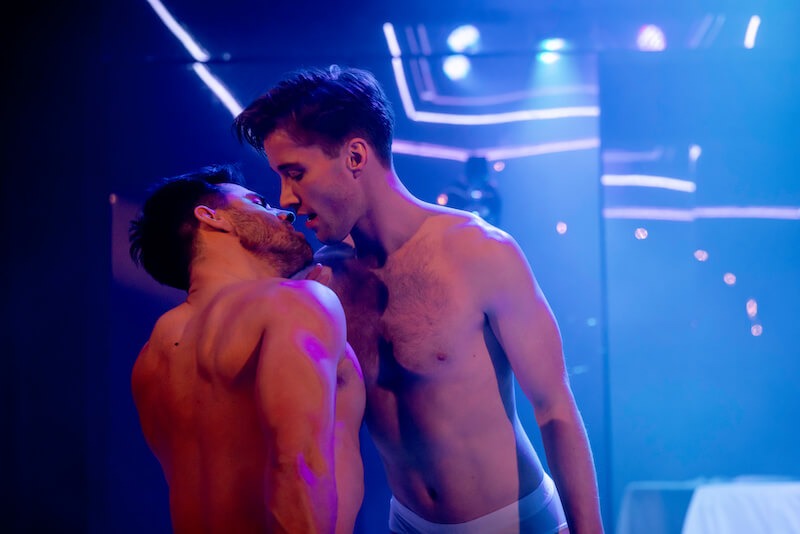
Writer and Director: S. Asher Gelman
Alex (Victor Hugo) and Josh (Peter McPherson) are married, trying for a baby, and in an open relationship but when they hook up with Darius their seemingly stable thirty-something lives are rocked. Afterglow examines the pleasures and perils of polyamory in a way that is very New York Off-Broadway, with lots of jokes, melodrama and penises.
S. Asher Gelman’s script delves semi-deep into the confabulations and confusions of modern gay dating, with particular nuance surrounding Darius’ situation. Having never had a boyfriend, he’s now been thrown into a heady romance with Josh whilst Alex waits at home. The dynamics between the three shifts amongst discussions of the nature of love, jokes about vaping (a great hit both with this twenty-something writer and the audience) and the fragile basis on which relationships are formed, with Josh and Darius’ puppy love and Alex and Josh’s more mature coupling being given equal weight.
It is however always clear where the story will end up: Gelman could perhaps have done more to challenge the audience in the shape of his drama, but the relationships between the three men are clearly drawn and consistently engaging. They feel real, even when their dialogue strays into the melodramatic.
Even stronger are the performances and staging. James Nicholson is immensely believable as the slightly naive Darius, whilst Peter McPherson as Josh can be both confident and vulnerable on the turn of a coin. Victor Hugo’s more understated portrayal of Alex grounds the piece as he is slowly discomforted by the relationship between the others: his movement from loving, open husband to a sense of betrayal is beautifully conveyed. Gelman’s use of physical theatre is both more needed and more convincing than in many fringe pieces, highlighting the tensions between the three in an excellently scenic way, and the recurring motifs of water are used to striking effect.
Although the script sometimes feels a bit overbaked and the conclusion is hardly surprising, Gelman weaves enough humour and pathos into his script to justify its examinations of love, connection, and what a ‘relationship’ should mean. It’s a well-told and constantly engaging queer love story presented on stage in all its naked glory.
Runs until 10 February 2024
