

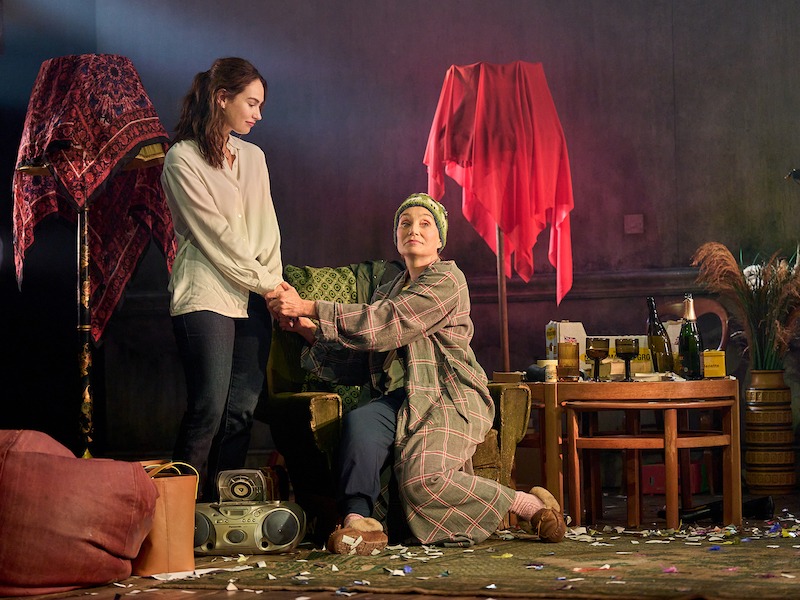
Writer: Penelope Skinner
Director: Ian Rickson
Believing women and how their stories become twisted is the substance of Penelope Skinner’s elliptical and vastly overwritten drama about an actor and a film developer who find solace in each other’s company. Lyonesse takes place in a house by the sea named after a “magical land,” but its long scenes never manage to convey the full potential of its characters, preferring repetitive exposition over the deeper meanings and possibilities sitting beneath the surface. Running at the Harold Pinter Theatre, Skinner’s play fades away.
Working for a production company, Kate is assigned to a fascinating project interviewing Elaine who went missing after her celebrated opening night decades before. Weighed down by her domestic commitments, Kate starts to come alive in Elaine’s home and, like the mysterious Lyonesse, begins to emerge from her fug determined to reclaim her place in the world.
Skinner’s play gets off to a slow start, most of the first two scenes, running close to 30 minutes, could be excised entirely with their workman-like backstory and set-up that could be better delivered and more interestingly structured through the narrative instead. As it turns out, these pedestrian conversations establishing that Kate has a baby and a pushy, self-centred husband and desperately wants a promotion, are repeated several times during the show – and with a near three-hour running time, including the interval, this excess of words is hard to forgive.
Lyonesse has the nub of a really great story, a woman taking centre stage to finally speak about a famous, toxic man who essentially took her life and career away. And there are a number of intriguing avenues for development that Skinner toys with but never fully develops. The mystery of Elaine’s disappearance, how she stayed hidden and the deeply rooted and entitled male behaviours that force women to be different have acres of potential, as does the ways in which the film industry incrementally encroaches on her truth, twisting it and turning it back on her when designing the movie by committee.
But the writer has too little to say about this and looks for repetitive drama in Kate’s marriage and parental decision-making instead. Whole scenes repeat conversations that have already taken place; at one stage Kate tells Elaine and her neighbour Chris about a phone call with her husband, only to have the same interaction again a few minutes later with Greg. It becomes a frustrating pattern in Skinner’s story, and although the audience has very quickly understood Kate’s situation, the circularity of the writing fails to advance the plot.
Lyonesse does, though, have a stellar cast and it is wonderful to see Kristin Scott Thomas given an opportunity to play something other the perfect, posh and poised. Here, her Elaine is warm and eccentric, a vision of alternative living with traces of the deeper, lifelong hurt that emerges through the film development process. Scott Thomas’ freedom on stage, exploring the nature of performance and moments of liberation from the expectations of others, is hugely enjoyable.
Lily James as Kate is given far less to work with but makes the best of her anxious and easily swayed character, finding her moments of steel and the nature of her compliance with the needs of others. Other creations, film company boss Sue (Doon Mackichan), neighbourly poet Chris (Sarah Powell) and particularly Kate’s husband Greg (James Corrigan) feel like archetypes, not real enough, a collection of two-dimensional traits that Elaine and Kate interact with.
With about 60 minutes of material spun across three hours, it gets itself into a muddle by the end and Lyonesse, like its namesake, just washes away,
Runs until 23 December 2023
