

Writer: Miranda Rose Hall
Director: Mingyu Lin
There are few things more dramatic than extinction. Miranda Rose Hall’s play, in which a woman tries to make sense of the sixth mass extinction event humanity is currently causing, certainly recognises this. The majority of the play’s emotion comes from the subject matter itself; often, the play feels more like a passionate lecture than a piece of dramatic performance. This results in some incredibly powerful, poetic moments – but by the end, it feels like this play about mass death could do with a bit more life.
The play follows Naomi (Stephanie Hutchinson), a dramaturg who finds herself in the spotlight due to an offstage tragedy. We get glimpses into her history as the play progresses, but there’s not much of a personal storyline to speak of. Instead, we get the history of the Earth, the evolution of species, meditations on various extinction events that have come before, and a vigil for endangered animals. Some of this – particularly the vigil, in which names of endangered species are slowly read out, one after another, accompanied by video footage of each animal – is truly powerful theatre. A lot of it, though, feels like a more animated, but just as wistful, Brian Cox programme on the wonders of the universe (at one point, Naomi pauses, looks up, and asks: “What is time?”).

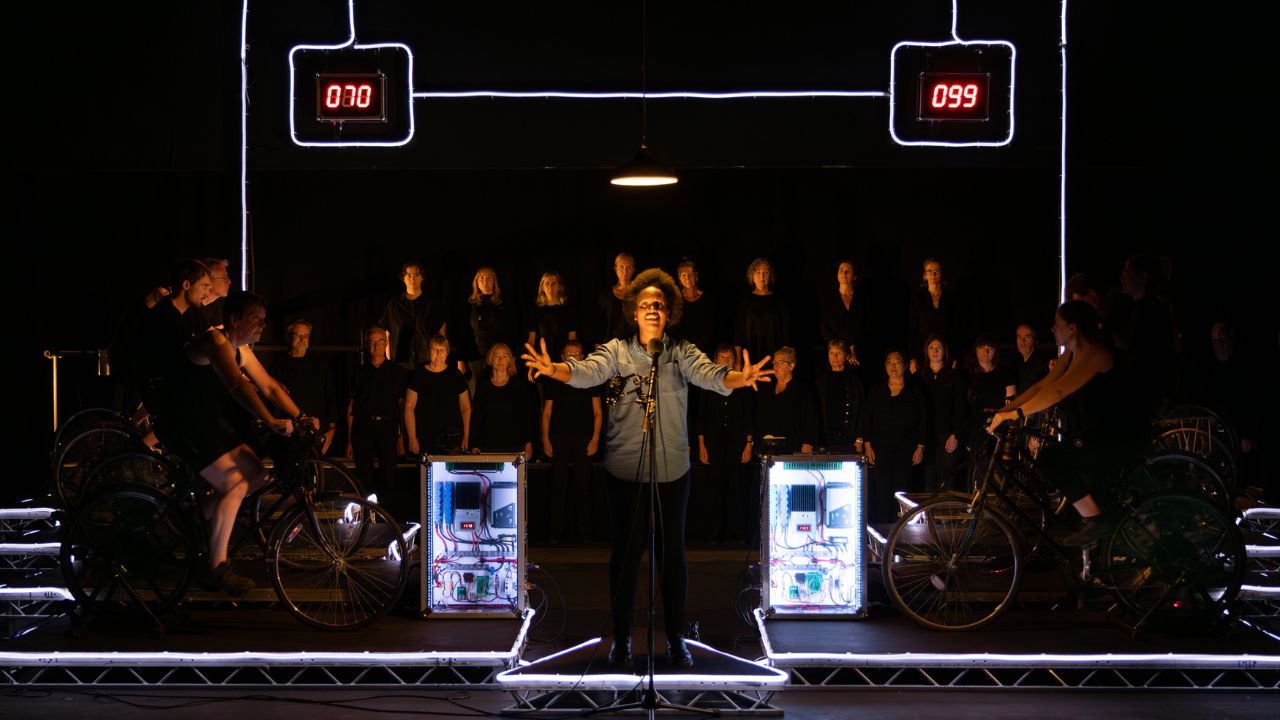
Hutchinson does a great job with the constraints she’s given. The play’s environmentally sustainable staging uses very few lights, all powered by sweating cyclists onstage. This means that, for most of the play, Naomi stands still, below a single, dim bulb. Hutchinson still manages to deliver a captivating performance that elevates the script, gesticulating passionately and almost jumping with enthusiasm for the scientific explanations. One particular moment, a weeping lament for dying bats, was unintentionally hilarious, but this is an impressive, expressive performance nonetheless.
At times, the staging and the performance really work together; after an introductory interaction with the audience, Naomi says the show is about to start. The theatre’s house lights cut out, leaving us in complete darkness, and then the wheels of electric bikes begin to whir. Slowly, the lighting flickers on, one element after another. This is deeply atmospheric, almost cinematic, and conveys the sense that we’re entering a new world. The staging, designed by Hannah Sibai, is arguably this production’s main provocation; this self-powered, second-hand-sourced set offers a working model for a new way of doing theatre in a time of crisis.
Paul Clark’s sound design is ominous, providing a half-natural, half-industrial soundscape to the piece, and the choir lifts the play from a simple monologue to a collective display, but the music does nearly drown out the singers, and the whirring of the bikes doesn’t help.
Media about the climate crisis tends to face much more severe criticism than other subject matter – take the critical outrage about Adam McKay’s film Don’t Look Up, for example – but there’s a good reason for this. The main message of media that addresses the climate crisis is that absolutely everybody needs to care about it, right now, because it’s the most important thing happening to the world. That’s an ambitious subject to tackle as an artist: surely, the greatest of challenges deserves the most thoughtful artistic responses?
This is A Play for the Living‘s greatest disappointment. Despite Rose Hall knowing the dire urgency of the sixth mass extinction, she didn’t make the effort to craft a play that offers answers, or even interesting questions. Naomi doesn’t really feel like an individual, more a vehicle through which to repeat ideas from books. The broad scope of the play, which covers deep time, intergenerational trauma, a specific fungal bat disease, a brief mention of a psychic medium, and the difficulties of dramaturgy, stretches far too thinly over the 70 minute runtime for anyone to truly connect with most of it.
This production is entertaining enough while you’re there, but isn’t likely to leave too much of an imprint on theatre’s fossil record.
Runs until 30th September 2023.
