

Writer: William Shakespeare
Director: Abigail Graham
There will be many Macbeths over the next few months, two with a very high profile indeed as both David Tennant and Ralph Fiennes take on this demanding Shakespearian tragedy. Placed in their summer seasons, the RSC have a new version opening in a matter of weeks while Abigail Graham’s interpretation at Shakespeare’s Globe Theatre may be the first but is also likely to be the most forgettable. Shorn to two hours plus interval, this Macbeth may have speed and energy, yet it lacks character consistency and the psychological gravitas that make this the greatest of thrillers.
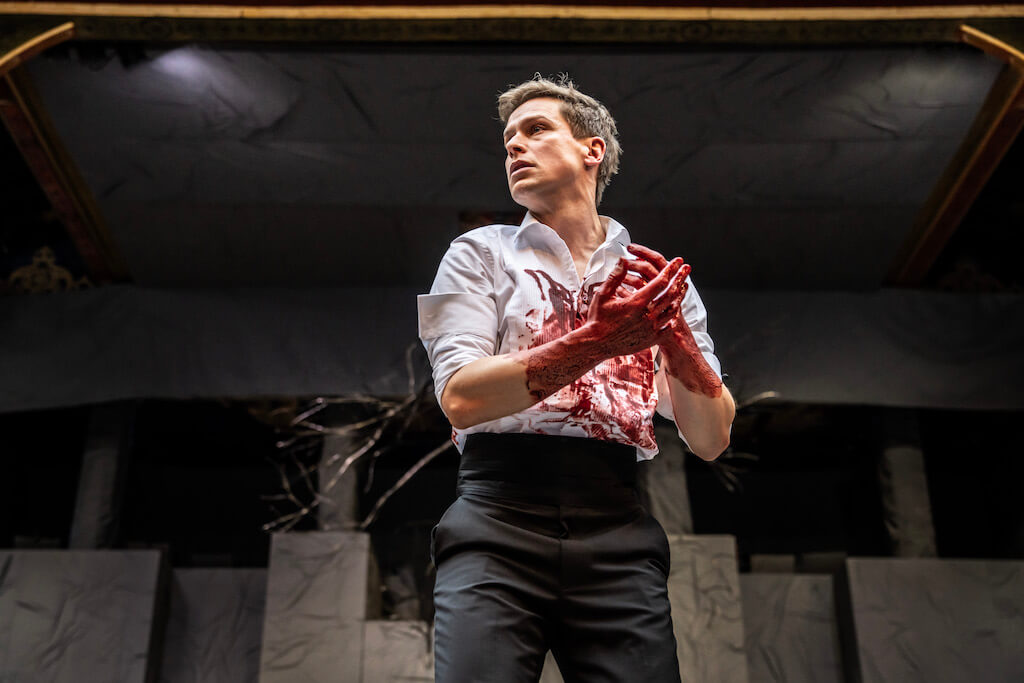
There are touches of magic in Graham’s interpretation, staged in modern dress in a grey shrink-wrapped set designed by Ti Green with the action on stage permanently overshadowed by the silvery branches of a tree, a symbol of the wood of Dunsinane that signals the fateful fulfilment of the witches’ prophecy. To this, Graham and Green add a touch of the plague with three male witches dressed in hazmat suits and donning sinister plague masks that frighten the protagonist who wheels the many corpses on mortuary trolleys, the deaths that Macbeth instigates moving around him and, at one insightful moment, hemming him in.
Yet Shakespeare’s play is far more complicated than a simple trajectory from ambitious opportunity seized to murder and tyrannous rule, underpinned by the doubts that torment any ruler without a successor. And Graham’s interpretation often misses the point, playing to the crowd as all productions at the Globe are hardwired to do, infusing the darkest moments with levity and sometimes slapstick comedy that shake the audience out of any tension or intensity the actors have built. In this version, time is what drives Macbeth’s behaviour, but the production too often dawdles when it should sprint.
A case in point is the prolonged Porter scene which many directors choose to jettison entirely but given the nature of this space and the opportunity to play with the audience, Graham devotes more time to this scene than the aftermath of Duncan’s murder in which the Macbeths come face-to-face with the reality of their deed. The latter scene is of the most crucial sections of the play which initiates Macbeth’s interior journey for the remainder of the story as he is haunted by and variably fails to master this act and his resultant emotional deterioration.
Max Bennett begins well as Macbeth, a laddish soldier braying about his achievements with his best friend but soon forgets his military background as he bounds between different states of being. One moment he is reckoning with his soul about whether to kill Duncan as though choosing a restaurant for the evening, the next hysterical about his kingship and screaming at audience members to get out of his way. Bennett is an emotionally unstable Macbeth who has chosen to believe in human agency and his own genius rather than fate but is rarely connected to the gravity or the life-and-death reckoning that hounds the character from the moment he picks up the dagger.
Matti Houghton also finds little consistency in her Lady Macbeth and while glimmers of darkness emerge early on, these become hysterical reactions that never investigate the changing relationship between the couple. Calum Callaghan, Ben Caplan and Ferdy Roberts have fun as the witches, while Fode Simbo as Banquo and Aaron Anthony as Macduff do what they can, but without purpose to anchor their performances the story and the production drifts away.
Runs until 28 October 2023
