

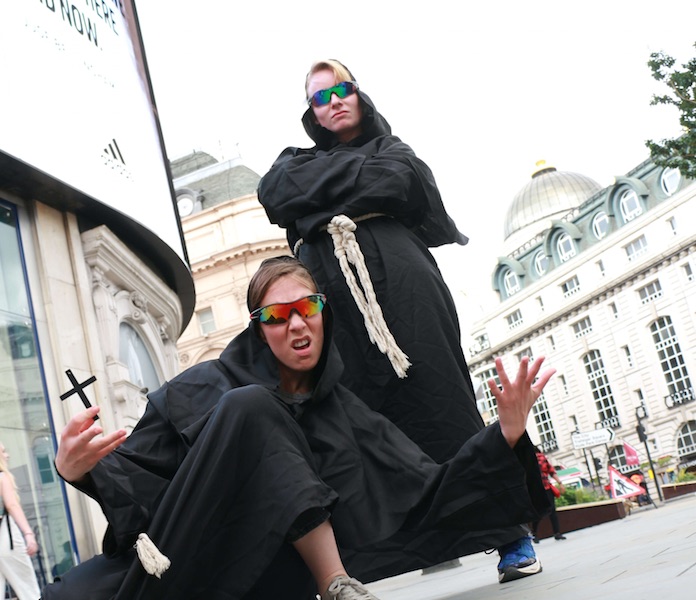
Writers: Sidsel Rostrup and Suzy Kohane
Director: Catherine Alexander
The roots of toxic masculinity stretch right back to the creation of Die Hexenhammer, a monastic book from Medieval Europe propagating the notion of women’s corruption evidenced by their propensity to become witches. Drawing a line between modern male arrogance and entitlement and the European tour of the monk creators, Hexenhammer performed at the VAULT Festival has an interesting premise that it struggles to translate into a successful satire.
Monk Henrich writes a tome that sets him on a path to greatness, a book that blames women for all chaos and temptation in the world. With his unassuming friend Jacob who hides in the senior monk’s shadow, the pair embark on a book tour that gives them a glimpse of the future, but they cannot outrun their own inadequacies.
Hexenhammer is a messy piece veering wildly between surrealist comedy and drama that is never clear what it wants from the audience; should they pity or despair of the two leads? It is a patchy show, written by performers Sisdel Rostrup and Suzy Kohane, who seem to have constructed their show as a series of riffs on particular topics with a loose narrative structure overlaid. It becomes, in performance, a selection of sketches of varying length that feel increasingly disconnected as the show unfolds.
There are comments on male fear of and obsession with women’s bodies including a tiresome section in which love-starved monk Jacob mimes the fondling of an illusory woman’s breasts. There are flash-forwards where the characters take drugs – a nod to the red and blue pill of The Matrix – where a terrible future filled with powerful women is envisaged. There is text lifted from Fight Club involving a punch to the ear, lectures in seaside towns and a very modern sense of media fatigue in which Henreich feels persecuted, and most inappropriately, a prayer session where he complains to God about the unfairness of a rape allegation that presumably forced him to join the Abbey but is unhelpfully not expanded.
What any of it means and its link to the witch-based Die Hexenhammer is unclear, even impenetrable. Witch trials are mentioned but never seen and the concept of sexually repressed monks hitting out at women they cannot have is not as well expressed as perhaps it might be. What does Hexenhammer want to say? Beneath the attempts at humanising Jacob and even sympathising with him, what do Rostrup and Kohane want the audience to feel about these men, and what are the contemporary attitudes and behaviours directed at women that this show wants to address? Surreal moments get a smattering of laughs but the messaging is far less obvious.
Runs until 11 February 2023
