

Writer: Arthur Conan Doyle
Adaptor: James Nicholas
Director: Oliver Hume
A Study in Scarlet was the first Sherlock Holmes story to be published and set in motion the crime novel genre still going strong. It’s been adapted for stage and screen many times since its 1887 appearance; this version  has been adapted for Birmingham’s Blue Orange Theatre by James Nicholas, a stalwart of the Blue Orange who also plays Holmes.
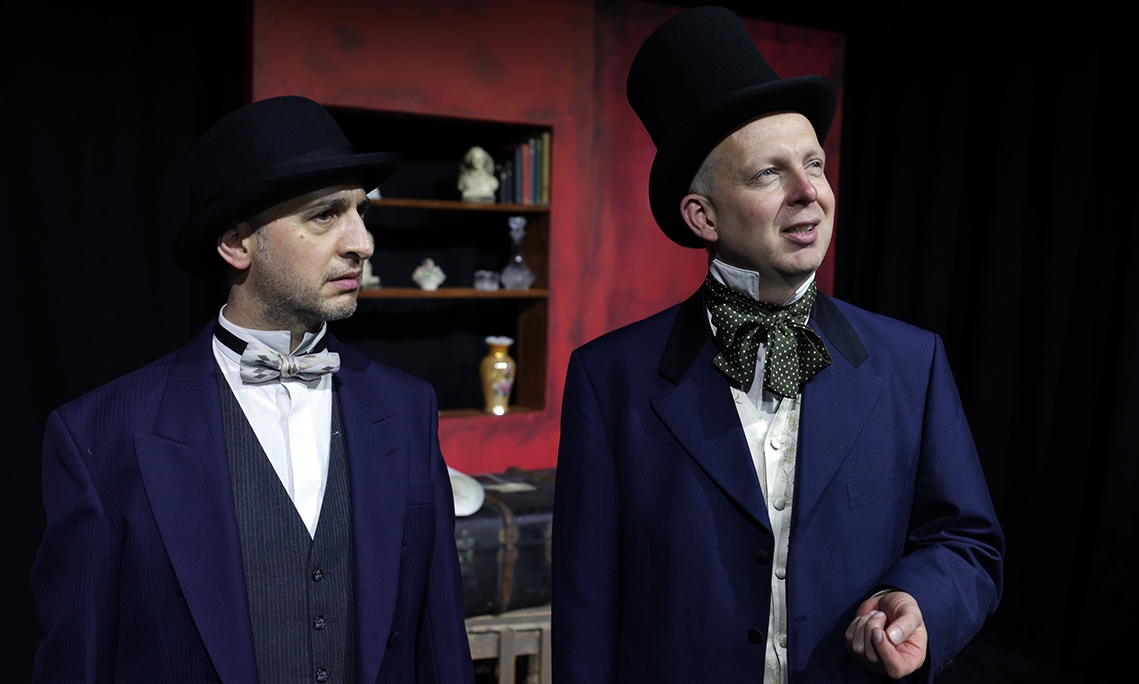
A static set stands in for Holmes and Watson’s rooms in Baker Street and the various hotel rooms and other important locations. It’s slightly less successful when we are outdoors or travelling; Nathan Bower’s soundscape helps set the various scenes, but lighting could maybe be used more to isolate action, for example, in the opening sequence where Watson is musing on their adventures and we see some action taking place elsewhere that is later reported. It’s not quite obvious what stance director Oliver Hume is taking: the whole is played absolutely straight by the cast of four, but in some scenes, wooden chairs are quickly moved to stand in for Hackney cabs or, memorably, a bicycle; in others, coats and hats stand in for characters, especially in a memorable and effective fight scene and this has echoes of The 39 Steps as performed by a similarly sized cast – albeit without its madcap humour and frantic pace. While the costumes echo the period well, they don’t always seem to fit terribly well, for example, Watson’s bowler and the constable’s helmet both seem rather too large for their wearers, which provides a source of distraction in some scenes.
Alex Nikitas plays the role of John Watson, freshly back from army service in Afghanistan. Watson acts as narrator – as he does in Conan Doyle’s stories – providing links between the scenes. Nikitas brings us both a lugubrious and matter-of-fact Watson, able to describe scenes closely, as well, of course, as the Watson continually amazed by Holmes’ pronouncements. He guides us through the story as Holmes is called to a mysterious murder scene where the victim has been poisoned, but an enigmatic message has been left on the wall in blood. Through the close observation of minutiae, Holmes discovers the backstory of the victim and killer through deduction and telegraphy, ultimately guiding Lestrade to the guilty party.
Nicholas’ Holmes is energetic, arrogant, pompous and fast-moving. His staccato delivery drives the pace whenever he is central to the action. His quick birdlike movements echo Holmes’ thoughts, making him a more three-dimensional character than might be typical.
A plethora of other roles is taken on by Tim Atkinson – notably Lestrade – and Emma Sian Cooper. Cooper takes on Mrs Hudson as well as cross-dressing to bring us a police constable and a member of one of Holmes’ Irregulars. Atkinson brings a fragility to Lestrade as he seeks Holmes’ help while simultaneously hating needing it. A sequence in which he plays a music hall performer is especially effective, bringing both some light to the performance as well as driving the plot. Atkinson and Cooper both undertake frequent costume (and accent) changes to support the characters they play and separate them in the audience’s minds.
This adaptation shows definite promise: while there are areas that could be tightened, it’s an entertaining evening with Holmes and Watson and a faithful adaptation of Conan Doyle’s story.
Runs Until 5 November 2022

1 Comment
Agree with this review. Has promise but needs work I felt.