

Writers: Lisa Schiller and Joshua Zeman
Director: Joshua Zeman
The hook for this documentary is simple: the search for a legendary whale, believed to have spent its entire life alone because the frequency of its call is unrecognisable to other whales. Scientist Roger Payne identified it as broadcasting at 52 hertz. He and a handful of fellow researchers believe this points to the existence of a unique whale, a hybrid between a blue and a fin whale. Director Joshua Zeman clearly aims to touch our hearts with the film’s focus on a lonely creature, swimming the oceans in solitude, unable to communicate with its own kind.
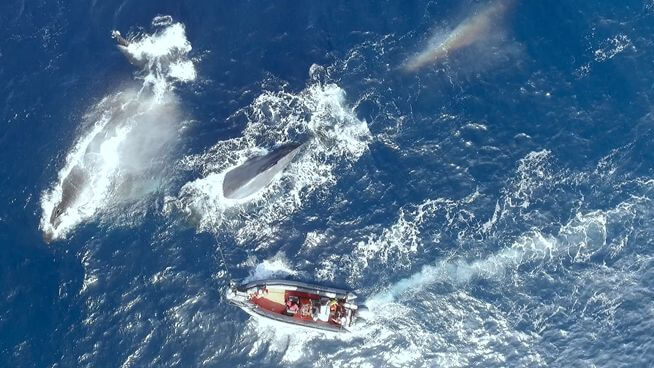
Zeman, who with Lisa Schiller, also wrote the script, is clearly passionate about searching for this creature. The early part of The Loneliest Whale features a series of interviews with members of the original team of marine biologists who first identified 52, as the whale is unromantically known. The film then follows the assembling of scientists plus equipment in readiness for a seven-day trip to track down the legendary whale off the coast of California. The seven-day thing isn’t explained. Possibly it’s biblical.
So the boat sets off with its gang of Ancient Mariners together with some nerdy young scientists who understand the equipment. The very maleness of the set up is only emphasised by the decision to include three young women as interns, whose job is mainly to point at screens or announce things like ‘I don’t know how long I can work in these conditions.’
Once we’re an hour into the film and there’s still been no sighting of the whale, you find yourself reflecting on the strangeness of the human obsession with whales, starting with the fictional Captain Ahab and Moby Dick. The documentary goes through the history of whaling. There is a fair amount of padding, but the film usefully pinpoints a significant moment when our attitude to whales changed in the late 1960s. This was thanks to the release on record of the first recordings of whales’ haunting songs. The scientist who was responsible for this is the film’s central figure, Roger Payne.
The importance of Payne’s achievement in this respect cannot be underestimated. It is, however, worth taking a look at his blogs on the website of Ocean Alliance, the organisation which he subsequently founded. In a blog in 2019, Payne wrote that the COVID pandemic could be seen as a positive thing for mankind as it helped reduce over-population. The same year he shared the text of his lecture promoting the need for scientific exploration of dolphin communication. ‘If this worked,’ he suggests here, ‘you might try asking dolphins direct questions. For example: Do you fear boats? Are sharks scary? Is you mother afraid of sharks.’ Is the Pope Catholic?
In this documentary, Payne gets to ask where the myth of the whale and science meet. Can whales feel emotions the same way as humans can, he asks. Various scientists are wheeled out, mostly male, mostly children of the 60s but not even the experience of flower power can get them singing from the same song sheet. ‘Whales are social animals,’ one says eventually, refusing to commit to the question of whether they can be ‘emotionally lonely’. Another is categorical – humans can’t have invented emotions: animals surely share them too. Another dodges the question by talking about ‘meaningfulness’ while tucking into a large sandwich.
By Day 5 the tension is ratcheted up. There are lots of posed shots of moody faces. Something has gone wrong. ‘We all fear risk: the risk of believing in something that may not come true,’ someone intones. They sit round watching a phone like they do on Location, Location, Location. But they still have two days to go …
Thanks to Blue Planet, we have come to expect an extraordinarily high quality from natural history programmes. Added to this, David Attenborough’s behind the scenes segments show the time and patience it takes to capture on film some of the earth’s most elusive inhabitants. He probably would have struggled too to record anything meaningful on a seven-day time budget. And he would have avoided the sentimental anthropomorphism of Zeman’s film.
The Loneliest Whale: The Search for 52 will be available on Digital Download from 4th April.
