

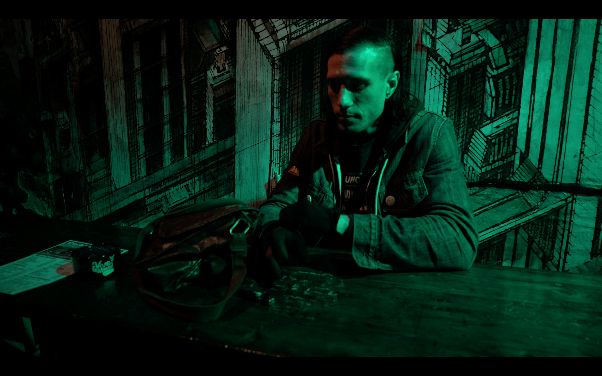
Writer and Director: Samuel Kay Forrest
This rambling, if well meaning, film about self-discovery in the queer clubs of Berlin is certainly atmospheric, but it is also clumsy at times, and its 90-minute running time could do with a sharper edit. If anything, HipBeat proves that the nightlife in Berlin is remarkably more exciting than London’s scene.
Angus, who grew up in Ireland, has travelled to Berlin where his father once lived. Berlin liberates Angus who is now a political activist fighting against fascism. What he actually does to break down the system is distinctly unclear. With a hoodie and a bandana covering much of his face, his nocturnal operations seem more sinister than emancipatory and it just underlines how, in recent years, the police have become the enemy of both the extreme left and the extreme right. Perhaps Angus does nothing more than sprays the word HipBeat on empty walls but there is a sense that he has other activities.
Despite this anarchic start, rather than large-scale politics, Samuel Kay Forrest’s film focuses more on personal politics, but the influence of capitalism and patriarchy on the construction of gender is never wholly forgotten. Angus (played by Forrest) wants to explore other parts of his identity that aren’t defined by the binary of male/female. Angus says that he doesn’t believe in gender at all, and we could say that he is agender and perhaps it would be better to refer to Angus as ‘they.’
Angus is also drawn by the free love celebrated in these dark, mysterious clubs, themselves a curious and enticing blend of the Weimer Republic and S&M. Drugs are lined up and snorted; it’s like Hell and Heaven combined. But Angus is not without their flaws; they are no simple queer hero. They cheat and they are unnecessarily argumentative especially with their lover Angie, who presumed they were in a monogamous relationship.
It could all be intriguing and celebratory but the film is undermined by Angus’s constant voiceover, often talking in empty slogans which over-simplify complex issues; if only love could save the world… His monologue is also quite didactic, closing down meanings when queer politics seeks to open up endless possibilities. The film works better when the viewer works things out for themself. The images draw in the viewer more than Angus’s words.
The acting is also clunky and, while Forest’s directorial style is at times deliberately amateurish, the dialogue feels unscripted which has the opposite effect of making it look natural. One key scene – probably the longest scene in the film – is undone by this ‘fly on the wall approach’ as actors try to remember to speak loud enough to be picked up by the microphone and not to walk too far out of shot.
But Berlin always looks beautiful. The bars and clubs look attractively seedy and the roads and alleys down which Angus walks are daubed with colourful graffiti. Perhaps, as Angus suggests, it is much easier to be yourself in a city that still has an aura of decadence. HipBeat works as an advert for Berlin, but otherwise this film is too self-absorbed to tell us much about queer politics today.
HipBeat will be released across digital platforms from 14th February.
