

Writers: W. S. Gilbert and Arthur Sullivan
Director: John Savournin
Musical Director: David Eaton
Charles Court Opera’s genial production of Gilbert and Sullivan’s lightly subversive political satire, Iolanthe, ran for just 4 preview performances before it fell victim to the pandemic. The piece, directed by John Savournin, has been on tour since, but Wilton’s Music Hall’s revival is the production’s first London outing.
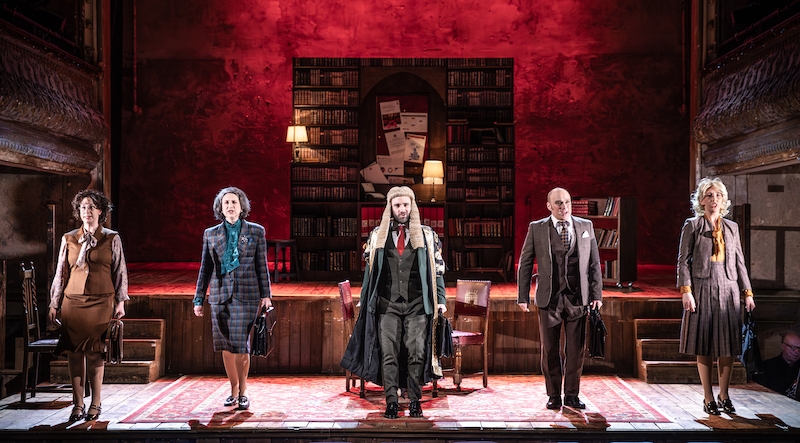
For some, the sight of bumbling, entitlement-heavy parliamentarians being outsmarted by a white-clad troupe of dainty, magical fairies somehow may feel a little too temperate for today’s sulphurously anti-establishment mood, despite Savournin’s best efforts to deliver some up-to-date political references. Still, the performances are great, Molly Fraser’s ersatz 1980’s costume palette of checks, browns, purples, and greens looks gorgeous, and the show’s gentle humour sits neatly in the venue’s faded Victorian splendour.
Eponymous fairy Iolanthe (a delightful Eleanor O’Driscoll finds genuine pathos amongst the satire) used to be “the life and soul of fairyland”, but was banished 25 years ago for the ultimate crime of marrying a mortal. Having spent her penal servitude living among frogs at the bottom of the Thames, plot shenanigans see her pardoned by the Fairy Queen (Meriel Cunningham’s lush, vibrant mezzo-soprano and barely suppressed, fulminating sexual desire are highlights).
Iolanthe returns to the fairy realm, bringing her half-fairy, half-mortal and all-dud son, Strephon (Matthew Palmer, dressed in Barbour, cap and Wellington boots, delivers a tone of down-at-heels rural gentry). Strephon is desperately in love with pragmatic, sensible Phyllis (Llio Evans, whose resemblance to Catherine Tate is uncanny), a Ward in Chancery.
The obstacle to the duo’s union is almost the entire House of Lords, all of whom are also in love with Phyllis. Chief among them is the Lord Chancellor (ensemble stalwart Matthew Kellett mashes up Hugh Laurie with a Croydon second-hand car salesman), who is not only the arbiter of Phyllis’s marital fate but Iolanthe’s long-lost husband and, unbeknownst to him, Strephon’s father. Jovial Earl Tolloller (David Menezes) and gender-swapped Lady Mountararat (Catrine Kirkman’s by-the-book, “you-turn-if-you-want-to”, Maggie Thatcher impersonation may leave Gen Zedders scratching their heads in befuddlement) are also on the delightful Phylis’s trail.
When Phyllis catches Strephon in an affectionate conversation with the perpetually young-looking Iolanthe, she assumes he is cheating on her and throws her lot in with the stuffy peers. The Fairy Queen, affronted at being taken “for a proprietor of a ladies’ seminary,” sends “champagne socialist” Strephon into Parliament to wreak legislative havoc by demanding that, God forbid, access to the Upper House should rely on talent rather than birth. Can the straitlaced political and airy supernatural worlds find a way to coexist? Spoiler alert: this being whimsical, fairy-tale, Gilbert and Sullivan, nobody gets hurt, and everybody, broadly speaking, gets what they want. Principal fairies Leila (Martha Jones) and Celia (Sarah Prestwidge) are on hand to aid Strephon’s journey and possibly find love along the way.
Savournin’s updated lyrics deliver digs at news fact-checking, ChatGPT, Trump, Reform UK, and current attitudes to immigration. One appreciates the effort, but jokes about out-of-touch politicians and partisan blindness probably ought to land with a little more bite than they do here. Events threaten to spiral into pantomime mode in the double entendre-heavy reference to “giving him one in St James’s Park”.
Musical Director David Eaton gets the most out of the newly-formed, six-piece Charles Court Opera Chamber Orchestra. Kellett’s rendition of the Nightmare Song — the frantic, tongue-twisting, patter centrepiece of the show — earns him a much merited round of applause. Savournin’s pacey direction moves events along swiftly enough. Placing most of the action on the stage’s lower level helps address the venue’s notoriously challenging acoustics.
Is the only way of making sense of politics to add a few wings and a heavy dose of fairy magic? Well, it is certainly one way. The ensemble here gives it their best shot. The blurb promises a dose of the “best of 19th-century comedy”, which broadly speaking is what the show delivers. Just don’t anticipate much in the way of grit.
Runs until 28 February 2026
