

Writer: William Shakespeare
Director: Emily Lim
Two things immediately stand out when you encounter Emily Lim’s vision of Shakespeare’s summer comedy. The first is audience participation: from the outset, audience members are brought into the play’s company of amateur theatricals, invited to audition on the Globe’s stage and with an involvement that continues to the very end.
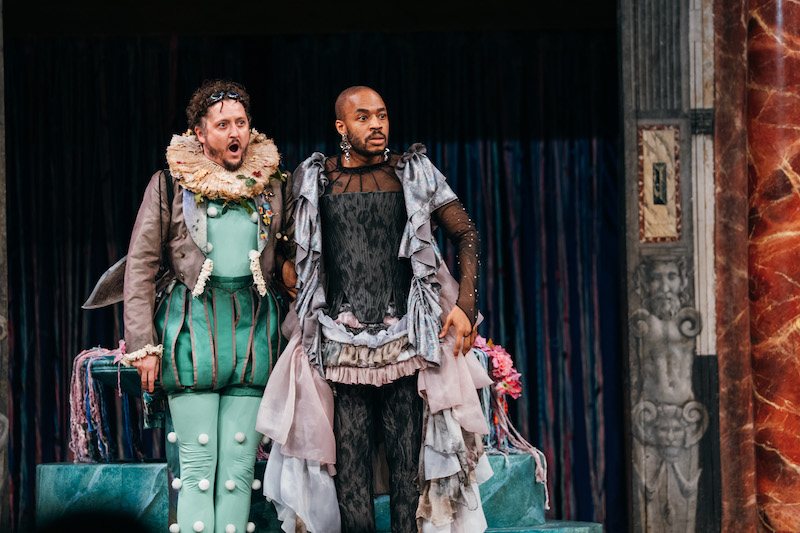
The second is the design aesthetic. Aldo Vásquez’s set design and Fly Davis’s costume design concepts reek of charity-shop chic. The court of Athens is lined by plastic box hedges, which snap open to reveal multicoloured florals as the action moves into the forest. Nearly everyone wears flamboyant, bright colours, from Gavi Singh Chera’s Demetrius sporting a blouse with a huge orange bow, or Enyi Okoronkwo’s Oberon sporting a ruffle-heavy dress that looks like something out of Desperately Seeking Susan.
It all screams fun, which would be a serious misstep were the performances not as deliciously camp as the surroundings. As with all productions of A Midsummer Night’s Dream, the fun is led by the faux pomposity of amateur player Nick Bottom. Adrian Richards, sporting a series of musical theatre-themed T-shirts, nicely juggles the weaver’s domination of rehearsals with a line of likeable doofusness.
Perhaps the greater comedic mayhem, though, comes from Puck. The way a director chooses to take on the role of Oberon’s manservant often dictates the tenor of the whole piece; playing up the sprite’s mystery and mischief can heighten the drama’s themes of magic and supernaturalism. Here, Lim takes Michael Grady-Hall to very much the stand-up end of the performance gamut.
There is such anarchic energy to Grady-Hall’s Puck that every scene that could be waved away as Shakespearean whimsy has a fulfilled scope for laugh-out-loud humour. That is reflected in the rest of the cast, too: from the four young romantic Athenians (including Mel Lowe as an acrobatically physical Lysander) to the fairies, led by Audrey Brisson’s maternal and sexual Titania, there is a sense of great fun that pervades the entire Globe throughout.
It all moves at quite a lick, yet feels more coherent than many renditions do. And when it comes to Act V, with the romantic entanglements resolved and the attention shifts to the amateur players’ performance of Pyramus and Thisbe, what could have been an exhausting epilogue to the main event instead becomes a second show.
That’s due in part to the excision of most of the asides from the Athenians, allowing the rude mechanicals full reign for a comedy that could rival The Play That Goes Wrong. The amateur company, led by Victoria Moseley’s Quince (whose resemblance to Globe artistic director Michelle Terry is surely intentional), once again leans on audience participation, paying off many setups that started in the pre-show to create a riotous conclusion to proceedings.
It caps off a delightful evening of midsummer mayhem that really reflects how possible it is to frame Shakespeare’s comedies so that the humour works for 21st-century audiences. Through Lim’s emphasis on bringing the audience in through membership of the rude mechanicals’ company, the Globe has a Midsummer Night’s Dream that is a crowd-pleaser in all the best ways.
Runs until 29 August 2026
