

Writer: William Shakespeare
Director: Sean Holmes
Uniquely among Shakespeare’s plays, The Merry Wives of Windsor is set in the playwright’s own contemporary England. It transplants the character of John Falstaff, a disreputable-but-charming, larger-than-life chancer, from some of the history plays into Elizabethan Windsor. Running out of money to support his cakes-and-ale lifestyle, Falstaff decides to seduce a couple of the town’s wealthy wives, Mistress Page and Mistress Ford, and writes them identical love letters. The women compare notes and decide to get revenge by humiliating their would-be wooer in a series of increasingly violent pranks.
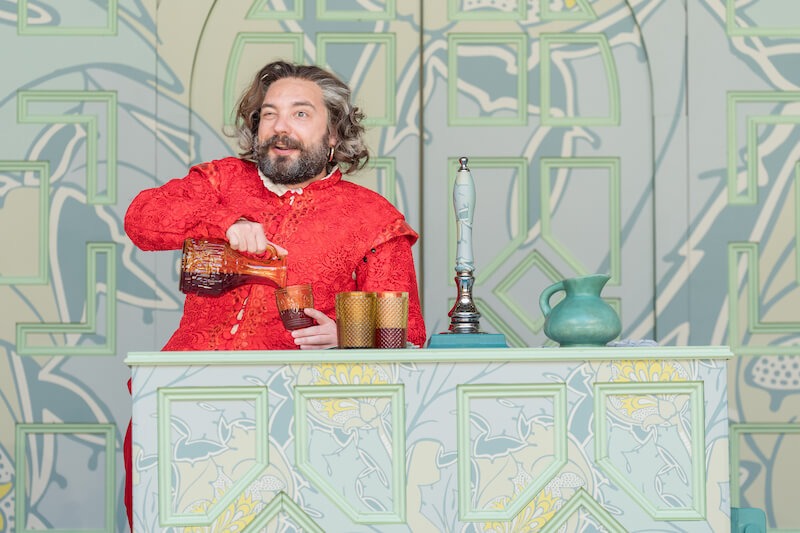
Set and costume designer Grace Smart has decked both the wooden stage and the two main couples in pale green and blue designs that look like William Morris wallpaper. It’s a nod to the bourgeois backdrop, but maybe also to the feral forest that surrounds the town. Shakespeare’s Windsor contains multitudes: everyday tales of gossiping wives and controlling husbands, puffed-up justices and eccentric innkeepers coexist with a potential realm of mischievous fairies and folkloric hunters. The middle-class characters mock these fading superstitions, but they still have to grapple with their own wild sides, interrupting their buttoned-up lives with outbreaks of lust and cruelty.
Black Country Comedian George Fouracres plays the “fat knight” Sir John Falstaff. In contrast with the tasteful uniformity of the Fords and the Pages, Falstaff wears scarlet. Fouracres’ performance is charismatic enough to carry the show, but also has an underlying vein of sadness that the good times have to end. Director Sean Holmes has run with the controversial idea that Mistress Ford (a nuanced Katherine Pearce) is genuinely, complicatedly attracted to Falstaff. Her husband Ford, obsessed with the idea of his wife’s infidelity, is played by Jolyon Coy with tics that hint at Ford’s unstable mental health.
Emma Pallant similarly brings a darker undercurrent to the role of Mistress Page. Often, the two wives are played as interchangeably playful. Here, fuelled by a compound of jealousy, puritanical morality and sadism, she relishes the punishments she devises. In her final convoluted plan, Falstaff is lured into the wooded Windsor Great Park to be ambushed by legions of fake fairies who will mock and “pinch the unclean knight”.
Sophie Russell gives an unsettlingly knowing and lascivious edge to go-between Mistress Quickly and doubles entertainingly as the bombastic Shallow. The rest of the cast is more straightforwardly comic, with Adam Wadsworth particularly funny as both the hopeless Slender, always failing to read the room, and the Python-esque Doctor Caius with an outrageous French accent. The doctor’s repeated oath “by gar!” is brilliantly delivered, and lines of Slender’s like “you shall find me reasonable; if it be so,/ I shall do that that is reason” have never sounded so hilariously silly. There’s an amusing turn from Samuel Creasey as Welsh school master Hugh Evans, and LJ Parkinson is powerful as the tavern host. Marcus Olale is a lively Fenton in purple, a match for Danielle Phillips’ feisty Anne Page.
Live music is often a standout feature of productions at the Globe. The domestic song-less Merry Wives has limited scope, but a talented ensemble provides upbeat brass-band-style musical stings between scenes with trumpets, French horn, tuba and sousaphone. The compositions by Frew and musical direction by Zands Duggan come into their own in the last act, where the faux-supernatural elements and climactic storm are soundtracked by an engaging score, featuring Duggan’s percussion. The final dance is fabulous.
A huge creative, supportive and technical team works behind the scenes on everything from embroidery to well-being, carpentry and mask-making to intimacy and fighting – here mostly snogging and groping, cudgelling and torturing, directed by Bethan Clark. Voice Coach Gary Horner has his hands full with the show’s comedic plethora of accents, and wig-maker Emma Vallance has her work cut out too with all the beards and hairpieces, ringlets and bowl cuts.
Merry Wives is Shakespeare’s purest farce. The text, quite apart from its fat-shaming and accent-mocking, is variously problematic. Combining prosaic sit-com-style episodes with masque-like verse towards the end, some critics have even seen it as two plays spliced together. This committed cast and crew have done a convincing job of presenting the sprawling octopus of subplots as a unified entertainment. Many double-entendres are milked and slapstick banana-skins trodden on.
And the production raises questions of its own about the nature of morality. The comfortable conclusion that “What cannot be eschewed must be embraced”, where everyone makes merry together, is subtly undermined. The laughter is mixed with a sense that human emotions are not so easily controlled. Falstaff replies enigmatically to Page’s platitudes: “When night-dogs run, all sorts of deer are chased.”
Runs until 20 September 2025
*BOOK TICKETS NOW FROM JUST £13 WITH THE REVIEWS HUB TICKETS*

1 Comment
The loud music, extreme french and welch accents, passing planes, and demented coughing from an audience member, meant most of the words were unheard by my companion and I.
DEI casting of females with weak voices in male roles was annoying.
Best thing was Falstaff. Not worth £160 plus £6 for cushions.