

Writer: Charles Dickens, adapted by Mark Gatiss
Director: Adam Penford
A Christmas Carol: A Ghost Story has selected its subtitle wisely. This heartwarming Christmas fable of Scrooge’s miserliness-turned-merriment is still true to its roots, but to spice things up, this play doubles down on its supernatural credentials. In the process of adapting this Dickensian classic, Mark Gatiss has opted to play up the gothic ghostliness of this story, adding a layer of horror and eerie discomfort to a tried and tested formula. It’s a clever strategy to make this iteration stand out, and a subtle differentiator which is particularly effective given the play’s November staging, as it bridges the gap between Halloween and Christmas.
Scrooge’s tale is well known: an old miser, grown selfish and cold after years of hoarding his hard-earned wealth, is visited on Christmas Eve by three spirits: the ghosts of Christmas past, present and future. These three endeavour to show him not only the error of his ways, but the consequences of his actions. Matthew Cottle plays Scrooge immaculately, in particular emphasising Scrooge’s wariness of all things merry, joyful and happy. This misanthropy is paired with a smattering of British humour and sarcasm, to make Scrooge a spiteful and hard character: perhaps, in many ways, exactly as Dickens intended.
But the real hero of the show is Paul Wills’ set, which deploys the vast Alexandra Palace Stage to great effect, layering in set piece after set piece. Staging A Christmas Carol is no easy feat: in this short story, Dickens takes us from the micro (Scrooge’s office and home, Bob Cratchit’s house) to the macro (Mr Fezziwig’s Party, the loud bustling streets of Victorian London, nephew Fred’s vast family gathering) and everywhere in between (a classroom, a market – not to mention a graveyard). Sets must contend with rapid location changes, and must do so without losing the magic of the transitions, which are key to the success of the play.
For his backdrop, Wills has constructed what can only be described as a set of ‘towers’ made from boxes and cabinets piled on top of each other. 15 metres high and scattered all over the stage, these ‘towers’ are oppressive and intimidating, functioning at first to convey the monotony of Scrooge’s office – and then later to represent the tall buildings of Victorian London. At the back of the stage, there is a thin screen onto which are projected various effects, including falling snow, ghostly silhouettes, and warm light. Scrooge’s desk is wheeled on and off: it’s an imposing structure, designed to ensure Scrooge towers over his lowly employee, Bob Cratchit. Other structures come and go on wheels: a luxurious throne for the ghost of Christmas present; Scrooge’s four-poster bed; and, at one point, even a headstone. The stage is mobile and in constant flux – and yet somehow, it never feels chaotic, in part due to careful choreography (by Georgina Lamb) and well-practised transitions by the cast.
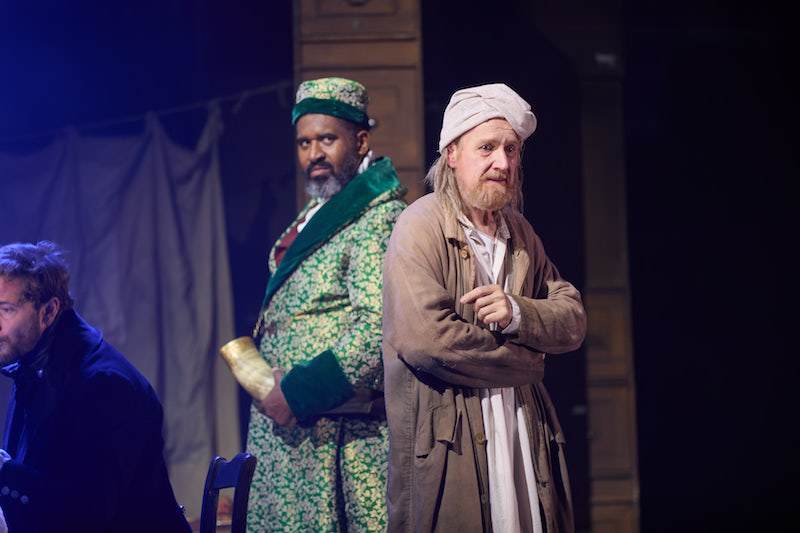
But this is a ghost story, and no mention of A Christmas Carol would be complete without the ghosts which haunt it. Each actor maintains the traditional aspect of their ghost, whilst also bringing a new slant to their role: Grace Daly plays the Ghost of Christmas Past as a mischievous, impish spirit who flits and dances round Scrooge; Mark Theodore portrays the Ghost of Christmas Present as a vibrant, charismatic and larger-than-life presence (deploying his booming voice to full effect), and Neil Morrissey plays the Ghost of Christmas Yet to Come/The Ghost of Jacob Marley as a terrifyingly tortured soul. Their endeavours are aided by a considered lighting and sound team who are not afraid to deploy the odd jump-scare here and there. In the dark eaves of the Alexandra Palace theatre, there are moments which are genuinely frightening; a testament to Adam Penford’s direction and decision to use the entire auditorium to achieve his effects.
The result is traditional enough to pay homage to the original narrative, whilst simultaneously staking claim to being ‘something different’. By doubling down on the spooky aspects of the narrative, this play manages to convince its audience that they are not being haunted by the ghosts of plays long past, but treated to a festive feast, whose flavours are familiar yet distinctive, comforting yet haunting, evocative yet eerie.
Runs until 4 January 2026
