

Writer: William Nicholson
Director: Rachel Kavanaugh
Anybody who has read the works of C S Lewis, even if limited only to the Chronicles of Narnia books, cannot help but be aware of the author’s faith. Born into a Christian family, he rejected his faith in his teens before rediscovering Christianity in his 30s.
After that, he wrote and spoke often about his own interpretation of the relationship between man and God. It is one such speech that opens William Nicholson’s Shadowlands, which sees Hugh Bonneville assume the mantle of Clive Staples Lewis, known to Jack to all who knew him. In the opening speech, Bonneville’s Jack tackles the age-old question: if God loves us, why does he allow so much pain and death in the world?
In Rachel Kavanaugh’s production, it is apparent that, initially at least, this is somewhat of a theoretical supposition on Lewis’s part. While he has a content life tutoring at Oxford, writing and giving speeches, and answering many letters from admirers of his works, there is a sense that he has not really lived – and certainly not loved.
True, he is surrounded by friends, albeit they are all irascible dons and vicars, and the bond he shares with his older brother (a subtly wry Jeff Rawle). The scenes in which Lewis spars jocularly with his peers are elevated by Bonneville’s quintessential wit and line delivery. But in his speech, Lewis argues that God’s actions are all meant to enable us to be loved, and one cannot help but feel that Jack’s ability in that regard is as yet untapped.
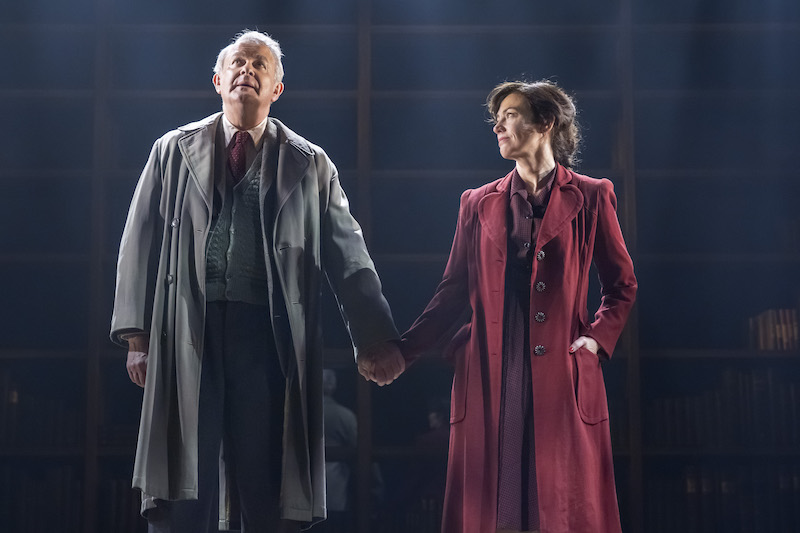
And then a correspondent, New Yorker Joy Davidman, arrives to have tea. Maggie Siff’s interpretation of Joy makes it clear why the pair become such friends: she is every bit as passionate, compassionate and intellectually curious as he is. Bonneville and Siff fit together as easily and immediately as do Jack and Joy.
The moral dilemma at the heart of their story is that Joy is already married, albeit to an unseen brute who has had numerous affairs before and during their marriage, and whose alcoholism has precipitated violence in the home. Even when the divorce comes through, and Joy moves permanently to England, Lewis’s faith considers that marriage continues under God even after the paperwork has concluded it in the eyes of the law.
The initial talk recurs, its message of why God allows pain refreshed each time by Lewis’s more personal experience. As the relationship between Jack and Joy deepens, the couple is challenged, too, by her unexpected diagnosis of terminal bone cancer.
It is in the exploration of the relationship under the most difficult of circumstances that Nicholson’s writing really shines. That is supplemented by performances from Bonneville and Siff that deepen and intensify the sensation of the couple’s abiding love for one another. As Bonneville gradually shifts from the comical whimsy of his early line deliveries to a more serious, more open expression of his emotions, we see a man finally living the ideas he once spoke of from a position of ignorance. The pain of future loss is part of the joy of the present, and we are not whole until we have become able to love and be loved.
Designer Peter McKintosh’s set is best at its subtle allusions to Narnia – a lamp post here, a secret world occasionally glimpsed beyond a bookcase. Some scene changes end up a little too busy, with the supporting ensemble rushing hither and thither in ways that rarely feel in tune with the piece’s sentiment.
But overall, Shadowlands is a testament to the power of opening oneself up to love. By turns hilarious and deeply affecting, it is a hard heart who could hear Bonneville’s final wail of grief and not want to join in.
Runs until 9 May 2026
