

Writer: Robert Bolt
Director: Jonathan Church
Many theatre goers will know this work from the highly acclaimed film version of 1966, now sixty years ago, which garnered no less than six Oscars including that for Best Writing (Adapted Screenplay). The huge success of that movie and the performances of its stars Paul Scofield, Robert Shaw, John Hurt, Orson Welles Susannah York, Corin Redgrave, Leo McKern, Wendy Hillier and Nigel Davenport (a cast made in heaven) live long in the memory. This revival is thus long overdue and will delight the many fans of both the movie and Bolt’s body of work, which also encompassed many other successful historical screenplays including Lawrence of Arabia, Doctor Zhivago, Ryan’s Daughter, Lady Caroline Lamb, The Mission and The Bounty.
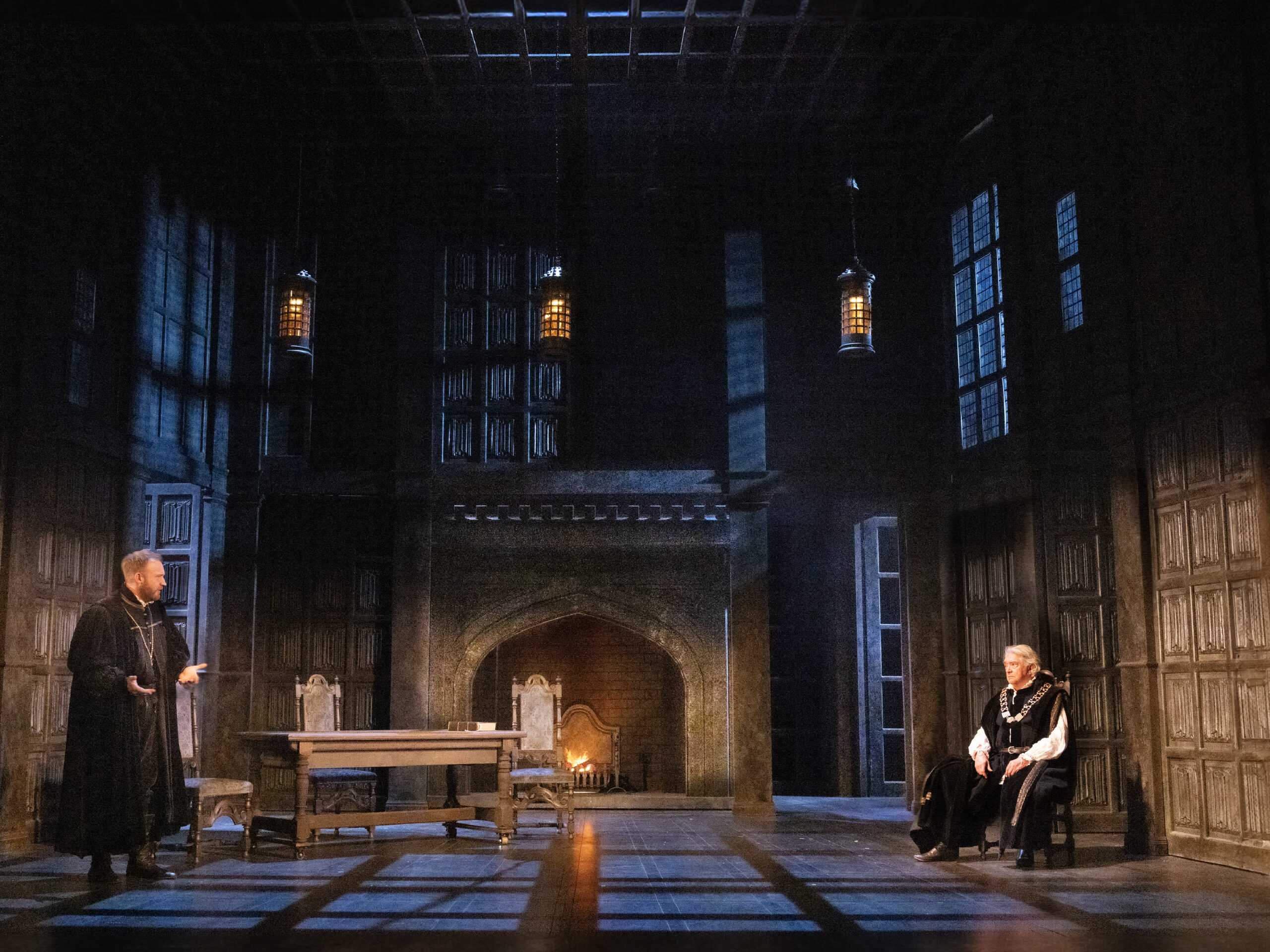
Present day audiences have much to admire in this production, from the all round high quality of the cast to the fine costumes and general look and feel of the Tudor period in which it is set. Leading the cast in the role of Sir Thomas More is the famous star of both stage and screen Martin Shaw, now 81 years young with a fine shock of white hair and assured confidence. The real Sir Thomas More was at the heart of one of the seismic events of Tudor history known as the King’s Great Matter, in which King Henry VIII wanted to divorce his wife Catherine of Aragon in favour of Anne Boleyn. This led to Henry breaking free of the Catholic faith and the Pope and the setting up of the English Church with Henry as it’s Supreme Head. This period, known as the Reformation, was a dramatic and violent time to be alive with many honest people losing their lives because of their religious faith in the face of a volatile and passionate king seeking to get his own way and ruling by fear, suspicion and execution. Bolt has created a fine play out of these historical events that is heartfelt in its portrayal of a decent and honest man of integrity brought low by the force of circumstances and the victim of his own strong faith and moral compass.
Shaw displays all these qualities, optimistic, contented and even humorous in the first half and noticeably more careworn and worried in the second half as the awful truth of his plight dawns upon him. He is the epitome of the antihero more sinned against than sinning, more concerned about his family’s safety than his own and despite his genuine fear at his situation putting a brave face on it. His final putdown remark at the traitorous and slimy Richard Rich (Peter Losasso) is priceless. More is the principled man of faith and integrity who suffered the ultimate sacrifice rather than perjure his soul, a beacon of honesty and truth as all around him cave in under pressure. Shaw moves through the piece steadfastly and sedately and never falters as his fate becomes apparent. His is a truly noble act to the consternation of all his family and friends even to it’s final brave act.
More’s antithesis and main architect of his downfall is Thomas Cromwell (played with relish by Sam Phillips), Henry’s right hand man and enforcer who himself came to an eventual sticky end on the scaffold (as many did). Phillips inhabits the role well, orchestrating all the various parts of the jigsaw in order to bring about the final resolution of the issue to the detriment of the victim. He resorts to bribery, corruption, bullying – anything that will achieve his final goal and bring about More’s demise by removing this sticky thorn in the King’s side. But even though More is the prisoner and at the mercy of Cromwell’s machinations his wit and astute oratory and reasoned arguments always get the better of him.
The shadow of King Henry hangs over the entire play but he has only one actual scene on stage, albeit a very iconic and dramatic one. His is very much a cameo and Orlando James makes the most of it, displaying the full gamut of emotions as a youthful and sprightly Henry demonstrates all his inner turmoil. His is an energetic, prancing King full of his own importance, susceptible to flattery and used to getting his own way, quick to anger, powerful and volatile in equal measure, not to be trifled with.
Another cameo is that of Cardinal Wolsey (Nicholas Day), a powerful performance in his one scene as he interviews More over his stance. Standing out in his scarlet red robes and his rich voice Day gives a notable interpretation of Wolsey under pressure to give Henry what he wants – a divorce – in the face of escalating problems and what he sees as the lack of support from More. Day makes the most of the one scene he is given.
Peter Losasso is the traitorous and misguided Richard Rich, eager to rise to the top and make his way in the world to the detriment of his “friends”. Corrupted in the main by Cromwell he betrays More for his own greedy ambitions and by the end, despite his outward success, is shown to be the shallow and grasping person he is.
Polly Kemp and Grace Molony are More’s wife and daughter in heartfelt performances that are realistic and very well wrought. Credit must go to Kemp in particular when the family visit More in the Tower for the last time – her final farewell with him is truly emotional to behold.
The only character who is not an actual historical personage is The Common Man (Paul Kemp). He is a combination of narrator and interpreter, linking all the various strands of the story whilst at the same time playing various parts such as Matthew, one of the household servants, the innkeeper, the jailer, the executioner and so on. Kemp has a very important function throughout to fulfil which he does with aplomb and skill, eliciting many of the laughs in his witty asides whilst providing some much needed commentary. He also moves various props and furniture around as and when necessary. His is a really vital role and is Bolt’s necessary invention to make the structure and continuity of the play work.
All in all, this is a terrific revival that will be sure to satisfy existing fans of the work as well as entertain newcomers to this very exciting – and true – slice of history.
Runs until 24th October 2026
The Reviews Hub Star Rating
-
10
