

Writer and Director: Kim Bartley
The care system in films is invariably bleak and cruel, leaving the children who pass through it with little to hope for. Kim Bartley’s new film Lemonade doesn’t entirely erode that impression but peoples it with caring key workers themselves trapped within a system that confines them while protagonist Danny finds the outside world is less welcoming despite his modest intentions to get a job and see his little brother occasionally overly-ponderous and a bit lost in its parallel track story, Lemonade doesn’t stay fizzy for long.
Just about to turn 18, Danny gets into a car stolen by his friends and must await his court date. Meanwhile having to leave his care home the moment he stops being a minor, Danny is set up in a grotty studio flat with a grumpy landlord and finds a factory job at the local abattoir. But life is not on his side, and as he tries to find his absent mother, Danny clashes with Key Worker Josh who cannot provide the unstinting care his charge needs.
Lemonade, written and directed by Bartley, loses it sense of purpose with too many distracting or underdeveloped strands that dilute its story. The least convincing is a parallel track with Barry Keoghan’s Josh dealing with the return of his own addict brother, staying in the house with Josh’s newly pregnant wife. Told only through sketches of scenes, the audience spend too little time with Josh to get to know him and his instinct to help that leaves these sequences rather stranded. It is clear that Key Workers have their own complexities to deal with but with so little development, these parallel brothers don’t convince.
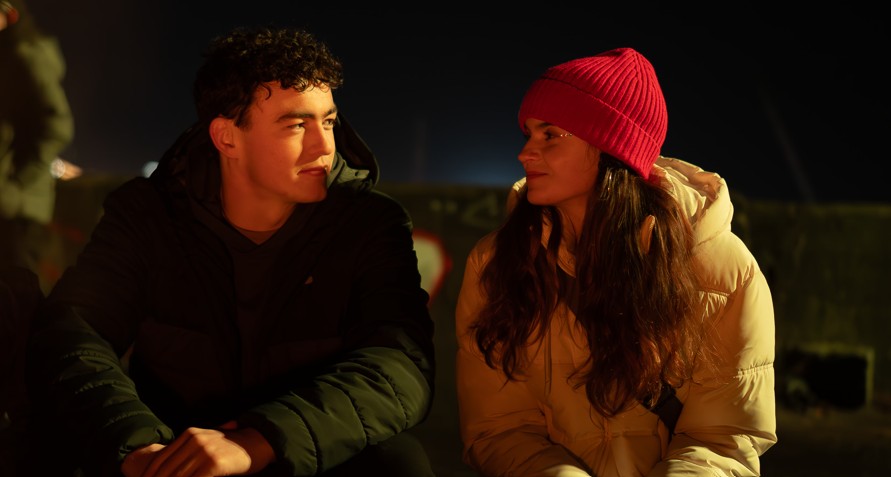
Likewise, Danny’s relationship with Mia, a girl who lives over the road who reminds him what it’s like to be young. Yet she becomes another person who cares for a time before disappearing and what the relationship means beyond a period of happiness that all inevitably fade is unclear. More convincing are the local gang of boys caught up in drug dealing – a familiar trope in Irish television and film – who pressure Josh to join them especially as his finances remain tight. To the film’s credit it avoids this cliché by creating a decent central character with enough forethought to prevent himself from getting into something he will never escape.
Lewis Brophy’s lead performance is the highlight, a modest, decent young man put under pressure by rules and adult decisions he cannot control. Danny’s love for his dog Tess and younger brother is really felt, particularly as his trajectory moves further away from achieving his aims. It is a sweet and sensitive performance that carries the narrative lightly but confidently through to its more optimistic conclusion.
Like gas escaping as soon as you pour yourself a glass, Lemonade does struggle the longer it sits out, but the eventual conclusion is worth waiting for.
Lemonade is screening at the BFI London Film Festival 2026 from 7-18 October.
