

Writer: Noël Coward
Director: Emily Burns
Director Emily Burns is known for bold, contemporary revivals of classics. Sheridan’s The Rivals was reimagined as a Second World War farce in Jack Absolute Flies Again. Her take on Coward’s enduring high-society farce Hay Fever is, however, resolutely, almost defiantly by the book.
Top-notch ensemble performances and lashings of well-tuned physical comedy carry the production, but it promises nothing revelatory. Perhaps that is because underneath the champagne froth of the piece there is little to reveal: Coward has an effortlessly stylish stab at the callous egocentricity of artistic bohemians, and that’s about it. Still, the wit alone makes for an engaging and comforting autumn evening.
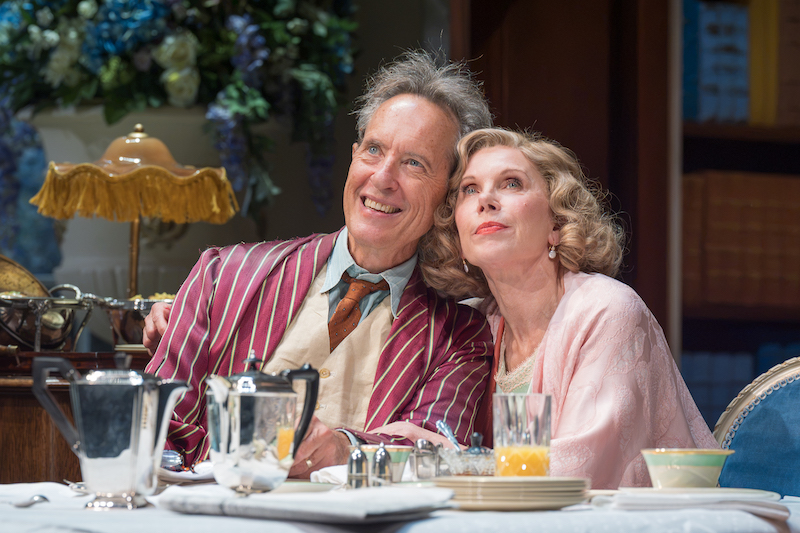
The wealthy, self-obsessed Bliss family – resting West End melodrama grande dame Judith (Christine Baranski), her novelist husband, David (Richard E. Grant), and their grown-up children, Sorel (Ophelia Lovibond) and wannabe artist Simon (Will Close) – discover that each has invited a guest to their Thames-side retreat for the weekend without consulting the others, much to the collective chagrin of the household and its world-weary housekeeper, Clara (Jo McInnes).
The buttoned-up “diplomatist” Richard Greatham (Charles Edwards) is there at Sorel’s invitation, only to find himself promptly entangled in Judith’s romantic machinations. Chic London socialite Myra Arundel (Nancy Carroll, oozing caustic, near-impossibly posh poise) is visiting Simon and, not so secretly, despises Judith. Jackie Coryton (Lucy Karczewski) is a gauche, teary young flapper invited down by David as research fodder for his latest novel. Judith has invited the handsome, infatuated Sandy Tyrell (Ash Hunter, permanently surprised) to pay court to her, but soon finds that Sorel catches his eye.
Not much happens in Hay Fever. After an intensely uncomfortable tea and dinner, the family ropes the bewildered guests into a ghastly parlour game and then sets about a series of pairings, declarations of love, and subsequent reshufflings that conclude with Judith selflessly giving away her husband: “David’s been a good husband to me, but it’s wearing a bit thin,” she confides disarmingly. Unsurprisingly, the guests cannot wait to depart the next morning, leaving the self-regarding family of narcissists to battle things out over breakfast. But a conventional plot is not really the point of the piece. As a study in extravagant performative bohemianism versus polite English conventions, it works perfectly, entirely on its own terms.
Baranski is a good actor playing a bad actor, brilliantly. Her Judith, part declaiming, gesticulating Edith Evans and part ferocious Brooklyn drag queen, has an accent that meanders back and forth across the Atlantic for much of the evening. Still, the comic timing is impeccable, and the sheer expansiveness of the performance is quite something to see. She gets a deserved round of applause for a gloriously off-key, faux-operatic rendition of a song the character seems to genuinely believe she is nailing.
Grant brings his trademark manic, rakish hedonism to the louche David, though at times it feels as if he is on cruise control: Grant playing Grant rather than Coward’s creation. Aside from Baranski, the real comic delights come in the form of Edwards’ permanently pained Richard – embarrassment frozen on his face as if desperately attempting to smooth over an impending diplomatic disaster – and Karczewski’s scene-stealing Jackie. The gloriously directed scene in which the two meet delivers a comic masterclass in agonising conversational pauses and British social awkwardness.
Frankie Bradshaw’s set, pale blues, greens and golds, quite deliberately takes its design cues from the Wyndham’s Theatre auditorium. The theatre wallpaper reappears in the rather too palatial Bliss family home. Is that Baranski’s face appearing as a winged angel on the theatre safety curtain? It certainly looks like it, signalling Judith’s monumental self-regard before the show has even begun. The design reappears on the poster for the diva’s greatest West End hit, Love’s Whirlwind, affixed to the rear of the set. One supposes Bradshaw’s point here is that, in the Bliss household, there is no distinction or barrier between real life and theatrical performance. The point is well made, if a little too literally executed.
Burns directs at a manic pace, which is the only way to really approach Coward, and her eye for physical comedy is superb. With an ensemble this accomplished, one imagines the director found it all rather easy. Does one really want a radically deconstructed Coward? Probably not. Hay Fever thrives precisely on this type of frothy reliability, and Burns delivers it with style: by the book, impeccably performed, and an unalloyed autumnal treat.
Runs until 12 December 2026
