

Writer: Robert Chelsey
Director: Henry Adams
The erotic thrill of late-night phone calls morphs into an intimate connection between strangers. Desires, hopes, and fears are laid bare against a precarious future.
Written by Robert Chesley in 1986, against the backdrop of the HIV and AIDS epidemic in the LGBTQ+ community in San Fransico, Jerker follows two strangers who build a bond over late-night phone calls. What starts out as explicit dirty talk shifts to explore fantasies and desires, then deeper into innocent hopes and fears.
Chesley was a gay rights activist, and he himself died in 1990 due to AIDS related illnesses. He uses Jerker to confront the pain of the HIV/ AIDS crisis and its ravaging of loved ones until they fade into nothingness. Yet, his writing does not contain judgment or shame. Chesley celebrates sexual liberation. As the couple watch their friends and lovers die and wither before their eyes, the calls merge from a method to explore sexual fantasies to the lonely helplessness of a couple looking for any sense of stability and connection.
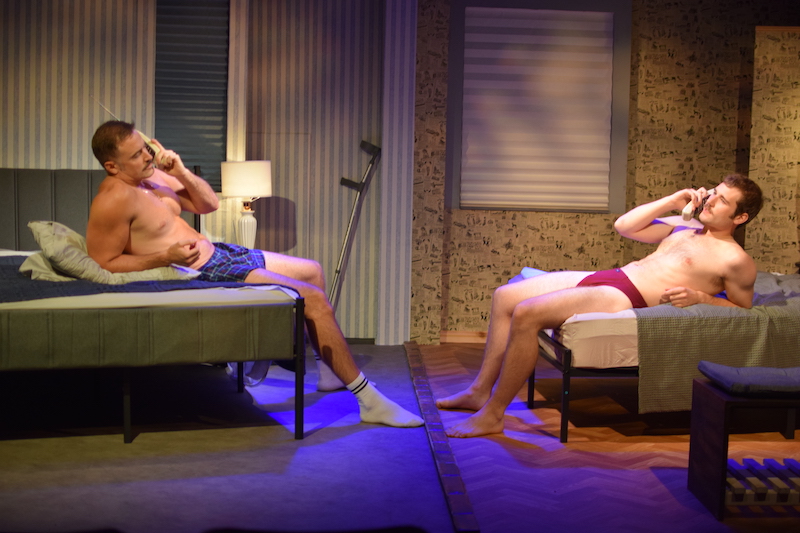
Henry Adams’ direction presents JR (Paul Dennison) and Bert (James Lee) as opposites. JR is particular and clean-cut. He still wears his dog tags from his days in the Vietnam War, and his room is designed to reflect that army precision: pinstriped wallpaper and a tightly tucked duvet. Bert’s home is more imprecise; he has paper floor lamps and newspaper decorating his walls. The clunky landline phones and answer machines are the only design aspects tying this production to a specific time period. Well, that and the 80s pop anthems that punctuate the scenes. The song choices are occasionally a little too on the nose, and they detract from the sentimentality and poignancy of what is happening on stage.
JR needs anonymity and control over the situation. He knows more about Bert than Bert does about him. Unfortunately, this imbalance in the relationship is not fully explored. We see JR using a crutch (JR is a disabled war veteran), but this injury never translates into insecurities or isolation in Dennison’s portrayal. There is no hint of fragility in the performance, so it falls short of bolstering the character and comes across as superficial. It’s only in the final moments of the play that we get any sense of powerlessness from JR, but it would be much more satisfying to see this strong façade slowly soften.
At times, Bert seems almost indifferent to JR’s calls. He placates him and, at times, does not participate in the calls. Lee’s performance is innocent and vulnerable, with an idyllic hope for the world. This is best seen when his friend David is in the hospital. He says of his friend, “He had to fight to have his life the way he wanted it.” It’s moments like this that make Jerker a relevant play to be performing. There is a tension in the lack of freedom to live one’s life however they desire that reflects the times.
San Fransico is set up as an ideal of a gay utopia, but those days are gone. As Bert notes, “I don’t give my number out nowadays.” There is a fear in being open to love. Love is safe but only at an emotional and physical distance. Getting too close in any sense can cause pain. Jerker skews too heavily towards the graphic and provocative phone sex and finds the genuine connection too late.
Runs until 18 October 2026
