

Writers: Mark Ravenhill
Director: Nick Edwards
The Tower Theatre presents Mark Ravenhill’s 1999 play Some Explicit Polaroids as part of its autumn/winter season, a work that sees a great deal of change between the 1980s and 1990s, despairing of a world without hope of political or personal salvation. Nick Edwards’ production struggles with momentum, particularly in the second half of the evening, failing to find a greater resonance in Ravenhill’s too-disconnected characters, while the conceptual approach is hemmed in by Millie Weson and Emma Brown’s overly naturalistic set.
Recently released after more than a decade in prison, Nick turns up at his ex-girlfriend Helen’s flat only to be disappointed that she’s now channelling her talent for protest into local politics. Thrown out, Nick meets Nadia, a club dancer, and is drawn into her relationship with friend Tim and his boyfriend Victor. But someone else wants to meet Nick, using Helen to track him down.
Some Explicit Polaroids suffers by comparison with Patrick Marber’s far superior Closer, written two years before, which much more successfully represents the complex intersecting lives and relationships of a group of people with nothing much to lose. Edwards’ production does relatively little to convince us that Ravenhill’s play, with its more overt complaints about capitalism and the perceived passivity of the UK population in the period of the play, is worth revisiting. The fundamental shift from the fiery anger about the state of the world that Nick has sustained since 1984 while everyone else turns away from the big problems by the late 1990s is an interesting point, but a singular thought barely developed beyond this statement.
For the Tower Theatre production, Weston and Brown’s set demands a realism that Ravenhill’s structure bucks against, creating two separate living rooms for Helen and Nadia as well as a hospital bed for Tim in the latter sections. However, many other locations are needed, including the terrace at the Houses of Parliament, street scenes, clubs and others that feel stuck in these fixed domestic spaces. Max Maxwell adds some colour with scenic projection, yet the piece needs a more representative staging to draw out the connections between these characters and the urban drain of their lives rather than the largely redundant furnishing that remains unused for great chunks of the story.
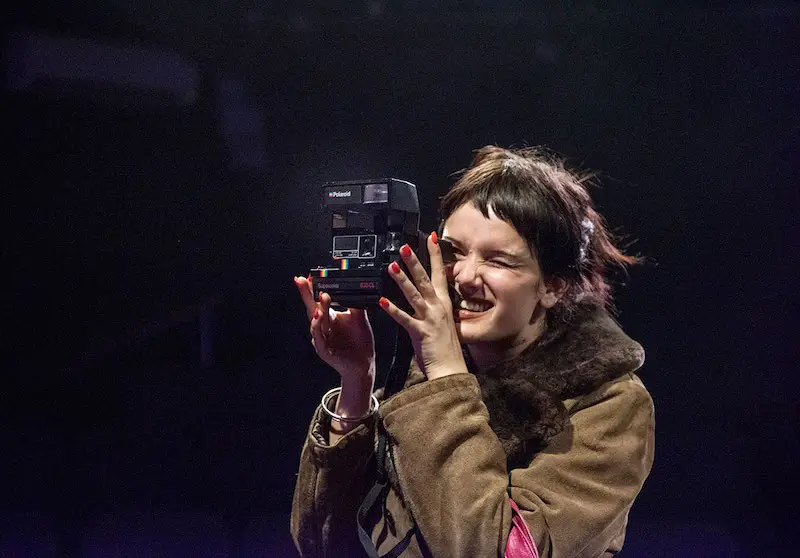
The performances vary, with James Stephen Finn never finding alternative gears for the consistently dislikeable Nick, while Rachel Bothamley is given little chance to offer more range as Helen, and Andrew White’s Tim makes major choices that carry less weight than they should. Lulu Freeman’s offers the best-pitched character as the lonely Nadia, convincing in the round as a young woman lost in the city sprawl, with good support from Alexander Astaniotis as Victor, the good time guy with a heart.
As part of a season of more contemporary works, Edwards’ production is ambitious, but it is a slow night at the Tower Theatre, and this polaroid doesn’t develop.
Runs until 27 September 2026
