

Writer: Patrick Hamilton, adapted by Simon Reade
Director: Matthew Iliffe
The producers of 2024’s critical and commercial hit, The Forsyte Saga, return with an adaptation of another of the definitive works of early 20th-century British realism, Twenty Thousand Streets Under the Sky. The London milieu is very different: privileged Mayfair haute bourgeoisie in the former, struggling jazz-age Euston working class in the latter. But the themes, the conflation of love with property, obsession, class and social respectability, are strikingly similar.
“You can make a man wait tables and serve drinks when all he wants to be is an author”, says emasculated pub barman Bob wistfully (Jordan Scowen) as Twenty Thousand Streets Under the Sky opens. Bob is not alone in dreaming of something different. But nobody in this story, adapted with economy, flair, and precision by Simon Reade from Patrick Hamilton’s trilogy, really gets what they want. Unrequited desire, loneliness, lack of money, and alcohol get in the way.
He may be struggling as a writer, but at least Bob has a nest egg of £80 to fall back on. Alcoholic Jenny (Yanexi Enriquez), formerly a domestic servant, now a street walker, has no such luck. Accompanied by her partner in crime, Prunella (Lucy Gray on great form), Jenny stops by Bob’s pub, The Midnight Bell, one evening.
Bob takes a shine to Jenny, and attraction soon turns to passion. She takes a shine to his £80, professing love while systematically milking him for cash to fund dresses, dances, and drinks. Beyond Jenny’s physical attraction, it is never quite clear why Bob is so obsessively determined to buy her redemption and such a “servant of his passions”. It could be a masochistic saviour complex, or simply that she is unobtainable. Sometimes you want to grab the man by the shoulders and tell him to grow a pair.
Reade takes an extended flashback in the middle of the play to explore Jenny’s fall from grace. A respectable, teetotal maid to two old ladies, she finds herself in the company of the villainous married George (a marvellous Alex Bhat plays him as a kind of vampiric Basil Fawlty). The duo get riotously drunk and knock down a motorist on the drive back to his flat. Should she go back to work the next morning or have another drink? “Would £10 be any good?” says George, settling the girl’s fate and setting up some later blackmail.
Meanwhile, back at the pub, Bob’s meek, respectable colleague Ella (Rosalind Lailey) quietly yearns for him and for a life looking after someone else’s kids in a posh St John’s Wood townhouse. Bob is oblivious to her charms, encouraging her when the comfortably off elderly pub patron Ernest (a glorious Michael Maloney wallows in grotesque pomposity) sets his obsessional sights on her.
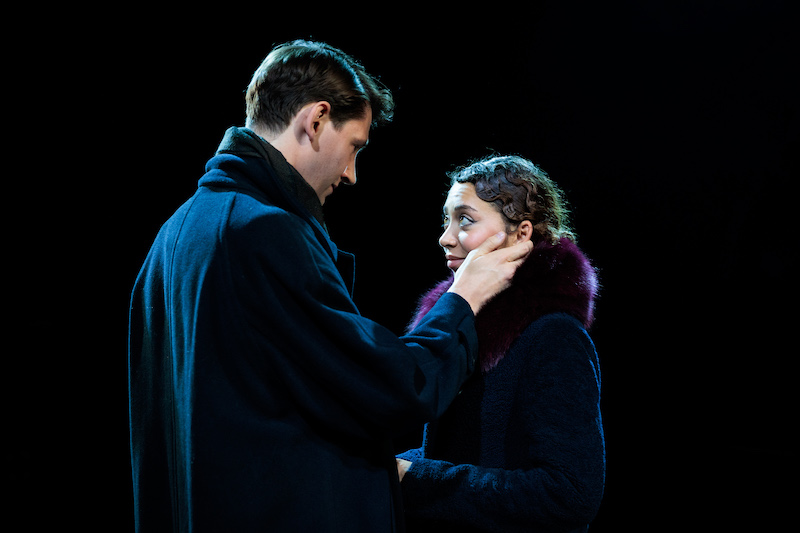
Should the impoverished Ella accept Ernest’s marriage proposal? In a place where relationships between men and women are mostly transactional, the temptation to trade the respectable deprivation of a Warren Street bedsit for a suffocating yet secure life in Chiswick is clear. Will my parents accept an older man from a different class into my life? Ella wonders. “But would I have to meet them?” Ernest responds, mulling over whether to kiss her or give her a good spanking for raising the question. “I can’t afford such luxuries,” she says when he offers to buy her a new coat, but the luxury she is really worried about is giving up her autonomy.
The action moves between the pub, Soho dance halls, plush mansion flats, a Lyons Corner House, Hampstead Heath and grimy bedsits. Set designer Ellie Wintour evokes the atmosphere with little more than a bar top that descends from the ceiling and bits and pieces of furniture brought in from the sides. It works, aided by excellent sound design from Elizabeth Purnell: carts, honking cars and buses, chiming clocks, the chuff of steam trains, and predatory, glass-smashing street gangs.
Maloney’s bowing, scraping, oleaginous Ernest, with an umbrella permanently in hand, dressed like a Chicago gangster, gets many of the evening’s laughs, as does Bhat’s moustached George. But the ensemble cast is uniformly good. Scowen finds empathy in Bob’s baffling fixation with Jenny. Hamilton was sometimes accused of misogyny, but in Reade’s adaptation the women are formidable, if flawed, feminist originals. Enriquez’s damaged Jenny sinks ever lower but never loses her dignity. Her mantra: “ladies must live, dear” is a badge of determination, not failure. Lailey’s beautifully rendered Ella, stoic to the point of self-flagellation, is a model of quietly despairing pathos, yet she remains strong underneath.
Director Matthew Iliffe lets his cast get on with it, giving us an unshowy attention to detail. One wishes the Southwark Playhouse Borough had a revolving stage. The performance is delivered in the round. Whichever side you are on, you will miss some of the ensemble interaction, and the sightlines can be poor. But it is a minor gripe. This is a first-class adaptation of a trilogy that speaks of today’s capital, as much as Hamilton’s Jazz Age city.
Runs until 17 October 2026
