

Writer: Clifford Odets
Director: Sam Yates
American playwright Clifford Odets honed his craft at the height of the Great Depression, in the mid-1930s. The opulence of the 1920s had long since faded into memory, and alongside economic hardship at every turn, the dread of another world war loomed on the horizon.
Odets funded his stage plays by writing Hollywood film scripts, in an era when, alongside the classics fondly remembered today, countless other fair-to-middling melodramas were churned out and then forgotten. Golden Boy does feel like it could fit into that category, though it’s easy to see why it succeeded when it made its stage debut.
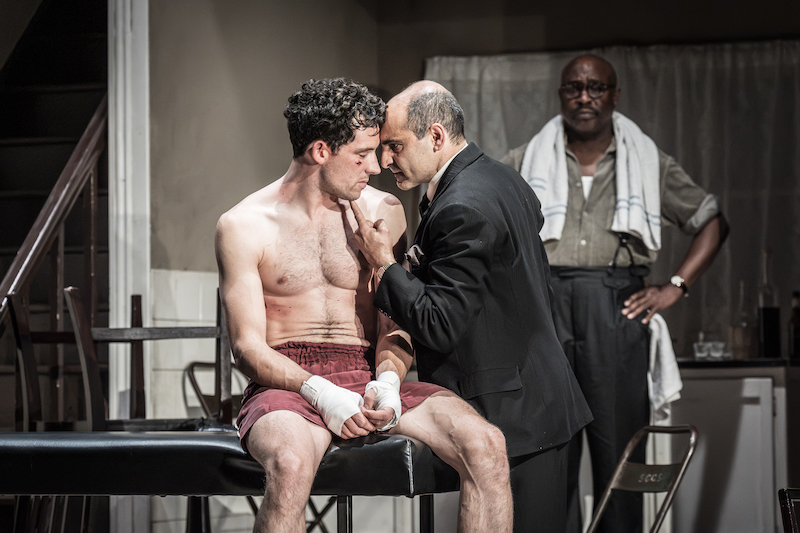
In Sam Yates’s revival, Josh O’Connor plays Joe Bonaparte, the son of an Italian-American family. His widowed father (Stanley Townsend) is proud of Joe’s prodigious musical ability, and for his birthday, he buys his son a $12,000 violin (the cost, comfortably more than an average worker’s yearly wages and thus akin to roughly $80,000 in today’s money, hits harder given the state of the US economy at the time). But that same day, Joe has decided to pursue a different career and become a professional boxer.
Choosing a career that offers wealth and fame over an artistic one that, while creatively fulfilling, is financially precarious at best is an understandable dilemma at any time in history. Thus, we can understand Joe’s two worlds and the pull each has, even if Odets’s script rarely offers such insight. Yates’s staging attempts to fill in the blanks, with a string quartet generally hidden from view behind a shuttered window that is pulled back from time to time, letting Isobel Waller-Bridge’s mock-classical score through.
Around Joe revolves a large cast of characters that, while they may have felt fresh and contemporary at the time, now feel reduced to stereotypes, with so many similar characters created then and since. Daniel Mays’s nervy boxing promoter echoes his Nathan Detroit in Guys and Dolls, while Hayley Squires as his girlfriend, Lorna, develops her own relationship with Joe and embodies the archetypal sassy broad from New Jersey.
While the slate of characters may not always feel particularly original, an earnest naturalism from the cast makes it clear how Odets has come to be seen as a progenitor of Arthur Miller. That is, until Zubin Varla makes his entrance as mobster Eddie Fuselli, who forces his way into buying a share in the business of promoting Joe. Varla is mannered to the point of caricature, with a performance that seems completely at odds with what is going on around him. While that’s clearly deliberate and does help give his character an air of unpredictable menace, it never really clicks with the stylistic choices elsewhere in this production.
Not that Varla’s performance is the only off-kilter element of this piece. A heavy punchbag, brought onto the stage once in each act, has a video camera embedded in it, unnecessarily projecting the bag’s eye view of O’Connor landing his punches on the back walls of Rosanna Vize’s otherwise naturalistic, multipurpose set. And as the melodrama hits its heights near the end of Act II, various characters collapse and wail in what could be outpourings of love, despair and loss of hope, but could just be an attempt to cover what is a sadly all-too-predictable narrative.
And that’s ultimately what keeps Golden Boy from becoming a classic of the era. While its story has much to say, there’s nothing particularly original in its moral or the way it’s been retold. The excellent cast delivers a fine rendition of Odets’s play, but can’t disguise that it is no lasting classic of the era. This boxing drama doesn’t so much pull its punches as fail to land its killer blows.
Runs until 31 October 2026
