

Writer: Thomas Harris
Adaptor: Gina Gionfriddo
Director: Nikolai Foster
The story of Clarice Starling and Dr. Hannibal Lecter is one that has been told, re-told, spun-off, and added on to for years. Thomas Harris’ original novel, set in the early days of behavioural investigation in the FBI, has inspired and influenced many stories in its time. We as humans seem to be drawn to trying to understand the reasoning behind incomprehensible violence, like moths to a flame. Leicester Curve’s new production, written by Gina Gionfriddo, is no different. It dutifully plays out the psychological workings of traditional institutions, 80s sexism, and the unbelievable mind of Hannibal Lecter with great attention to detail, skilful stagecraft, and captivating intensity.
Bringing Gionfriddo’s new text to the stage as Lecter and Starling are Mollie Gallagher and John Partridge, respectively. Their scenes together are full of drama and tension, and plenty of opportunities to make audiences squirm in their seats. Oliver Farnworth as Starling’s boss/mentor, Agent Jack Crawford, and Sam Jackson as Buffalo Bill make excellent additions to the uncomfortable tension. However, the standouts of the production are the ensemble. Each appear throughout the play, moving set pieces and taking on a number of different characters. For their emotional clarity and top-notch range, Jo Mousley, Lottie Amor, Jonny Magnanti, Andrew Joshi, and Mark Peachey, deserve commendation. Their consistency and excellence makes this a higher-quality production.
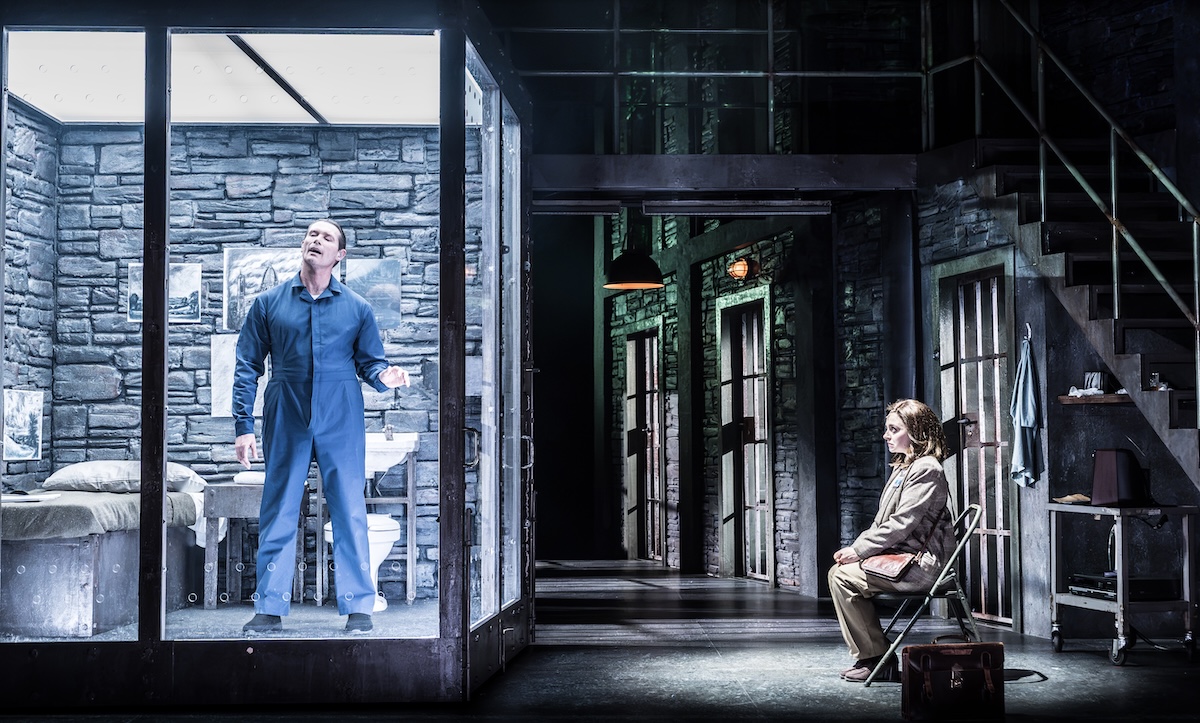
The team at the Curve have crafted a great team offstage as well as on. The production elements truly stand out in this production, making great examples of what sets live theatre apart from film or novels. George Reeve’s projection design efficiently and artfully laces itself throughout the play, lightly accentuating little details or providing necessary information, as well as blowing huge moments out of proportion in the most perfect way. The projection blends beautifully with Howard Hudson’s lighting design, which uses a mix of period-appropriate lights in addition to more dramatic stage lighting. Both are cheered on by Carolyn Downing’s eclectic and depressingly upbeat music and sound design (composed by Grant Olding), and all these elements work brilliantly into Michael Taylor’s chilling and effective set design. The story takes place in a variety of locations, and this production finds little ways to shift the space drastically, without ever leaving the cold, deep hallway of Hannibal Lecter’s cell.
Nikolai Foster’s directing uses this fluid setting to play with time and space with the characters – Gionfriddo’s script may show snippets of different times in the character’s lives, but Foster’s direction allows them to occupy the same space and talk to each other at times when doing so isn’t logical, but heightens the horror. It’s difficult to maintain the tension needed to present a thriller onstage, especially with the added distraction of hundreds of audience members, but this production gets close. It’s easy to let gruesome stories like this one get overplayed and become comical, and this production avoids that. The tension of Starling and Lecter crosses the line into over starched at times, but despite this, the story remains engrossing.
For fans of thrillers (both onstage and off) or newcomers to the genre, this production is a worthwhile watch. True to the story and the time, and paying homage to the multi-award-winning film, the Curve’s play is carving out its own little spot in The Silence of the Lambs’ cultural world.
Audiences who miss it might never hear the silence again.
Runs until 15 August 2026 and on tour
