

Book: Claude-Michel Schӧnberg & Alain Boublil
Music: Claude-Michel Schӧnberg
Lyrics: Richard Maltby Jr & Alain Boublil (additional lyrics Michael Mahler)
Director: Jean-Pierre Van Der Spuy
‘The Legend Reborn’ boasts the marketing material for Cameron Mackintosh and Michael Harrison’s new production, reaching the end of its UK tour before it returns to London next year. Since it debuted almost four decades ago, Miss Saigon has been seen by over 38 million and continues to win new fans every time the curtain rises on Dreamland, truly earning the legend moniker.
Miss Sa
Early on, Seann Miley Moore establishes themselves as an unforgettable presence as The Engineer; he is sleazy as the manager of Dreamland, vulnerable as a prisoner in post-war Vietnam, and unapologetically audacious as he guides the audience towards the end of the show singing ‘The American Dream’. In ‘The American Dream’ Moore gives a moment of relief between two of the show’s most emotional moments, but they don’t need a large set piece and backing dancers to provide comic relief, knowing exactly how to use their character to lighten the mood when needed and knowing when to fade into the background to let the show’s emotion take hold.
Starting the show as Moore’s newest Dreamland recruit, Julianne Pundan stars as Kim. Pundan makes her professional debut in this tour and immediately shows that you don’t need to have a decade’s experience leading festivals (like Moore, a former X Factor hopeful, has). Her Kim is strong, determined, and eminently watchable. What she lacks in credits, Pundan more than makes up for in natural talent. There were times when her voice didn’t quite carry enough power to be heard over her fellow performers but, through the majority of the show where she could be heard, her voice was the perfect fit for Claude-Michel Schönberg and Alain Boublil’s score.
Alongside her, Jack Kane plays Chris, a US Marine who falls in love with Kim when he gets taken to Dreamland by former marine John (played by Owen Johnston, understudying for Dominic Hartley-Harris). Kane’s performance is strongest when he is opposite Pundan or Johnston, both of whom encourage Kane’s performance to a higher standard. He’s a strong performer alone, but it is when he’s seen with someone that he excels himself, showing himself not only to be a strong performer but also one that is incredibly generous in allowing his co-starts to shine.
Johnston, as John, connects easily with the character of a US Marine, but it is as a humanitarian in the second act that his ability to develop a believable character is tested – and he succeeds in every measure.
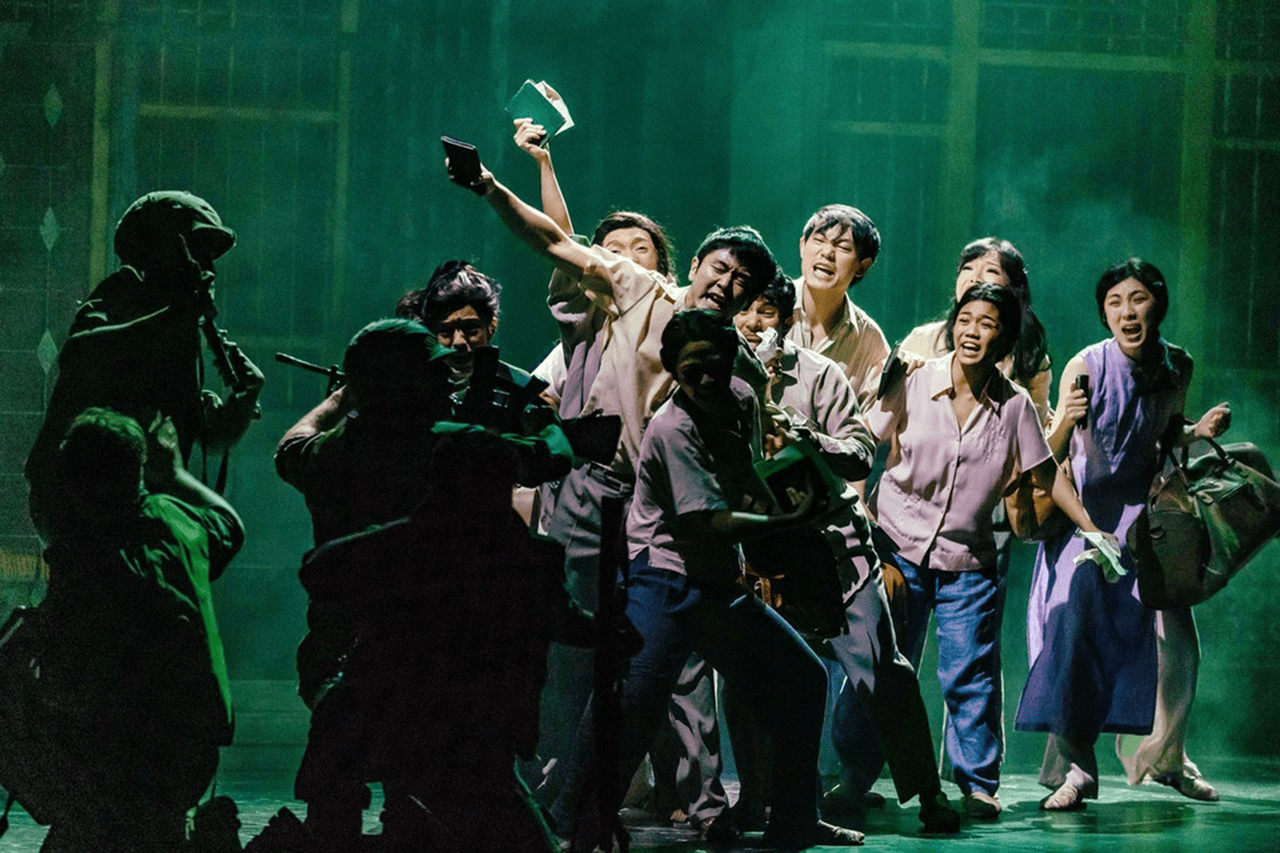
Designer Andrew D Edwards’ set is brilliantly designed, moving around the stage to create each setting and interacting seamlessly with van der Spuy’s direction and choreography from Chrissie Cartwright and Carrie-Anne Ingrouille. The set is often minimalist and yet the stage never feels empty or underserved, but minimalism is discarded in both set and costume for Moore’s ‘The American Dream’ as the stage fills with members of the company for a flashy musical theatre number. What set there is works well; flags become trench-laden fields and rooms move to create the streets of Saigon and Bangkok.
The centrepiece for any production of Miss Saigon though is the helicopter, descending from the top of the stage and brought to life with the support of Adam Fisher’s sound design and Bruno Poet’s lighting design. Edwards’ set and Poet’s lighting work in partnership throughout the show, neither overshadowing (or under-shadowing) the other. The group of designers is completed by wigs, hair, and make up designer Helen Keane and projection designer George Reeve.
Reeve’s projections manage simultaneously to be the central element of parts of the show and to fade away as if they weren’t there. American bombers fly across the back of the stage in an attempt to turn the tide of the war, literal tides cover the front as refugees flee for a new life, and audiences are transported around the world through scene locations flashing before them. Each projection adds depth and meaning to the show, becoming both a principal character and a piece of set while never distracting from the story being told on stage.
This production, slightly updated from previous outings, is a worthy continuation of the legend. It manages to feel both extraordinarily large and intimately small in its presentation of the human element of the Vietnam war and, although the loudness of the music sometimes made hearing individual singers a struggle, shows love in all its forms – love of self, love of others, and love of country – in a manner that is pure and enjoyable. It may not inspire people to see the show hundreds or even dozens of times, but it will certainly inspire its audience to reconsider and recommit to love in their own lives.
Until Saturday 18 July, then on tour.
