

Writer: George Fitzmaurice
Director: Conall Morrison
George Fitzmaurice’s The Magic Glasses was first performed in the Abbey Theatre in 1913 and revived in 1967. The one act masterpiece is Fitzmaurice’s darkest earlier work, blending folklore, superstition, and psychological unease. The play reflects on the Irish society of the early twentieth century in rural Ireland when folklore was a belief system filled with tales of the banshee, cures, charms and travelling strangers. The play shows how superstition can become a mechanism of control and fear.
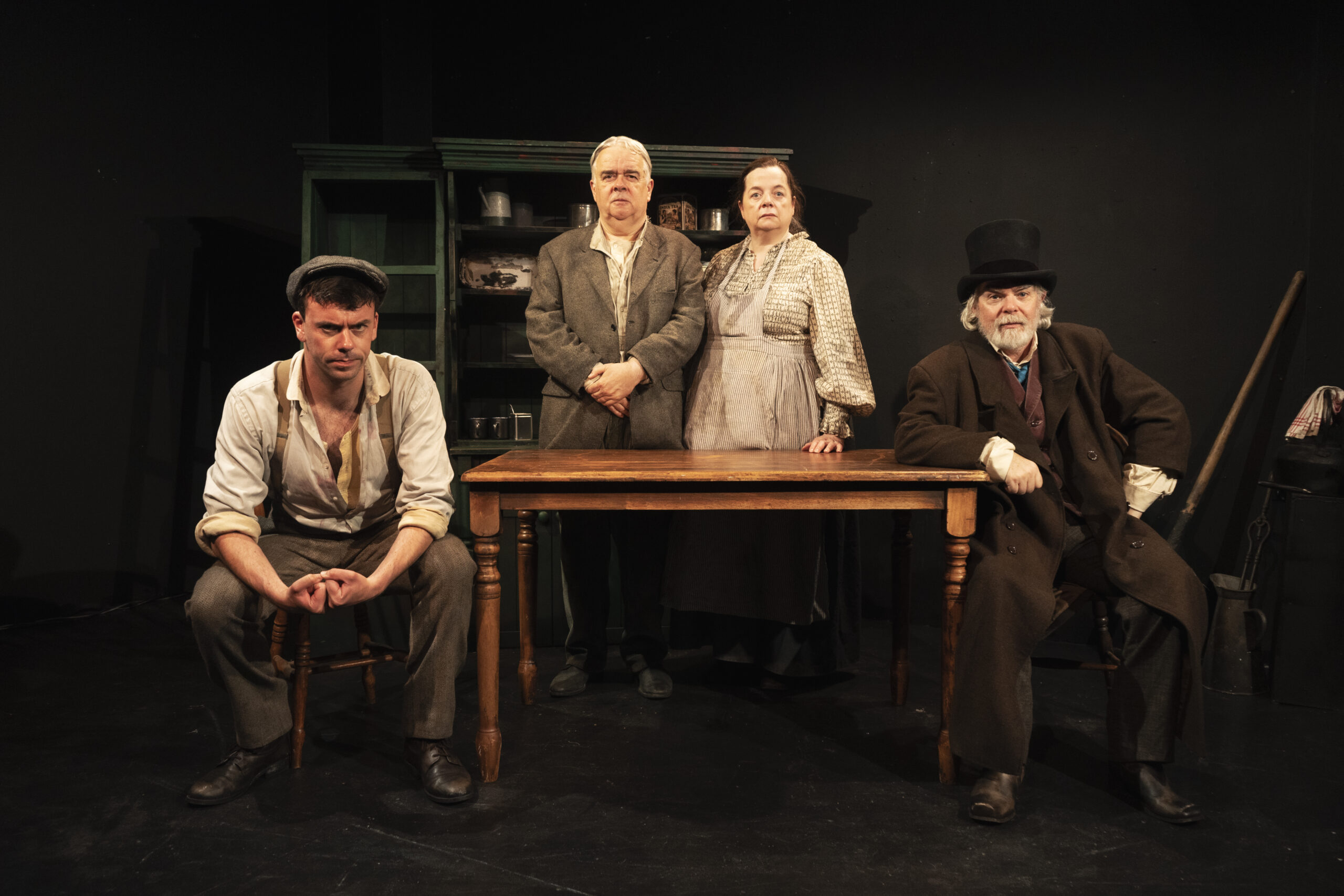
Jamony Shanahan spends his days in the loft playing strange music and staring into a pair of magic glasses given to him by a ‘brown woman’. Mr Quille, a faith healer, is summoned by his parents, Maineen and Padden to exorcise the changeling aspect of Jamony – but he fails in his attempt to restore Jamony to reality. His parent’s inability to understand Jamony’s behaviour only serves to isolate him further. In a modern interpretation Jamony’s behaviour could be seen through the lens of delusional obsessiveness.
The play mixes farce with darkness. The characters behave absurdly. His parents believe that there is a thin veil between rural life and supernatural forces that lurk out of sight. The situation is grotesquely funny as in Synge’s one act play The Shadow of the Glen.
Jamony Shanahan played by Ross Gaynor displays the manic qualities of the character, however we need to feel the conflict in him. Is he mentally unwell, haunted, or just in a trance? Mrs Shanahan played by Helen Norton creates the character of the mother, filled with a belief that the stories of the other world are real. She portrays authentically a real fear of the unknown.
Padden is played by Jonathan White and his stage movements are motivated by his fear of a sinister presence in the house. In the construct of the character of the father, Fitzmaurice was exposing a masculine tendency of the time who adhered to rigidity, emphasising a complete lack of understanding of his son’s mental health and difference. We could see this more in the actor’s body language and intonation.
Mr Quille played by Malcolm Adams enters the stage with a confidence bordering on pompousness. He believes in his own importance, which highlights his failure in the end. Adams displays this element of the character with panache, and his costume, designed by Sinead Lawlor, is suitably theatrical.
Balance is needed in the direction of this piece by Conall Morrison. The pace shifts between comic and unease, but the direction veered towards melodrama. This may have suited a 1913 performance but not a 2026 one, where a more subtle approach is required. Interpreting The Magic Glasses for a twenty-first century audience should leave us contemplating the fragility of those who are experiencing mental health issues, questioning how society handles mental health issues, and examining how those who are different navigate the modern world.
Sound and light are key in supporting the play’s shifting atmosphere. Colm Maher (lighting) and Simon Kenny (sound design) contribute to the delicate, eerie, trance-like essence of the play, linking the atmosphere of menace and the other world to the domestic space of a rural cottage.
The Magic Glasses is worth a visit to see this forgotten masterpiece and hear Fitzmaurice’s lyrical prose and witness his farcical black humour.
Runs Until 18th July 2026.
