

Writers: Tõnis Pill and Laura Raud
Director: Tõnis Pill
Is it still too soon to replicate that plastic bag scene from Sam Mendes’s 1999 American Beauty? Tõnis Pill doesn’t seem to think so, and bookends his film about a friendship between a 13-year-old boy and a man with learning difficulties with shots of a plastic bag caught in the wind above a small Estonian town. One plastic bag may be regarded as a misfortune, but two look like carelessness.
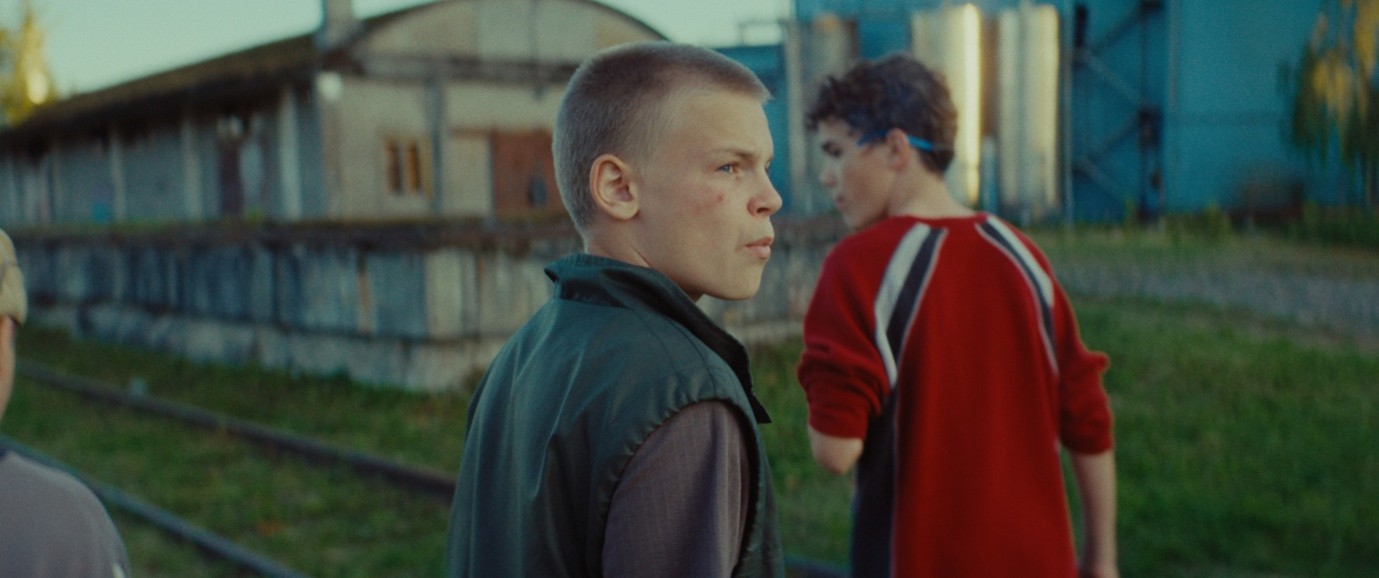
But the rest of Pill’s film, shot in rich saturated colour, isn’t bad at all. Derek Leheste puts in a finely nuanced performance as young Paul, who goes to stay with his uncle while his mother sorts out things with his abusive father. Paul arrives at his uncle’s small town with bruises on his face, the result of his father’s temper. His uncle is much kinder, but Paul treats him with disdain, slamming doors and coming home late.
He falls in with the local boys, a ragtail bunch of young teens sniffing glue, smoking stolen cigarettes and drinking shoplifted alcohol. Paul is welcomed into the group by its leader Jasper (Tõru Kannimäe), who also has issues with his own father. They spend their time brawling and getting high. Plastic bags make another appearance as they huff the glue Paul has bought from the local hardware store.
The gang also torments a resident of the town; a man with facial difference and learning disabilities. His name is Sasha, but the boys call him Frank, after Frankenstein’s monster. Sasha spends his days collecting bottle tops to place on the railway line and watching them get flattened when a train roars by. After being coerced into throwing purple paint over Sasha, Paul slowly recognises Sasha’s humanity, and they become friends of sorts. Paul starts gathering bottle tops, too, and Sasha is drawn to the sounds of Paul’s harmonica.
Most of the boys are from single-parent families; a few have fathers who have upped and left. Jasper disappoints his father by not having the ‘courage’ to shoot a deer when the two are out hunting. It’s easy to read Pill’s thesis that bad/absent fathers lead to misbehaved sons. However, two father figures bring a chink of light to Pill’s film: Paul’s uncle (Märt Pius) and Sasha’s brother.
Oskar Seeman is the childlike Sasha wandering around the town with his light-up trainers. It’s a strong, heartfelt performance, but some may take issue with the prosthetics and the make-up. Based on a man from Pill’s home town, Sasha embodies an innocence that the teenagers have already lost, an innocence that Paul seems distantly aware of when the two play.
This film demonstrates that children don’t have to be cruel and that fathers, some at least, can be redeemed. Pill expertly captures the confusion and the intensity of childhood, but at times, Fränk is a little too sentimental. We don’t really need to hear Moon River (its lyric, ‘My huckleberry friend’, unspoken, but obvious) so many times.
Fränk is screening at the Raindance Film Festival 2026 from 17 -26 June.
