

Writer: Florian Zeller, translated by Christopher Hampton
Director: Lindsay Posner
When the French playwright Yasmin Reza described her play Art – classified as a comedy by audiences, critics, and awards ceremonies – she spoke of it as a tragedy. “Laughter is always a problem… the way people laugh changes the way you see a play.”
Florian Zeller’s The Truth falls into that same problem area. As translated into English by Christopher Hampton (who translates much of Zeller’s works, as well as providing the same duties for Art) and directed by Lindsay Posner, this tale of two couples brought to the brink by an affair is presented very much as a comedy of manners.
Starting with Stephen Mangan’s Michel in the hotel room he uses for afternoon sex with Alice (Sarah Hadland), the pacing is very much as of a farce, although there is little in the way of the sort of door-slamming, quickfire escalations on nonsense that typifies the Ray Cooney style. Instead, that all comes from the dialogue, in particular the increasing mania of Mangan as he struggles to stay in control of the web of lies.
The trouble with relying on verbal comedy is that it relies upon the dialogue being whipcrack smart, and very often Zeller and Hampton fail to match that. There is an over-reliance on Michel’s repetition of stock phrases, and while that is, on occasion, deployed very well, at others it feels like it is disguising a lack of either incident or humour.
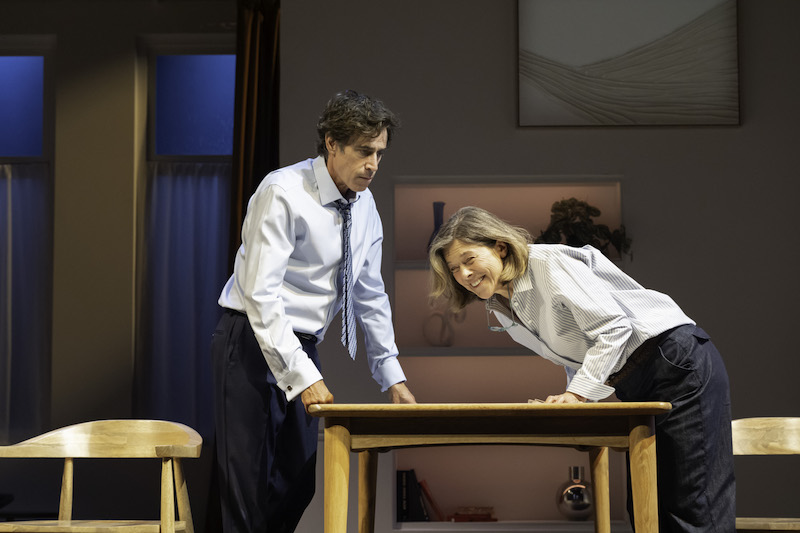
Still, Mangan sells it well, which helps the play immensely since the entire piece consists of scenes in which his character is alone with one other cast member. But his character is also such a mess that one is left wondering why Alice would bother with him. Mangan’s scenes with Janie Dee as Michel’s wife Laurence do at least hint at a softer, more compassionate side that, while it may have faded over time, justifies their 20-year marriage.
Dee does at times seem to be playing a different genre than Mangan. Her character is closer to a Pinteresque stoic next to the frenetic whirling dervish of her husband. That actually creates perhaps the most believable relationship out of any on stage, rooting the play in a stratum of reality from which the director’s efforts are always begging to escape.
There is much delight in Mangan’s ability to act wounded when he thinks that others are being cruel to him – when he thinks Alice’s husband (and his best friend) Paul knows about the affair but hasn’t said anything, he can frame it only as a betrayal to him, rather than the other way around. It is just as well that particular joke lands, for it is the backbone to the entire vein of comedy, one joke repeated in each scene to much the same effect.
Mangan meets his match with Ardal O’Hanlon’s Paul. Where Michel is brash, loud and all surface, Paul says very little — just enough to send Michel spiralling. In a play that relies upon not knowing who is actually telling the truth (and if they are lying, why they might be doing so), O’Hanlon’s enigmatic performance perhaps fits the play’s true purpose best of all.
There is scope for The Truth to be a salutary lesson. In a world that increasingly diminishes factual truth in place of personally twisted versions in politics and elsewhere, a comedy about a lie snowballing out of control should carry lessons for us all. But while Zeller’s play offers an entertaining 90 minutes of relief, it is not a production that delves as deeply as one feels the playwright’s original work intended to go. And for a comedy about something as important as honesty, that’s a tragedy.
Runs until 12 September 2026
