

Writer: Martin Crimp
Director: Indhu Rubasingham
On the surface, Martin Crimp’s update of Molière’s most famous play, The Misanthrope, at the National Theatre, has much in common with Patrick Marber’s reworking of David Mamet’s Glengarry Glen Ross at the Old Vic, both exchanging their originally male character for female actors and looking to explore some of our contemporary assumptions about how men and women behave. But while Marber’s work offers some genuine insight into the nature of gender performance and cycles imposed on the lives of men and women, Crimp’s adaptation rather loses sight of its social satire, increasingly unravelling as the modernised story unfolds.
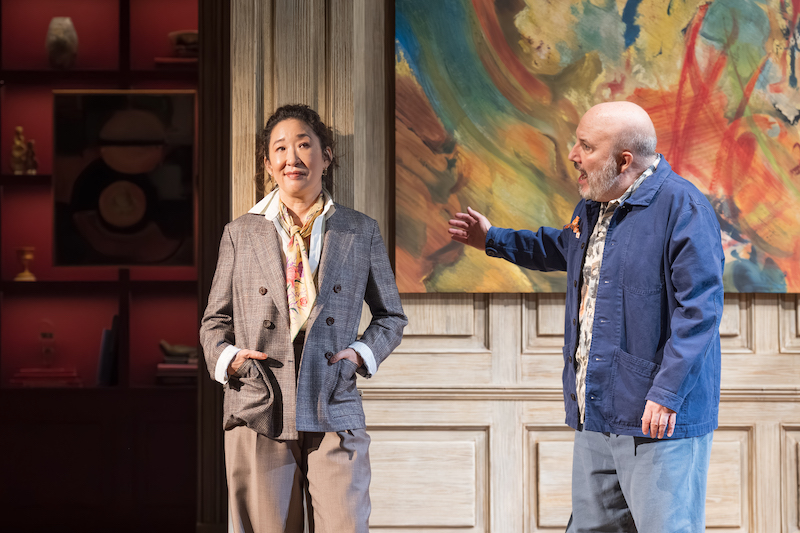
Author (of books) Alice is tired of playing the PR game to win prizes, accolades and devotion, speaking her mind about all kinds of topics despite warnings from her playwright best friend John. When she insults the work and presentation of Esmée, a young influencer, Alice becomes toxic property. She is distracted by the affectations of her younger lover Stefan, who may be betraying her.
Crimp’s update of The Misanthrope is grounded in the world of art and artists, despising the falsity of “ritualised emoting” and the social requirements to behave in an environment dominated by digital representation and the need to be liked. And there are clear parallels here with the original play in which the curmudgeonly Alceste rails against the demands of politeness which Crimp has brought into the modern day with a view that young(er) people than Alice and John are shallow and unreflective, while their behaviours are enabled by a troupe of fixers and facilitators who never put them in their place as Alice so happily does.
And while Crimp packs the 1-hour and 45-minute play with plenty of theatrical in-jokes about the dignity of ‘proper’ literary writers rather than hack playwrights and, regardless of the sentiment or political dimension, insists there’s no excuse for bad writing, the writing here is often thin and unconvincing. Alice and John have several ranty conversations to chew this over that are neither naturalistic enough as convincing speech nor exaggerated sufficiently to suit a jauntier piece – and Indhu Rubasingham’s production never quite nails the tone with some scenes grounded in realism and others in more exaggerated, comic and fantastical forms.
But the play just fizzles out and rather than a story with lots of hinge points, bringing together new information and insights, The Misanthrope becomes a series of conversations that barely hang together; Alice talks to John (Paul Chahidi), to Stefan (Tom Mison), to his ex-wife Elaine (Jemima Rooper) but amongst the chatter about the pressure on female composers and arrogant actors fretting about their PR, it’s not easy to follow what is going on, what the jeopardy is and why the audience should care. If you’ve never seen Molière’s original, then this won’t make much sense, lending even greater weight to Alice’s line about “acting in a play I don’t understand,” and you feel she’s not alone in that.
The big draw here is Sandra Oh, and she is excellent, fiery and likeable, great comic timing, and just listening to her Alice rant about the ills of twenty-first-century living would have been enough. But there’s so little for everyone else to do that by the time they appear in eighteenth-century costume for the bizarre party ending in what look like leftovers from Les Liaisons Dangereuses (the last production on this stage), any opportunity to think about the regendering of Molière’s characters and the point of all of this has drifted away.
Runs until 1 August 2026
