

Writer: William Shakespeare
Director: Richard Cheshire
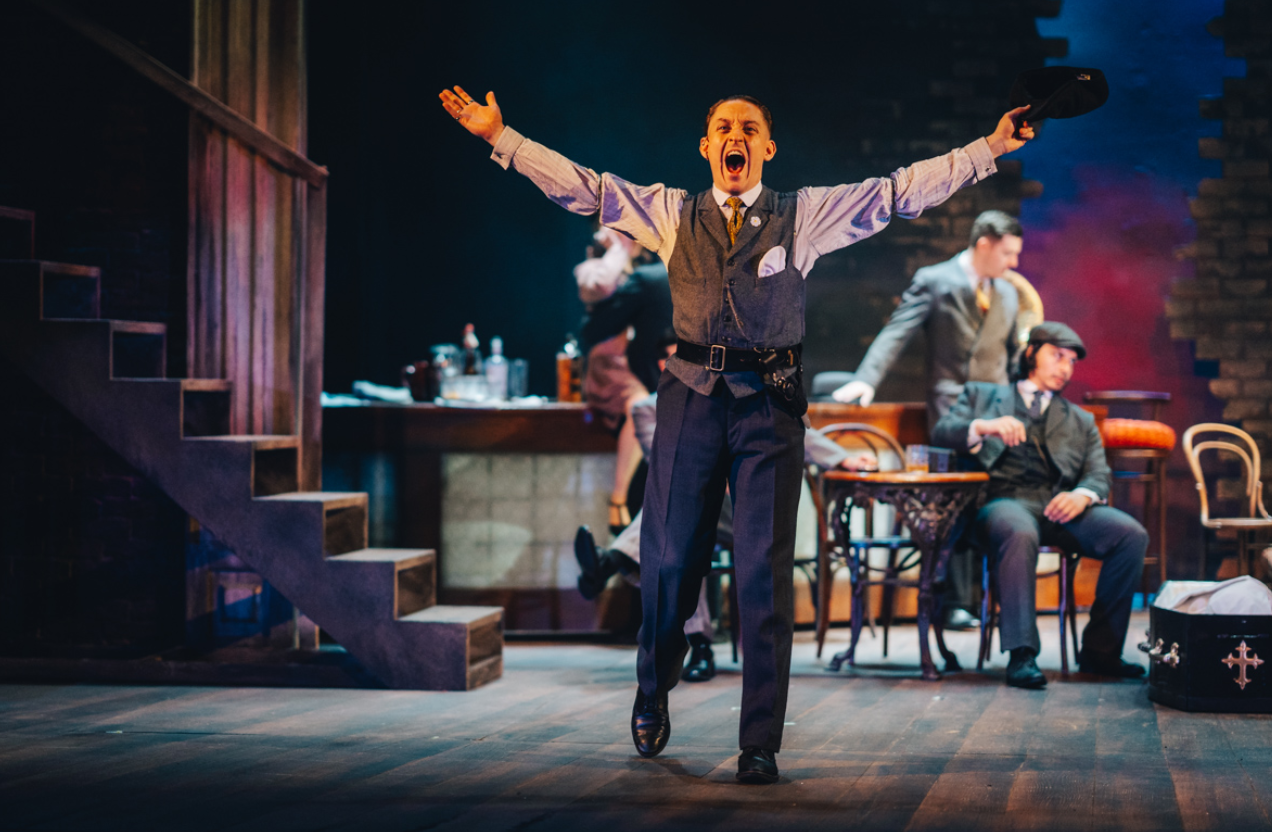
Period transposition is the oldest trick in the Shakespeare director’s playbook, and it raises one question – does this setting help understand the play? Richard Cheshire’s Richard III for Stafford Shakespeare, set in a bombed-out post-war pub and drawing liberally on the aesthetic of Peaky Blinders passes that test convincingly. This is not a production that just borrows a look – it finds, in the codes and hierarchies of gangland Britain, a world that maps onto Shakespeare’s power politics beautifully.
Patrick Connellan’s design is central to the piece. A multi-level, war-damaged pub interior, which establishes a world of surveillance and threat from the first moment. The pub is a space where every conversation might be overheard, every alliance observed, a place of treachery and intrigue. Lucas Elliott’s score hits the right tonal mark – atmospheric, menacing, a nod toward the Peaky Blinders soundscape without becoming mere imitation. The costumes complete the world – the peaked caps, sharp tailoring and period detail are handled with a precision that makes the whole thing hold together visually. Leanne Pinder’s movement direction and Kenan Ali’s fight choreography add further layers – violence here is deliberate and controlled.
Where the concept loses some grip is in the production’s final movement. The Battle of Bosworth sits awkwardly in the setting, even though the former interior menace is replaced by an open stage. The lighting struggles to differentiate adequately between the smoky back-room world and the open field of battle.
Matthew Duckett’s Richard is the production’s centrepiece and is a joy to watch. He pitches the role with a sardonic lightness that makes the character’s early charm entirely credible – glances at the audience that invite complicity rather than simply signalling villainy, with a sense throughout the opening scenes that here is a man running for office as much as than plotting a coup. The humour is present, but it is never broad; it operates, as the best Shakespearean comedy does, through a shared understanding between performer and audience that what is being said and what is meant are two entirely different things. The transition from charming schemer to something altogether darker is handled with care, and the effect is a Richard whose menace grows precisely because his likeability has been so thoroughly established. He is constantly accompanied by his henchmen, threatening figures with caps pulled over their eyes, and who in a clever piece of direction, are despatched to carry out murder and execution.
Benedict Shaw, returning to Stafford after last year’s Hamlet, brings a very different energy to Clarence and James Tyrell – two roles that could not be more different, and Shaw navigates both with assurance. Lucinda Freeburn’s Lady Anne and Mari Fflur’s Queen Elizabeth are constant, suffering presences; neither character is given much agency by Shakespeare, but both performers make their women feel integral to the storytelling rather than peripheral to it, which is to the production’s credit. Karen Archer’s Duchess of York carries quiet authority and resignation.
The production’s most significant misstep is the casting of Sean O’Callaghan as Margaret. O’Callaghan handles Edward IV and Lord Stanley with ease – the former a patriarchal head of the firm, the latter a man carefully reading which way the wind is blowing – but Margaret, here a veiled, deep-voiced figure looming over Anne and Elizabeth while delivering the play’s prophetic imprecations, tips into something closer to parody. Whether this is a directorial statement about Margaret’s status as an outsider in this world, or simply a practical solution to a casting constraint, the effect is to undermine one of the play’s most dramatically potent roles.
Michael Skellern’s Buckingham is a steady, credible presence – the production makes good use of his arc as the closest of close supporters who discovers that proximity to power offers no protection. Daniel Carter-Hope’s Lord Mayor is a well-judged cameo – a civic official of studied pomposity, waistcoat buttoned over portly self-importance, utterly ineffectual in the face of forces he cannot begin to comprehend.
Stafford Shakespeare has here found a production where setting, design, performance and text feel genuinely integrated. The Peaky Blinders framing is more than a marketing trick– it is a persuasive interpretation of a play that has always been, at its core, about what power looks like when stripped of ceremony.
Runs until 4 July 2026
-
8
