

Writer: Tim Connery
Director: Nathan Osgood
In the pantheon of American jazz musicians, Nat King Cole is probably best remembered for his remarkably smooth voice and for standards such as Straighten Up and Fly Right, Unforgettable, Nature Boy, and The Christmas Song. Beyond that, there are elements of his life that have fallen out of the public consciousness.
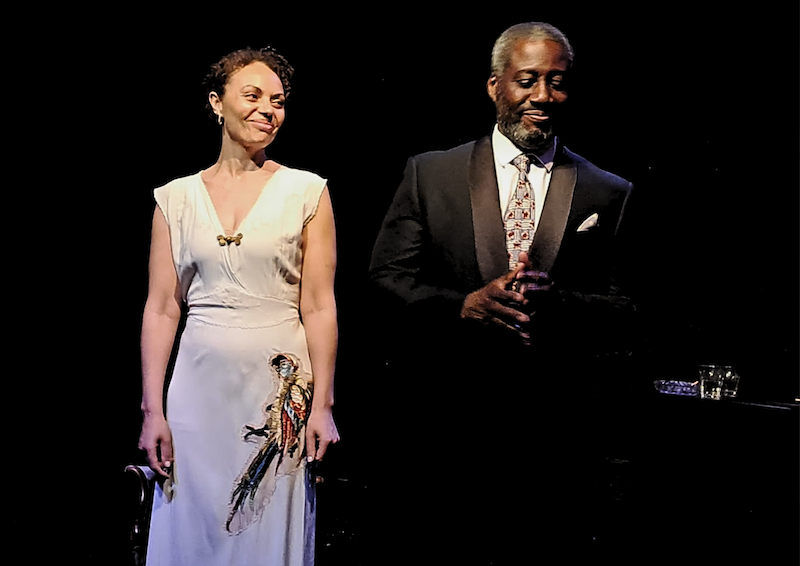
Tim Connery’s new biographical drama starts in 1946, with Kwame Bentil’s Cole resting backstage between shows with his jazz combo, the King Cole Trio. He meets singer Maria Ellington (Alicia Charles) and the pair instantly hit it off, despite Cole already being married.
As the couple’s relationship grows into marriage, Connery suggests Maria is one of the driving forces behind Cole’s move from becoming a jazz pianist in a largely instrumental trio to stepping into the spotlight as a singer. This is presented less as a Lady Macbeth-style power-behind-the-throne dynamic, and one that is born out of expedience: Cole is neither good with money nor with paying taxes, and combined with the burden of alimony payments to his first wife, it becomes clear that the drive for her husband’s fame is an attempt to salvage their finances and keep the family together.
As the story heads into the 1950s, the civil rights struggle rears its head. While more and more Black people were standing up against American segregation laws, Cole is more keen to keep his head down. Conversations with his wife about how she needs to go shopping with a white woman, whose role is only to hand over Maria’s money to retail workers who would not accept the cash coming from black hands, present elements of life in Jim Crow-era America that deserve a greater spotlight.
And yet the bitty nature of Connery’s play structure works against any sort of single theme from emerging. Scenes are presented with projected captions that indicate their place and time, often jumping ahead by several years. Narrative style changes, too, with an inconsistent use of first-person monologue from Bentil. The overall effect is of a play that knows all the various small elements of Cole’s biography that it wants to include, but has not quite grasped how to help them cohere into a single, satisfying narrative.
That’s most evident when Cole’s success enables him to buy a large home in the affluent Hancock Park neighbourhood of Los Angeles. The local residents’ association drop heavy hints about not wanting any “undesirables” in the area – but resistance to the presence of a Black family does not stop at such microaggressions. The placement of a burning cross on the Coles’ front lawn is a shocking moment in itself, but the play does not dwell on the repercussions of such actions.
Instead, we get further documented instances of racist attacks on Cole, especially during a performance in his Alabama home town, where white supremacists stormed the stage with the intent to kidnap, and possibly lynch, the singer. The low-budget nature of Unforgettable helps retell this element, allowing us to pause and dwell on Nat and Maria’s reactions to such an attack rather than attempting to reconstruct the events themselves.
But as the play continues its relentless progression through Cole’s life and on to the health issues that plagued his later years, it feels as if the civil rights struggle is minimised into a side plot. In later scenes, Maria talks about her husband’s performances supporting the civil rights effort and his participation in marches – but the discrepancy between that Cole and the version we first saw, who wanted to keep his head down, is not really engaged with.
That aside, both Bentil and Charles give engaging performances. And while Bentil neither looks nor sounds like Nat King Cole, his performances deliver enough of the smooth, charismatic charm of the jazz singer to help the whole play adhere to our memories of his landmark performances.
Nat King Cole was only 45 when he died of lung cancer. He left behind a legacy of great music and recordings that will forever remain some of the best jazz standards of the era. Cole really is unforgettable – but for Unforgettable, the play, a stronger focus on storytelling is necessary for it to truly reflect the power and charisma of its subject.
Runs until 4 July 2026
