

Writer: Kurt Vonnegut
Adaptor: Eric Simonson
Director: Douglas Baker
Slaughterhouse-Five is not an easy play to stage. In fact, it possesses a set of characteristics which make it perhaps uniquely ill-suited for stage adaptation: non-linear narratives, genre-switching, and an unreliable narrator, to name but a few. Director Douglas Baker, it seems, is infinitely aware of these challenges, seeing them as obstacles to overcome, rather than barriers to theatricalisation; in a director’s note to accompany the production, he writes that ‘I was drawn to translating the time-jumping, fragmented story of Slaughterhouse-Five into live theatre because of its challenges and opportunities.’
His production of Slaughterhouse-Five (adapted by Eric Simonson) is – it must be admitted – an ambitious piece of storytelling. On one hand, it grasps the inherent challenges of staging this fragmented, disorientating piece of theatre, using some remarkably innovative lighting and production-based cues to orientate the audience throughout a play which is lost in space and time. On the other hand, at moments, this production teeters between being fragmented and actively disjointed: some serious effort has been invested into conveying the jumps forward and backwards in time, but potentially at the cost of the play’s pacing and flow. Taken as a whole, the play is thought-provoking, but it never quite justifies its transmutation from the page to the stage.
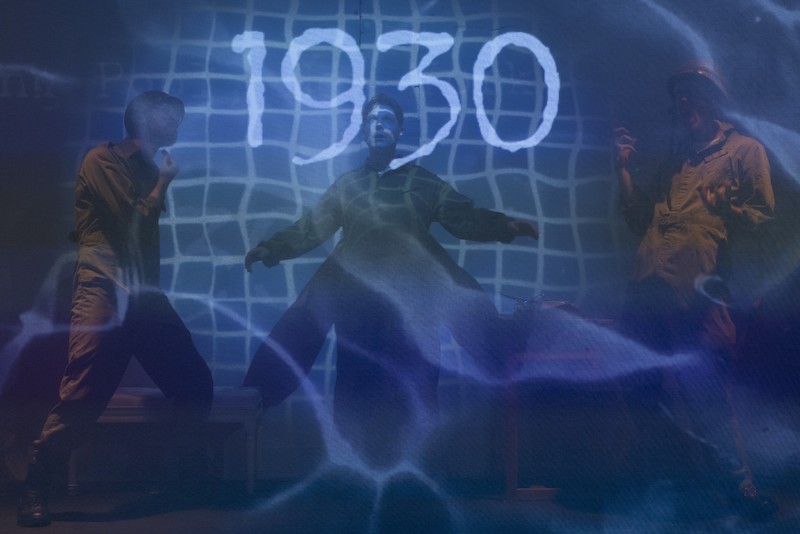
Perhaps this is because Billy Pilgrim’s story is inherently uncertain in the first place: having become ‘unstuck in time’, he experiences the past, present and future simultaneously. This is evidently easier to convey when a reader can flick back and forth between pages, rather than having this non-sequential series of events performed sequentially in-front of them. The production team (led by Jamie Rycroft) make a valiant effort to overcome this difficulty: the stage is built predominantly around a single projections screen, onto which are layered various clues to help the audience situate themselves: as we flit backwards and forwards in time, the date is indicated on screen.
But rather than just using the screen to tell time, Baker opts to make these projections a more prominent feature in the production: the screen is variously used to augment the background/setting; to separate characters into separate rooms, and even to introduce new characters altogether. Little snippets of videos and short clips are projected across the screen, giving the actors another dimension to their story and a new way of bringing more voices onto the stage at once. Laurel Marks (lighting design) and Calum Perrin (sound design) further enable this visual storytelling; in fact, this multimedia setup is a real highlight of the play because it emphasises the story’s uncertainty: like a projection onto a translucent screen, we are never quite sure whether what we’re seeing is a representation of the truth, or the incoherent ramblings and imaginations of a madman.
The four actors (Patrick McAndrew, Alex Crook, Ethan Reid and Sofia Engstrand) further help to blur this distinction between truth and imagination. Apart from McAndrew (who plays Billy Pilgrim), the cast all inhabit multiple roles, forcing them to quickly switch – either by deploying different accents, or by portraying different characters in different eras. This, too, is impressively done: cuts between characters are precise and clear, and the constant switching of roles enables moments of comedy to cut through the tragic narrative around the Dresden firebombing, or the eccentric narrative around the abduction of Billy Pilgrim by extra-terrestrials. In particular, the play creates some amusing caricatures in failed author Kilgore Trout and eccentric professor Bertram Rumfoord.
On paper, Baker’s Slaughterhouse-Five, therefore, has all the suits and trappings of a successful production, including an innovative storytelling technique bolstered by a creative multimedia set; a talented cast working through various roles in quick succession; and a clear language and set of cues to help guide the audience through a confusing narrative. But the end result is still lacking in purpose and flow. Perhaps, however, this is exactly the point: Billy Pilgrim’s abduction by aliens with the power to see in four dimensions results in him seeing the circumstances of his own death; he ultimately adopts a fatalistic worldview, eschewing purpose and narrative flow for the inevitability of fate. Unfortunately, his audience (on-stage and off-stage) still didn’t buy it.
Runs until 4 July 2026
