

Writer and Director : Miiku Sakanishi
Miiku Sakanishi’s Memorizu is a lovely film about memory and the enchantment of small things. Yuta and Yoki are a young Tokyo couple, parting at a ferry. Yuta, the husband, explains to their daughter Hana that his sixty days away means sixty sleeps, or sixty breakfasts. If she sleeps a lot or eats extra breakfasts, does that mean he’ll come home sooner? she asks.
There’s little dialogue, but what makes the film fascinating is the slow accumulation of memorable images, images that increase in resonance often without a word spoken. Thanks to Sakanishi’s direction and Kamakari Yoichi’s cinematography, we become aware of the exquisite framing of every shot. Often there are additional frames – indoors, we see out of windows and doors; outdoors there are satisfyingly symmetrical shop fronts, neat parallel rows of washing. Individuals are often at the centre of a shot, as if an eye is focusing on them. And indeed this focus on capturing visual images draws attention to the fact that, during their time apart, the couple share snatches of videos from their day-to-day life. Yoki and Hana are back home in Tokyo, Yuta now far off in rural Kyushu, helping out his father-in-law, Makoto, who has broken his leg and needs assistance with his photography business.
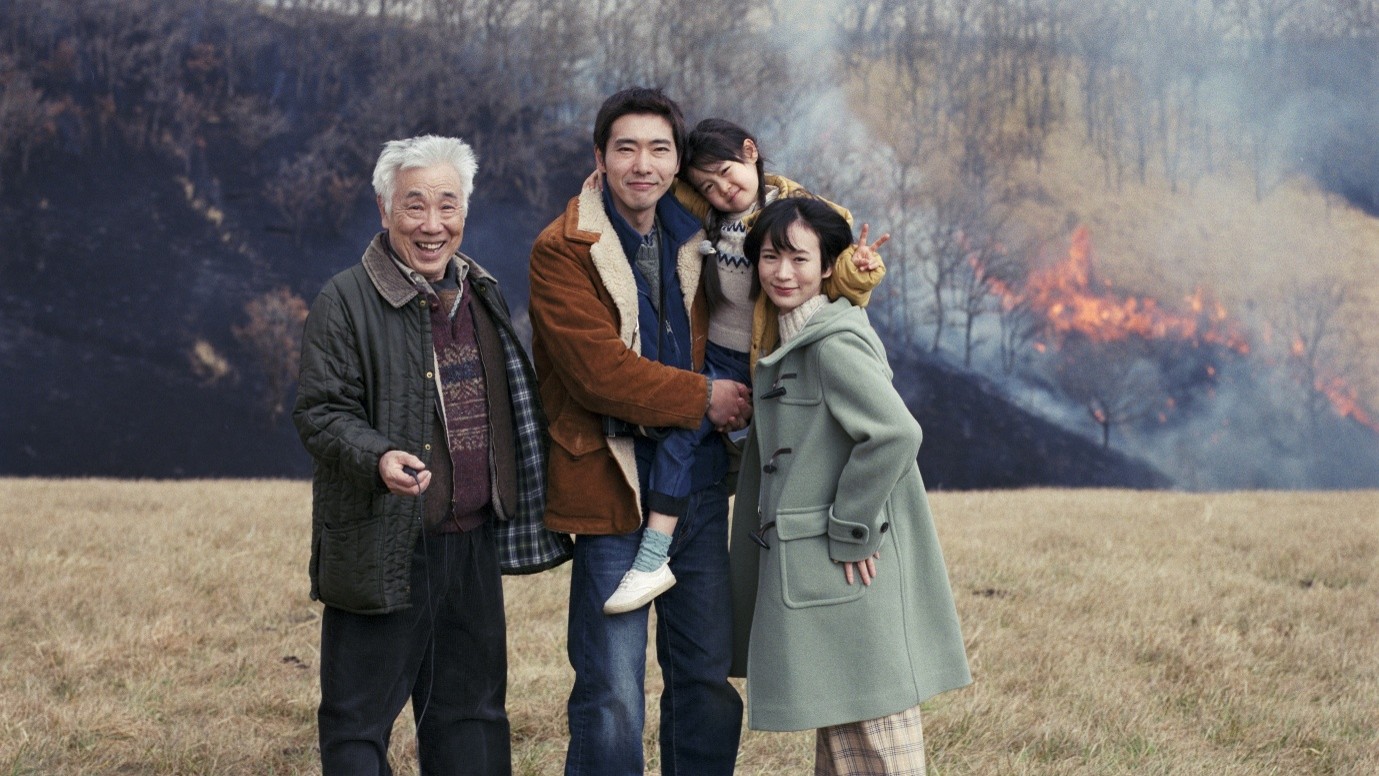
We see Makoto going about his work. It’s humble stuff, but even when he has to take mug shots of a class of kids he does it with a twinkle in his eye. “Grin!” he commands, and a timid boy beams. His magic makes a stiff bridal couple relax into laughter. Photos are everywhere in this film. Framed ones hang from every space in Makoto’s flat while back in Tokyo; Yoki acts as translator for visitors and sense they always long for someone to take a group shot.
Indeed this is very much Sakanishi’s philosophy. What interests him, he has said, is the “accumulations of minor moments in time,” moments we tend to forget, his aim being to capture “an everyday, ordinary stretch of time visually.” He names among his influences José Luis Guerín and Abbas Kiarostami. But there is something too of Terence Davies here in his faith in the power of the image.
Music plays a part too, with an appealing soundtrack used sparingly between periods of silence or ambient sound.
The pace is deliberately slow as Yuta stops and observes quiet scenes in this remote place. He sits to eat a sandwich beside a field beneath a mountain. All we hear is the wind in the trees. Standing in the golden field, is an old farmer beside his horse. Seeing him, the old man stands erect, doffs his hat and formally bows. Yuta responds in kind. Nothing more happens. It’s something Yuta might instantly forget, but the film suggests the hidden richness of such moments. When the film returns to the same field a second time, we feel the joy of recognition as the farmer again waves and bows. So it’s a shock on a third occasion when we see the farmer isn’t there. Yuta waves instead to the chestnut mare, slowly approaching to stroke it.
Nothing is said. Nothing needs to be said. But we sense Yuta’s anxiety every time he returns to Makota’s apartment and is greeted with silence. The sense of things coming to an end pervades the film. But in this celebration of simple things, it is pleasure that predominates over melancholy. Hearing of the death of an old friend, Makoto goes to the funeral bearing a framed photo of him. Picking him up later from a restaurant, Yuta is surprised to find the funeral party all having a grand time chorusing karaoke songs. Life, in Memorizu, is full of unexpected joys.
Of the tiny cast, Tasuku Emoto, Moeka Hoshi and Issei Ogata are outstanding as Yuta, Yuki and Makoto. There is a brilliant final sequence in which Makoto gives Yuta a slide show. Still images of Yori as a child with her mother blend with others in which Yori is now the mother, Hana the child. Implicit is the contrast with modern habits: we’ve seen Yori scrolling through a thousand photos on her phone. When we see Yuki suddenly moved to recognise the country lanes in Makoto’s slides, it’s a perfect example of Show Not Tell. For those lanes are familiar to us too – we’ve seen Yuta over the months on his daily walks there with Komugi the dog. Memorizu makes us feel alive as if for the first time to the magic of memory.
MEMORIZU received its world premiere at the Tribeca Film Festival.
The Reviews Hub Star Rating
-
10
