

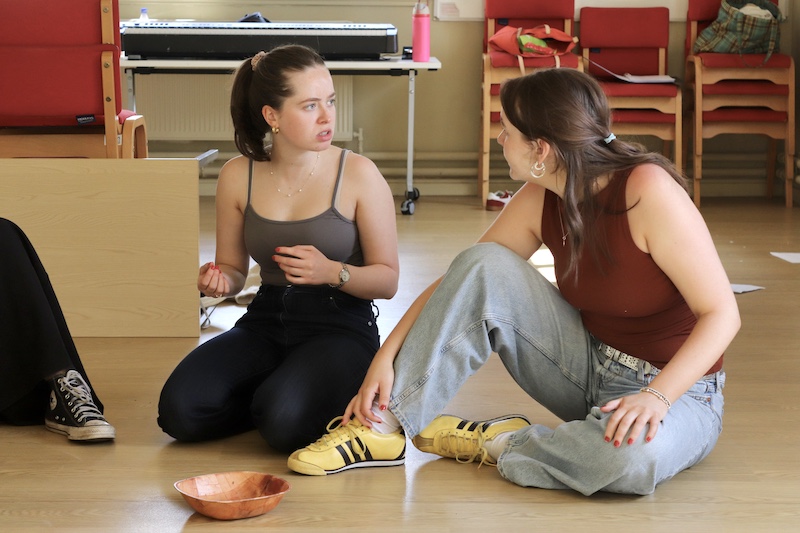
Writer and Director: Ellen Davies
Ellen Davies’ new play, We, The Women Wild, explores a world of women destroyed by a man and like Ava Pickett’s 1536 and to some extent Joan Lindsay’s Picnic at Hanging Rock, the growing influence of a man starts to unpick and actively poison a near-harmonious commune of female ‘sisters’ and ‘mothers.’ Performing at the Old Red Lion Pub & Playhouse, Davies’ world creation is exemplary for an hour show, a fully thought-through society with hierarchies, mythology and methods of control all built around a distinctive form of worship that offers the characters many potential directions as the young women question the society they have been born into.
Rayah (Grace Hey) and Rovine (Emma Cavell King) enjoy an innocent connection, a tactile friendship full of kisses as they spend their days alone undertaking their chores for their commune. But their closeness is shaken when two decisive events start to tear at the truths they rely on: their beloved Mother Elder becomes too sick to continue, and they stumble across a man for the first time. Keeping him secretly captive, the innocent victim becomes the aggressor as the loyalty of all of the women is eventually called into question.
Davies’ idea of a happy tribe of women spoiled by a man offers a reverse Garden of Eden narrative that plays out nicely through the two tracks of the story. Having established the routines of the commune, the writer-director seeds some trouble in this seeming paradise as power play comes between the characters with the succession of a new, younger Mother Elder, who is not welcomed by the whole group. This is bound up with the theme of mothers and daughters that anchors this community and looks at the loyalties that arise from blood ties and those based on the adoption of motherless children, about which there is more to say.
Similarly, the younger girls are fascinated by the ‘world beyond,’ a point in the forest that leads to the world we know, from which they have been entirely shielded, driving some of the reckless character behaviour as women like Anya are drawn to the strangeness of the man they find and the escape he represents. All of this suggests pre-existing tensions in this group, lots of unanswered questions as the curious women pull against both the discipline imposed on them by the elders and their more compliant friends.
The role of the man is also well worked through in a story where the heroes and villains are never clear, everyone behaving in complex ways, so their true motives and desired outcomes alter audience perception of them as the story unfolds. “I’ve been burdened by the knowledge of men my entire life,” the departing Mother Elder concedes (and could almost be Blanche Dubois), a fantastic line that will bring a note of recognition for many, but Davies smartly uses the male figure to bring out the paranoia and manipulation under the surface of this community, which is sundered by his actions.
Do the young adult women ever wonder why no new girls are added to the community? Nera, at 13 years old, seems to be the most junior member. What happened to the men who conceived all of these young women? What is the expectation of the Mother Elders in prolonging their community if there can be no more children, and what if they had boys? Some more investigation of Rayah’s anger would be helpful, and why her first resort is violence and conflict, while someone like Anya is kindly and inquisitive.
This is a really great first draft, but there is a little more work to do on character behaviours and, whether this is conveyed to the viewer or not, some more individual backstory for these wild women.
Runs until 30 May 2026
