

Writer: Jamie Radford
Director: Sapphire Shoferpoor
Skilfully set in motion just before the 2026 US World Cup, Jamie Radford’s revelatory new play is a dynamic, incisive and heartfelt take on the notorious fraternal feud between Bavarian businessmen Rudolf (Rudi) and Adolf (Adi) Dassler, whose hugely influential brands Puma and Adidas have shaped sport globally. The brothers’ revolutionary footwear designs, customised for different sports disciplines like never before, helped to give decisive winning edge to legendary figures like Jesse Owens, Pelé and Muhammad Ali.
Sprinting through a vast arena of Dassler folklore, rumour and conjecture – the brothers always lived their lives at fever pitch – Radford has wisely chosen to focus the action on just one (albeit long) night: 21 December 1947. It’s a date special to the Dasslers because their dearly departed father loved its optimistic significance: “We are gaining time… down on the bottom looking up.”
The family has gathered for their usual solstice / pre-Christmas revelry in the close confines of matriarch Pauline’s house, set above the workshop housing her laundry business that gave way to the brothers’ passion for sports shoe making and selling.
There’s pressure to go out and celebrate, but Adi is still anxiously testing and tweaking his designs. He knows it’s a pivotal time in sporting history: the run-up to London’s 1948 Olympics. In the wake of WWII, Germany has not been invited to participate, but the brothers may have an opportunity to supply the US team, continuing an association that began in 1936 when Jesse Owens won four gold medals at the Berlin Olympics wearing hand-crafted Dassler spiked shoes.
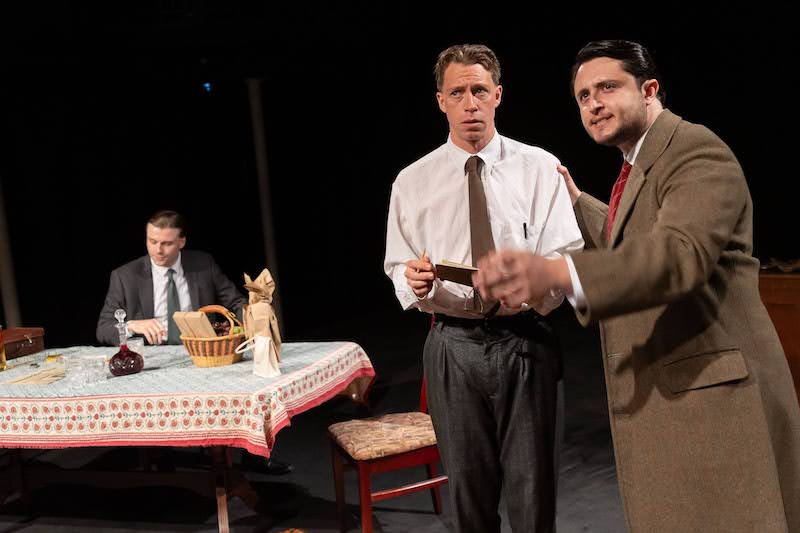
Lawyer Hans Schmidt (played here with impressively forthright volubility by Matteo Caporusso) has been negotiating with the Americans on behalf of the brothers, but arrives on the 21st bearing challenging news: the US committee is demanding that the Dasslers must streamline their operations under the control of one brother alone; Adi and Rudi having caused confusion and delays by issuing conflicting commands.
This brutal ultimatum gives the brothers until 6am to agree on a way forward, precipitating a series of internecine rows between Rudi and Adi, their respective wives Friedl and Käthe and domineering matriarch Pauline. Accusations, bile and venom fly with the voicing of long-suppressed resentments and secrets, giving the main cast ample opportunity to present their characters in full.
Edward Tarling is suitably obsessive and flustered as Adi, constantly testing and tweaking his designs – “We need to tighten the thread pitch by a millimetre!” – in pursuit of optimal performance. Bullied by his brother and hectored by his wife, he cuts a cowed figure that descends into stuttering inadequacy when put on the spot and forced to make decisions.
Supremely confident, clean-cut and preening – he keeps smoothing his Brylcreemed hair – Finn Samuels is particularly convincing as suave, womanising salesman Rudi. His strident sales pitch into a mirror / the audience is one of the highlights of the play: “This isn’t just a shoe company: it’s a revolution!” Samuels makes it clear that Rudi has been hardened by action and internment in two world wars: he treats everyone apart from his mother briskly and pitilessly, attempting to browbeat both his wife and Adi into submission.
In a brief but poignant appearance, nightgown-clad Anne Rutter as Pauline Dassler effectively conveys the imbalance of her affections for the two boys, petting and fussing over clear favourite Rudi as Adi hovers agitatedly in the background. She lays bare the deep roots of Adi’s jealousy, displays all the overbearing narcissism inherited by Rudi, and criticises the strident Käthe: “Before you came, the boys got along.”
Dressed in a tight scarlet dress and brassy blonde, as befits a frowned-upon daughter-in-law, Lula Marsh portrays Adi’s ambitious wife Käthe with force and clarity. Showing genuine loyalty to Adi, she encourages him to stand up to his brother – “Tell him it’s your company, and you’re not going anywhere!” – but is also ruffled in Rudi’s presence, suggesting previous, unresolved interplay between them.
Siân Elissa initially plays Rudi’s wife as Friedl as a no-nonsense hausfrau who acts largely as an anchoring, conciliatory figure, deftly shifting emotional tone as she reveals Friedl’s depth of feeling for Rudi, and her dissatisfaction with his path in life as she reads out a long, unsent letter to him: “How can it be home without you? I want to go walking in Bavaria and clasp your hand.”
One of the play’s most notable aspects is the ways in which it examines post-war German attitudes to defeat, politics, the horrors of The Holocaust and economic reconstruction. Käthe shudders at the concentration camp films the occupying Allies make the townspeople watch, and the members of the Dassler family are clearly reluctant even to mention the word ‘Nazi’, aware that the mere suggestion of allegiance could shatter their prospects.
The one-night framing of the Dasslers’ story is sensible given its sprawling, multi-generational nature. It does mean, however, that the piece is a little exposition-heavy at times, and many striking events such as Rudi’s dealings with Pelé at the 1970 World Cup are absent or rushed through after the slightly abrupt ending. But even at this early, experimental stage of the play’s life cycle, it’s highly impressive: well-written, fast-paced and compelling.
Reviewed on 23 May 2026
