

Writer: Shelagh Stephenson
Director: Karen Traynor
Shelagh Stephenson was born in Tynemouth and, whilst creating work that has been produced both nationally and abroad, has a long-standing relationship with Live Theatre. Astell & Woolf is the third play in her Cullercoats Trilogy to be produced there, following A Northern Odyssey and Harriet Martineau Dreams of Dancing.
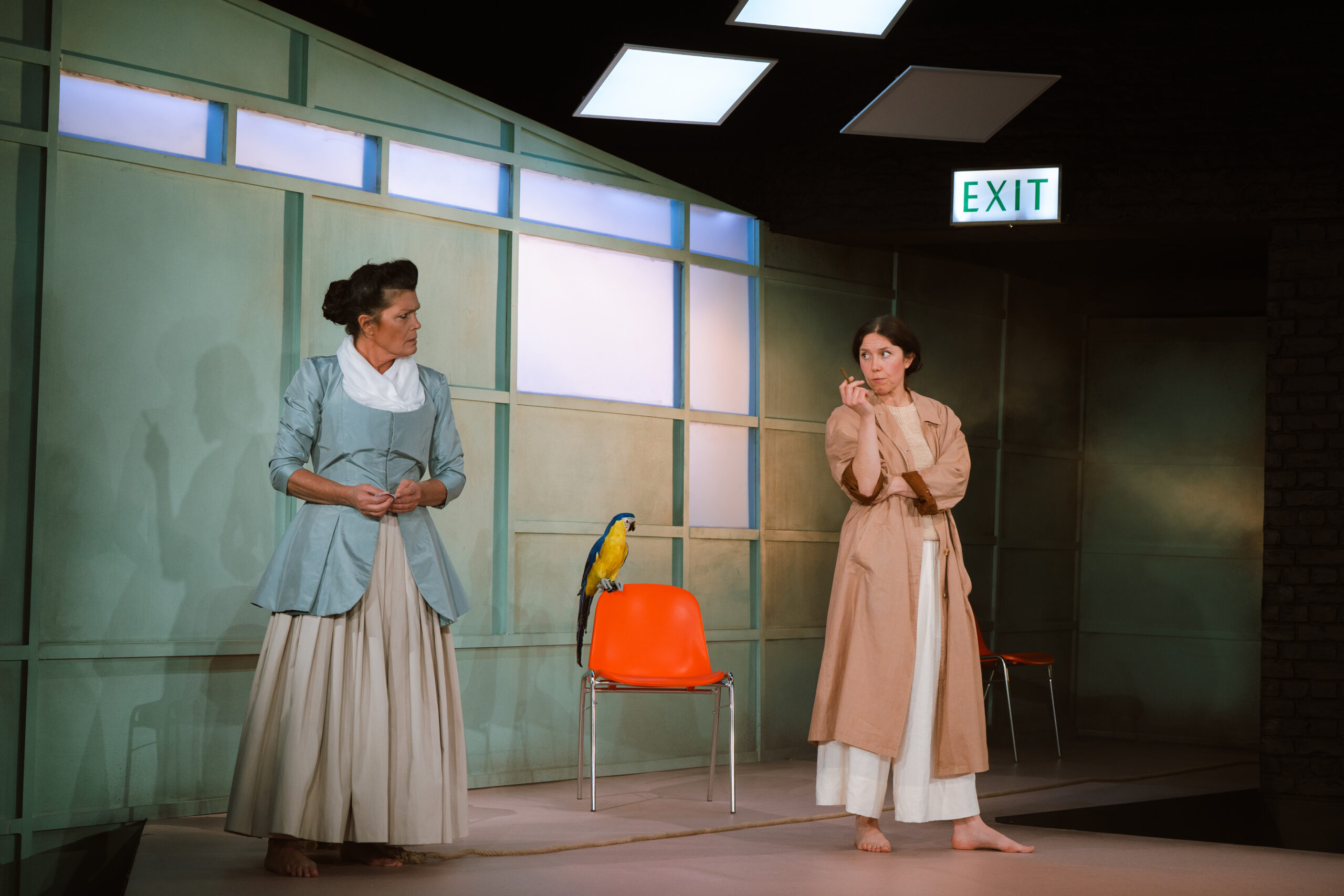
The play is set in a bleak, characterless waiting room in the afterlife, where Mary Astell, a Newcastle born writer and philosopher from the late 17th century, often described as the first feminist, is shackled by a rope to an exit. We are meant to perceive that she is being drawn inexorably into oblivion. Meanwhile, she sits knitting and complaining about the shortcomings of the afterlife in comparison with her expectations as a devout Christian, her only companion a stuffed toy parrot.
She notices the novelist Virginia Woolf passing by, and calls her in. Woolf is still a highly celebrated author and an influential thinker. She is therefore free to roam, with no fear of the oblivion that threatens Astell. Amusingly, she has a stuffed toy spaniel. Neither woman can get rid of the toy animals and they conclude that they are transitional objects, meant to give them comfort by recalling their earthly lives. Tellingly, each toy is slightly wrong compared to their real-life counterparts, and they seem to provide little of the intended consolation.
What follows is a dialogue on human relations, philosophy and feminism. The contrasting characters of the two pepper the account of how, and to what extent, the treatment of women has progressed in the 200 plus years since Astell published her books advocating the equal education of women and giving some revolutionary views on marriage and its desirability, or lack thereof, from a woman’s perspective. From time to time, women’s voices are heard coming from the exit, singing plaintively, a sound that unsettles them both.
Tessa Parr’s Virginia Woolf is piquant, vivacious and satirical, in contrast to Philippa Wilson’s more hidebound Astell. They clash on the subject of religion, and their attitudes betray their times of origin, but they find common ground in their evangelical zeal for the advancement and support of womankind.
After asking a departing Woolf to try to find scissors to cut the rope shackling her and to bring back a bottle of liqueur, Astell submits herself to the distant voices and goes into a primitive, atavistic dance, which closes the first half.
Opening the second half, Astell meditates on an Albanian tribe that compels women either to marry a man selected for them or to entirely forswear marriage and, effectively, their femininity. This is one of the analyses of the oppression of women by the patriarchy that run through the play.
Woolf returns with a Waitrose carrier bag, containing sherry and crisps. That it is Waitrose chimes with a thread whereby the undeniable elitism of both women undermines their effectiveness as advocates for women in general.
The two women get drunk and become more outspoken. Woolf poignantly describes the abuse she suffered at the hands of her stepbrother. Astell seems to reach an accommodation with her religious faith in the face of their discussions and her current plight. Driven by the voices of the unseen women, they improvise an attack on the rope. The denouement, though undeniably valid, seems inevitable and as such, packs less of an emotional punch than probably was intended. We are left with the tragic reminder that many women are no less oppressed today than at any time in history.
The dialogue is highly literate, persuasive and witty; laugh-out-loud funny and profound by turns. The actors contrast and collaborate to great effect, creating believable and involving characters, and illuminating the complex and layered script with great skill. Largely, this is a philosophical discussion in the form of a play. It is a testament to Stephenson’s writing, as well as the flawless performances of these remarkable actors, that it entertains and engages so effectively.
Runs Until 6 June 2026
The Reviews Hub Star Rating
-
7
