

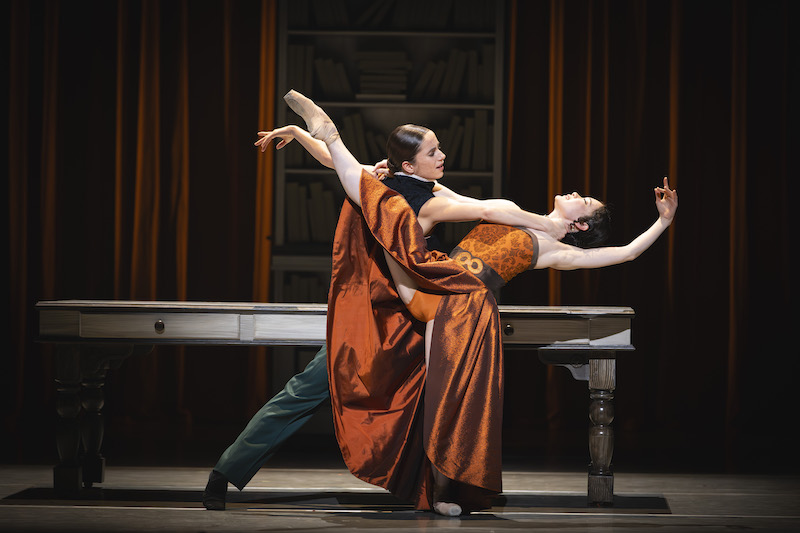
Choreographer: Annabelle Lopez Ochoa
Composer: Peter Salem
Yorkshire-born Victorian Anne Lister was certainly unconventional. Given to dressing in all-black suits more commonly worn by men, she was insistent on dealing with the estate she inherited from her uncle on the same terms as the local businessmen. Coupled with her affairs with women, she has some claim to the description some have given her as “the first modern lesbian”.
Lister was also an expansive diarist. Written in code, the diaries’ five million words include descriptions of Lister’s identity and affairs, as well as national events and her business interests. It is partly due to these diaries that Lister has become so well-known; in recent years, TV writer Sally Wainwright took the diaries and several academic studies of Lister’s life to create two series of the biographical drama Gentleman Jack.
Northern Ballet’s new work credits Wainwright as a creative consultant and, not altogether unexpectedly, uses a similar dramatic arc as Wainwright’s first season. When Gemma Coutts first appears as Anne, though, one of the most noticeable elements is that her character’s preference for all back clothing is complemented by some deep greens, both in her trousers and the lining of her tailcoat.
Annabelle Lopez Ochoa’s choreographic language accentuates Anne’s masculinity, ensuring that she shares the forceful fluidity of the men of the local town. Led by George Liang’s Rawson, the menfolk reject this interloper despite her moves being the perfect complement to her own.
The women in Anne’s life have a different cadence to their dance. When Saeka Shirai, playing Anne’s first true love Marianna Lawton, first performs a lover’s pas de deus with Coutts, Anne’s own dance style softens slightly, with Marianna rising to meet her. Their movements have a graceful strength that is different from what has gone before – and is markedly different from the more rigid balletic moves that Shirai plays as Marianna recedes from Anne, turning instead to a more traditional, heterosexual marriage.
Christopher Ash’s lighting and set design propel us from location to location across Yorkshire, including some ingenious use of portable video walls whose displays move in time with the rate at which they are pushed along the stage, looking as if they are portals into the past. Anne’s love of striding across the moors at a rapid pace is achieved by the use of a small treadmill, which stays just the right side of ridiculous while still being the weakest part of the evening’s presentation.
Even more abstract are the moments in which Anne loses herself in her diary writing. The stage lights up with her encoded texts, and the corps de ballet becomes personifications of her words, giving us the sense that it is only in her writing that Anne really feels safe. That is, until Ann Walker arrives on the scene. As Anne’s new love, Rachael Gillespie offers a third, very different view of femininity in dance from Shirai, and again elicits changes in style from both her own character and Coutts’s as they find one another.
As the couple’s story reaches its zenith, with a marriage ceremony (in reality, Lister and Walker took communion together and thereafter considered themselves married, even though it would be some 180 years before same-sex marriages were legal), Anne expresses some traditionally feminine attributes for the first time. Her long tailcoat is replaced by a leatherette tutu-like peplum, and both Coutts and Gillespie dance en pointe for the first time as they celebrate their union.
This all plays out to some truly gorgeous new music composed by Peter Salem. The classical sound of the orchestra occasionally veers into more modern arrangements – some electric guitar creeps in as Anne is forced to deal with her rage following a homophobic attack – but overall it is as sweeping a score as one could hope for in a ballet.
There is a sense that Lister, a woman whose life was illuminated for us by all the words she left behind, only affords us a glimpse in this dance adaptation of her life. But the storytelling in choreography and performance leaves us in no doubt that, as well as bringing the first modern lesbian back to life in a defiantly queer way, Northern Ballet has created a piece of theatrical excellence that speaks to everyone.
Runs until 23 May 2026
