

Writer: Bertolt Brecht, translated by Anna Jordan
Director: Ellie While
When Bertolt Brecht wrote Mother Courage and Her Children, he set it within the Thirty Years’ War, which ran from 1618 to 1648. But he was writing in 1939, so a much more modern attitude to warfare must have been closer to mind.
And wars have remained with us ever since. Anna Jordan’s translation, first performed in 2019 at Manchester’s Royal Exchange Theatre, transposes the action to a nebulous world where the warring factions are the Blues and the Purples. A third force, the terrorist Oranges, makes their presence felt later on. This abstraction makes the setting feel even more contemporary: references to a war based on territory and resources, with military figures spouting Biblical rhetoric, feel remarkably prescient of the current US-Iran conflict. Meanwhile, references to drones suggest the war in Ukraine. The parallels all too sadly abound.
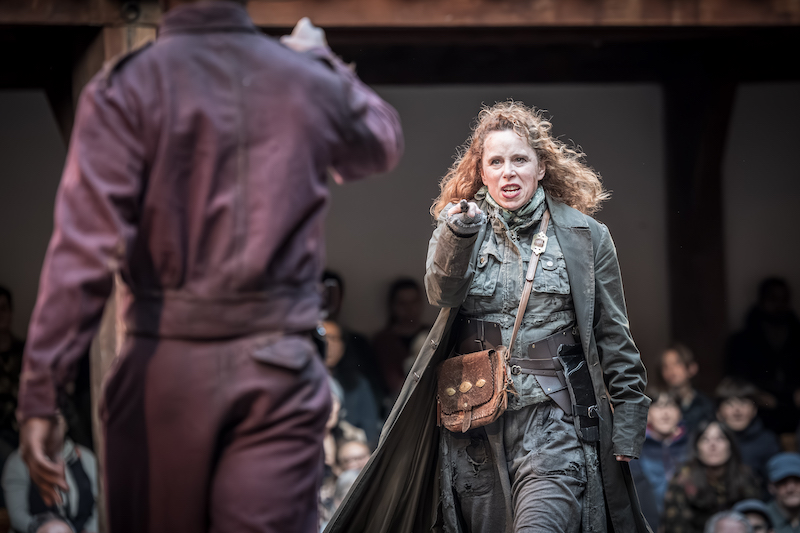
But beyond that macro view of powers at war, Mother Courage is a portrait of people striving to survive at whatever price. The Globe’s artistic director, Michelle Terry, plays the titular antiheroine – a permanent chancer turning her hand to providing anything, to either side, that provides enough money for sustenance for her and her three children – as a cross between Fagin, Del Boy and Nancy Sikes. It’s a performance one can quite imagine is a tribute, in part, to Joan Littlewood, who played the role in its London premiere in 1955.
It’s a powerfully robust performance, starting off jocular but failing to hide much of the tragedy and fear within. As she flits between money-making schemes (selling armour that’s not quite as protective as she claims, providing food to hungry troops, running a brothel), she and her three children – Vinnie Heaven’s Eilif, Rawaed Asde’s Swiss Cheese, and Rachelle Diedericks as the mute Kattrin – haul a rickety caravan around designer takis’s circular track of set, which extends well into the space normally given over to the Globe’s audience of groundlings.
That stage extension brings the sense of war even closer. Gunfire, sirens and more come from all around, emphasising how there is no escape from the effects of war. Brecht eschewed realism so that his audiences would be forced to consider the play’s message, and both Jordan’s adaptation and director Ellie While bring the same ethos here.
That is reinforced by James Maloney’s songs, which sprinkle in echoes of Kurt Weill with elements of folk and honky-tonk jazz. Often jarring in the best Brechtian way, there are opportunities for tenderness, too: in one particular affecting moment, Heaven sings a song his mother (from whom he has been estranged for two years) taught him; Terry joins in with a sad counter-harmony, Mother Courage hearing her son in the next room but unable to go to him.
Rivers of emotion run through this work in ways that one does not typically associate with Brechtian performance. Diedericks, in particular, is put through the wringer and takes us along with her tragic story. This is a production that does not shy away from the horror of what happens in war – Katrinn is raped and has acid thrown in her face (the latter action, her mother brutally notes, is more likely to ensure the former never happens again). When Ferdy Roberts’s minister laments that war makes good men do horrible things, the doubt hangs in the air; nobody believes such men were ever good.
As the action proceeds, Terry’s powerful portrayal of Mother Courage deepens. The effects of war run deep on her, too. Dehumanised to an extent that she rails against a ceasefire – she has just pivoted into arms sales, so peace threatens her income – she is no heroine. What she is is an everywoman: however hard she tries to get through war unscathed, she bleeds every bit as painfully as anyone else.
Runs until 27 June 2026
