

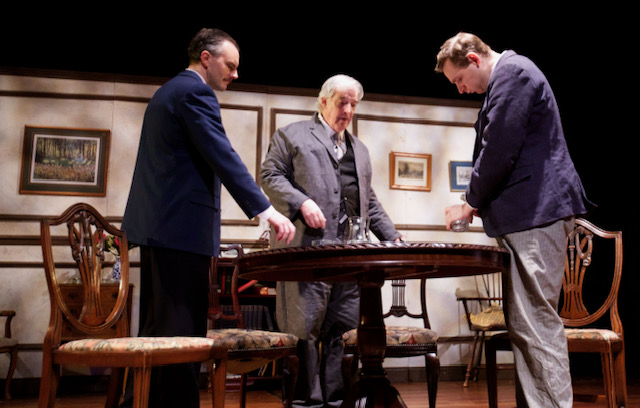
Writer: Eugene O’Neill
Director: Jake Murray
Eugene O’Neill was a towering figure in American drama. Harnessing the form of dramatic realism, so often associated with Chekhov, he wrote over thirty plays, winning a total of four Pulitzer Prizes over his long career. Long Day’s Journey Into Night is his most autobiographical piece, with the thinnest of veils thrown over his own family, so much so that he insisted it not be performed until 25 years after his death in 1954. In fact, it was performed only three years later, winning the Tony for best play and the Pulitzer Prize. It is frequently referred to as one of the greatest plays in the American theatre.
Set in 1912, the script forensically dissects the tensions and weaknesses of a family of four over a day and night in their shabby summer home. James Tyrone is an ageing matinee idol, still touring the same tired star vehicle that made his name. His miserly nature, born out of a childhood of crushing poverty as an Irish immigrant, oppresses his entire family and may have led to many of their personal troubles. He is a heavy drinker, breaking down under disappointment over his unfulfilled potential as an actor.
His wife, Mary, is a depressed morphine addict. She has recently been discharged from a sanatorium, and the family are watching her like hawks to see that she doesn’t relapse. Her addiction, we are told, came about because of her illness after the birth of her youngest son and Tyrone’s hiring of a cheap quack doctor to treat her. Her inability to conquer her addiction is rooted, however, in her discontented life, isolated from her friends and her stratum of society by marrying an actor. She consoles herself with memories, real or imagined, of her more genteel upbringing, her convent school life and wistful thoughts of becoming a nun or a concert pianist. That she escapes being absurd is down to O’Neill’s detailed and empathic writing giving her three dimensions.
Her older son, Jamie, is an actor, living in his father’s shadow. He is full of bitterness about his father’s meanness and self-deception and also riddled with self-loathing. He eases his pain with alcohol and whoring and has disgraced himself publicly enough to further isolate the family.
The younger remaining son is Edmund, the cipher for O’Neill’s younger self. An aspiring poet and writer, he has been a discontented wanderer and a seafarer for some years, as O’Neill was. Having returned to the family, he is now seriously ill with suspected tuberculosis.
The only actual events of the play concern the confirmation of Edmund’s diagnosis and Mary’s relapse into using morphine, detaching her more emphatically from reality as she struggles to deal with Edmund’s illness and Jamie’s behaviour. Over the course of the day, numerous bottles of whisky are consumed by the three men as they, ironically, discuss her addiction.
Scene by scene, progressively all pretence and politeness is stripped away. The beleaguered Tyrone describes his desperate childhood and Edmund counters, in one of the few clumsy lines of the play, by asking if he wants to hear his memories. Unsurprisingly, his father is looking for the cheapest sanatorium to which he can be sent for treatment. Jamie comes in, roaring drunk and smelling of the whorehouse, to deliver a stinging character assassination of the whole family, with the harshest diatribe reserved for himself. Mary then enters, doped to the eyeballs and, completely cocooned in her past, delivers a poignant stream of consciousness that brings them all to a despairing silence.
At over three hours, this play is a big ask, both for actors and audience. The actors must negotiate a complex and layered script, maintaining conviction through its contradictions and changes of mood. The award-winning Elysium Theatre Company, under Jake Murray’s assured direction, are generally up to the task. It is unfortunate, though completely understandable, that the withdrawal of the original actor playing Mary has necessitated her replacement, Joyce Branagh, performing book in hand. It is a testament to her quality that this intrudes as little as it does. Her initial hesitancy gives way to greater assurance as the evening progresses and her final monologue is masterful.
Danny Solomon makes the most of the acerbic Jamie, skilfully negotiating the clashing contradictions in character and dialogue and painfully believable in his drunkenness. Dan Bradford also deals well with the less rewarding role of Edmund, though he seems somewhat too vigorous to make his illness believable. Macy Stasiak does a great job of providing much-needed light relief as the Irish maid.
The role of James Tyrone is perhaps the most challenging, needing a commanding presence to make this semi-monstrous character believable. Edmund Dehn shows intelligence and nuance in the role but the cracks in his assured façade are already visible from the first line, thereby forestalling his character’s journey, and one might look for more robustness in the exchanges with his sons to maintain the dynamic of the play. Of course, one should not underestimate the impact the production’s difficulties may have had on this small company from whom so much is demanded.
Touring until 30 May 2026
The Reviews Hub Star Rating
-
6
