

Book and Lyrics: Richy Hughes
Music and Lyrics: Tim Sutton
Director: Lynette Linton
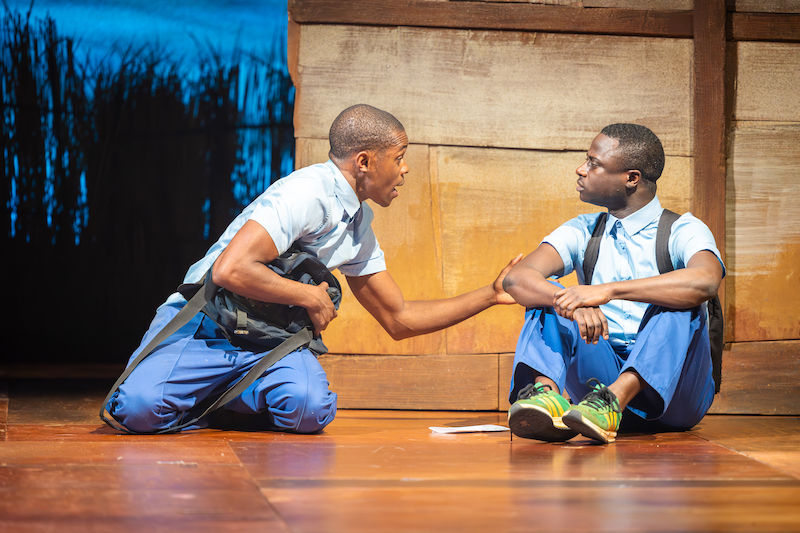
When true events are transmuted onto the page, then into film, and finally onto the stage, there is an inherent risk that somewhere along the way, the soul of the story gets lost during the adaptation process. The risk with a musical is even greater because its set pieces should spur and elevate the narrative rather than break it up. Lynette Linton’s The Boy Who Harnessed the Wind, first a memoir by William Kambwamba, Bryan Mealer and Potboiler Productions, then a film starring Chiwetel Ejiofor, and now a musical, masterfully avoids these pitfalls by using music to propel the tale and using the tale to propel the music, rather than holding the two separate. The Royal Shakespeare Company’s production is a soulful, colourful, and uplifting example of how musical adaptation can bring a story to new heights, layering in a new dimension for a pre-existing tale.
This is a story about famine and family, about invention and innovation, and perhaps most importantly, about the value of education in a village where the immediacy of basic needs pushes learning to the periphery. It is the story of William Kamkwamba (played by Alistair Nwachukwu), a young Malawian boy who is denied access to schooling and resources due to a lack of family funds, during the very period in which his education in science and electronics could be most valuable to the community.
With a famine on the horizon and limited access to water for crop irrigation, William believes the secret to salvation lies in being able to pull his village out of energy poverty with a homemade wind turbine. But this is a tale not just about the realisation of William’s scientific ambitions: it is also the story of a community. Interwoven in the main narrative are little subplots, including the ascent of his friend, Mofat, to chieftainship, the romance between his sister, Annie and one of the school’s teachers, and the dynamic of a village increasingly put under strain.
So, although the play is eponymously titled after its main character, it never loses track of the community spirit which underpins both its messaging and its chorus. At its core, this is a story about the residents of Wimbe, in Malawi. It is breathtakingly brought to life by Frankie Bradshaw’s set, which repurposes the theatre-in-the-round of @sohoplace, deploying foliage, wooden buildings with corrugated iron roofs, and a dynamic stage to situate the audience in the location.
The atmosphere is further aided by a carefully curated wardrobe from Kathy Richardson-Howell, whose usage of bright colours and rich patterns is a fixture throughout the performance. The set is changeable and fluid, allowing it to be deployed dynamically: a farming scene is enabled by lifting up panels on the stage to reveal the soil beneath; at other times, a lightshow (designed by Oliver Fenwick) is projected onto the buildings to represent the inner musings of a mind at work. These simple innovations further draw the audience into the façade of the performance.
The jewel at the heart of this crown is, of course, a talented cast whose delight in the soul of their performance is contagious. The audience initially meets them as friends: the play begins with the actors slowly infiltrating the stage, going about their daily routines and interacting with the audience as if we were part of this bustling market scene. This disparate mass slowly converges into a single united chorus, bursting into song with the first number – Tagwirizana (Welcome Song). The message is clear: this is a community, and the audience are part of it. There are moments of comedy (Mofat’s gentle teasing of his best friend’s brilliance), moments of tragedy (Chief Wimbe’s fate), and moments of wisdom (chief among them, the dialogue between William’s father and mother during a pivotal moment for the family). Transitions between these moods are seamless: just as music blends into narrative, so humour becomes pathos.
There is a sense, perhaps, that the play takes a while to warm up: the start drags a little while we get to know the cast, and while we build a sense of the community in Wimbe. A bit of cutting perhaps wouldn’t have gone amiss; however, this is more than made up for by a riveting second-half, which benefits from all of the groundwork put in during the first.
As famine descends on the community, and the situation of the Kamkwamba family becomes more desperate, the stakes are raised. The play culminates in one of the most glorious set-pieces imaginable: having faced up to the scepticism of his father and fellow villagers who believe that only manual labour can raise them above their plight, William’s final redemption is majestic. Paired with the Malawian-inspired celebratory vocals and Jason Chowdhury’s percussion, it is a dramatic summit, more than justifying the play’s runtime.
The Boy Who Harnessed the Wind is a tale of scientific triumph over energy poverty: of a boy whose single-minded determination to move his community beyond energy-intensive agricultural practices leads him to mastermind his own, renewable solution. And while it’s a humbling reminder of the importance of equal access to modern innovation, the play itself is never moralising or sermonising, because, above all else, it’s a story of people and community.
Runs until 18 July 2026
