

Writer: Samuel Beckett
Director: Gary Oldman
In 1958, a new play by Samuel Beckett debuted at the Royal Court Theatre, as a curtain-raiser to the evening’s main event, the same writer’s Endgame. Nearly 70 years later, it is the turn of that play, Krapp’s Last Tape, to take the prime spot.
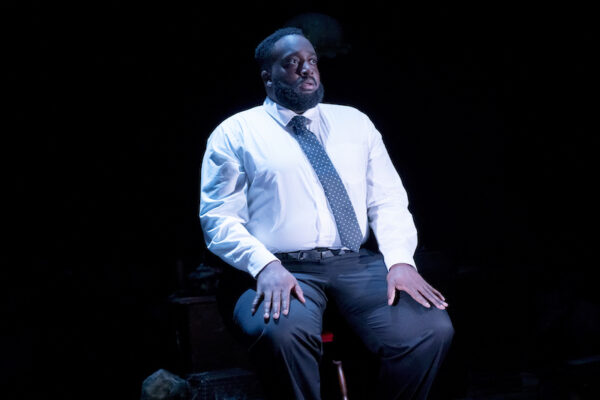
Image by Camilla Greenwell
This time round, the play is preceded by Leo Simpe-Asante’s Godot’s To-Do List, a Beckett-inspired piece in which a young man, Godot (Shakeel Haakim), is given a series of tasks by an unknown remote voice. Some of the tasks succeed, some fail; some trigger existential reflection, some just agitate. One can fully appreciate the symmetry in pairing a Beckett-like piece featuring a man only just embarking upon adulthood with a contemplative piece reflecting on a life already lived.
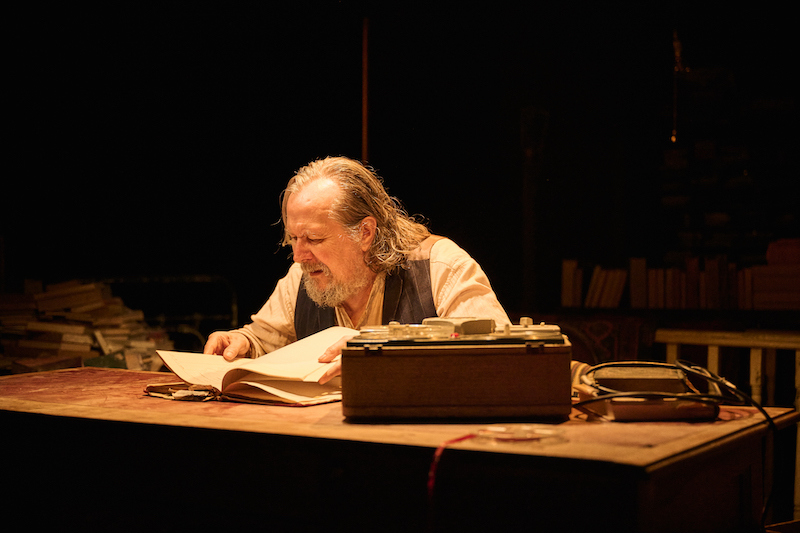
The man at the centre of Krapp’s Last Tape is someone who, on his 69th birthday, ventures into his cluttered, dimly lit attic, dusts off his old reel-to-reel tape recorder and listens to one of the tapes he made as a younger man. That tape, also made on a birthday, includes its own reminiscences of an even younger Krapp.
Each iteration of the man seems detached from the one before, a distillation of how we, as humans, are wont to look back on our past selves with a mix of wonder and revulsion. But there are similarities, too: on stage, Gary Oldman takes a delight in devouring banana after banana just as his younger self talks about doing the same thing.
Initially, Oldman’s onstage persona spends much of the first half of the play listening and reacting to the tape. It is a studied portrait of a listener, largely static but ensuring that every movement has intent and purpose. Later, as Krapp unearths an unused tape and extricates a microphone from the attic’s detritus, we get his new, latest – and very possibly last – contribution to his audio archive. Further memories, from fully-formed to near-forgotten, illustrate how, as another writer once said, the past is another country.
We get further snippets of tapes spooling and unspooling, all delicately lit as if solely by the pendant light hanging above Krapp’s desk. Malcolm Rippeth’s lighting designs help the detritus of the cramped, overflowing attic to cast shadows and hold secrets. Oldman (who also directs and designs this production) sits among a life accumulated, most of which now lies discarded and forgotten.
By the end, the light fades until only Krapp and the tape machine are visible. He places his arms around it; memories that are partly alien, sometimes disbelieved, but wholly accepted. Krapp’s Last Tape is an ode to memory, in whatever form that takes.
Runs until 30 May 2026
