

Writer: Hannah Khalil
Director: Chris White
Writer Hannah Khalil teams up with director and husband Chris White once again for this fictional comedy-drama at Theatro Technis.
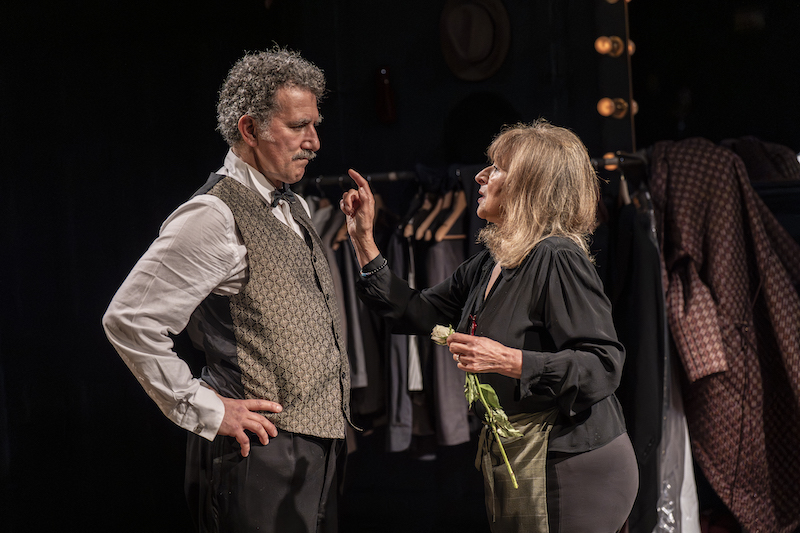
1983. Omar Sharif (Al Nedjari), legend of the screen, now past his peak, prepares for a role in Terence Rattigan’s The Sleeping Prince at the Chichester Festival. Mag (Lara Sawalha), his assistant director, enters on a pretence but lingers, and the play revolves around their conversations, a verbal sparring match as tense as one of Sharif’s games of backgammon.
New Order’s Blue Monday is an odd choice of song for the opening track. It is soon replaced with the more apt theme from Lawrence of Arabia, and the play gets underway. The setting and costumes are both time-appropriate and well done. The play is filled with slightly shoehorned references to Larry Olivier, O’Toole, Sir Alec Guinness, Beckett, Shaw, and other giants of the era. Although clumsy at times, this helps to set the scene.
It is no easy feat acting a man who was famous for being charming, charismatic and handsome. Johnny Flynn battled with and succeeded in capturing Richard Burton in The Motive and the Cue, but Jack Laskey failed miserably in trying to recreate T.E. Lawrence in Lawrence After Arabia. Perhaps it is unfair to compare those two plays. In any account, Al Nedjari is one of the few brilliant aspects of Love Omar perhaps summed up in the review that Sharif about his own performance reads aloud: “if he was nervous it did not show…subtle and succinct, compelling and capable in a role that honestly is not a great one”.
Lara Sawalha plays Mag, the assistant director. Mag is a confusing and unlikeable character. If that is how she is supposed to be represented, then Sawalha does well. Ishia Bennison plays Daphne, Omar’s dresser, and does a wonderful job. Bennison’s comic timing is great, and her character is thoroughly believable.
There are elements of a good play within this one. The themes of identity, nationality, and growing up in a post-colonial world with a mixed background are all thought-provoking and relatable, as indeed is the notion of using Sharif, the titan Arab actor of the 20th Century, as a mascot for orientalism. However, the play suggests Sharif never encountered, or had even heard of, racism in his life, which seems unlikely, and criticises him for not having ideals more in keeping with 2026. This feels unfair to the late actor. Perhaps Khalil’s next play will be a criticism of Elvis for not using enough techno in his songs, or Napoleon for his lack of drone warfare.
Runs until 6 June 2026
