

Writer: Joel Horwood
Director: Sean Holmes
The show blurb for Joel Horwood’s complex, ambitious, visually arresting take on Sherlock Holmes describes the piece as a new story. In fact, for the first half, the production leans heavily on Conan Doyle’s densely plotted 1890 novella, The Sign of Four. What is new then? Horwood positions the piece as a post-colonial critique of the entire rotten enterprise of the British Empire – racist, class-obsessed, avaricious abroad, and slowly decaying from within – and, by extension, current attitudes towards race and immigration. Newish, yes, though one cannot help feeling that the theme of greed and colonial entitlement in the Sherlock Holmes canon has been addressed before.
This is not to say there is no novelty in the always engaging production: stunning design and costumes, lashings of well-observed comedy, lions on bicycles, and the sight of a hot air balloon ascending above the stage of Regent’s Park Open Air Theatre, amongst other delights. Perhaps it is simply that Holmes has been so strip-mined over the years by theatre, film and TV, that ‘new’ will always be a relative term.
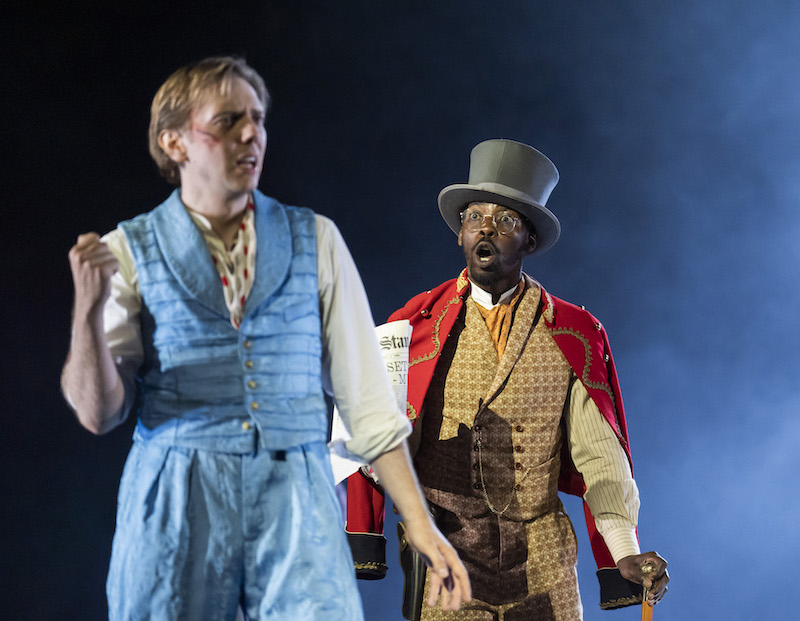
Horwood’s London is a dark, dystopian place. Political prisoners from across the empire rot in Wandsworth prison. “This isn’t a country, it’s a business with an agenda and a national anthem”, someone says. The business in question is the systematic plundering of subjugated colonies. Wild animals, looted from the far corners of distant realms, roam threateningly across Regent’s Park. Inspector Lestrade (a tremendous cameo from Will Brown) calls Sherlock Holmes (Joshua James) and Dr Watson (Jyuddah Jaymes), “Tweedle-dumb and Tweedle-dickhead”, and is not averse to punching the latter in the stomach when it serves his purpose. Mycroft Holmes (Patrick Warner) sits at the head of a sinister cabal of top-hatted, morning-suited civil servants whose business involves keeping the entire “show” on the road through “the performance of total control” and the systematic ‘othering’ of colonial subjects.
Grace Smart’s glorious metatheatrical set, a revolving red-and-gold music hall proscenium arch, picks up on the idea of the ‘show’ of empire. The arch, which, in the cleverly staged denouement, becomes Tower Bridge, is cracked, hinting that the entire imperial edifice is poised to collapse if only someone would take a stand against it. Rebellion is in the air, quite literally in the final scenes. It is in Holmes’s heart, too, if only the damaged, bitterly cynical man would recognise it, or even acknowledge he has a heart that can be reached.
James’s damaged slightly camp Holmes (“something of an Oscar Wilde type”, Marcia Lecky’s in-your-face Mrs Hudson tells us), eyes cast skyward, hands behind his back, and, bog-eyed from drug-addled days without sleep, is desperate for a new case. Into Baker Street walks Mary (Nadi Kemp-Sayfi), the illegitimate daughter of a native woman and a British Army officer. An anonymous benefactor has been sending her expensive jewels, year after year, and she wants to know why. The jewels, of course, are a metaphor for theft from the empire. Being mixed-race, Mary sits at the intersection of the oppressed and oppressor. Which side she chooses to take forms the meat and potatoes of a complex narrative, much of which you may choose to let wash over you in favour of the visual spectacle.
Dr Watson, attracted to Mary’s charms, urges Holmes on to investigate. Jaymes’s strait-laced Dr Watson, the evening’s star turn, is damaged, too. Not just by the bullet to his leg, though the limp may be psychosomatic, but by the feeling that being black, however much he buys into the myth of British imperial benevolence, he may never fit in.
Events take us to rural Berkshire, and a dastardly murder by poisoned arrow for which Mary is seemingly falsely accused. As an immigrant, Mary is always likely to face rough justice and soon finds herself facing the gallows. Holmes and Watson set about proving her innocence before the hour of her execution.
On the men’s journey, anticipate a visit to an opium den (there are hints that the evening may be taking place in Holmes’s mind), a cleverly staged river chase, a British Empire freak show in which foreigners are seen as oddities to be gawked at, and subplots involving stolen national secrets and an impending war. The empire may well be on the verge of striking back, and one cannot blame them.
Sean Holmes makes full use of the revolving stage and directs at a ferocious pace; one feels it could not be otherwise with so much story to get through. Neatly choreographed dance segments top and tail the evening. When not performing, the actors watch unfolding events from the rear of the stage, adding to the evening’s meta tone. This is not exactly new Sherlock Holmes, but there is originality here aplenty in an evening that looks and sounds tremendous.
Runs until 6 June 2026
