

Music and Lyrics: Tamiko Dooley
Book and Lyrics: Cathy Farmer
Director: Craig McKenzie
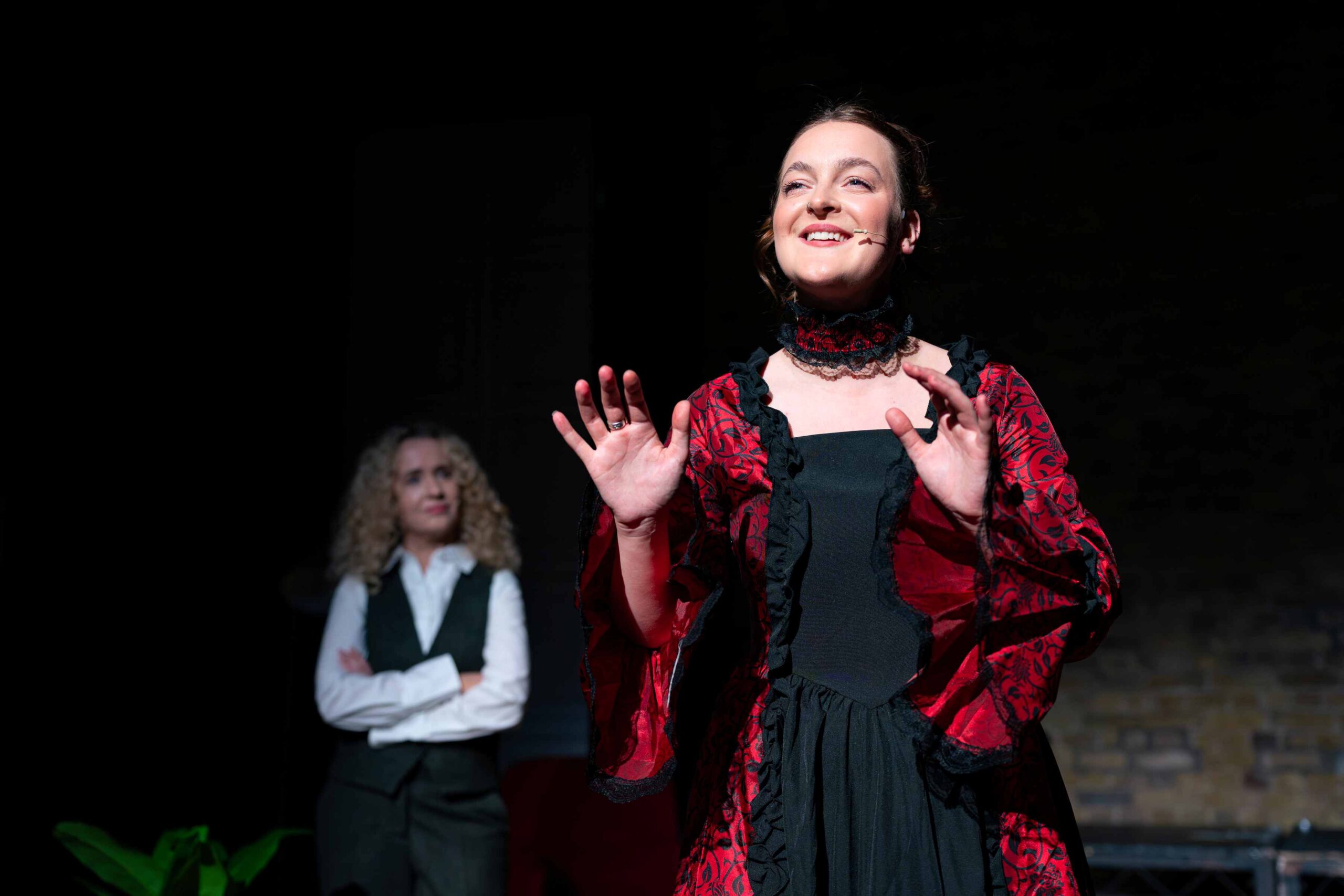
It takes only one woman to blaze a trail, and others will follow, and so it appears for empowering female-led musicals with Tamiko Dooley and Cathy Farmer’s Sylvia-inspired Flyology, which mashes pioneering historical women with contemporary technology. Arguably in workshop form with a bit of refocusing still needed, this 70-minute musical is packed with interesting metaphors about the structures that shape and confine women, the commercialisation of the patriarchy and the rousing call to arms needed to shake us all awake, and with a little finessing, this nascent show has plenty more to give.
Drawn into a virtual reality world designed by Callum to experience a better life free from bothersome emotions and anxieties, mathematician Ada Lovelace, composer Ethel Smyth and Suffragette Emmeline Pankhurst are set to be deleted. In order to return to their real lives, the intrepid trio must outwit Callum and the female computer he has designed, but with investors watching, the race is on to save or break the system.
Dooley and Farmer’s scenario building is strong, and the science fiction concept of the omniscient computer manipulating timelines and the characters it plucks from the past has plenty of potential. From Doctor Who’s many visits to the past as well as the Holodeck on Star Trek, the human need to experience better versions of the world while accessing the minds of a historic genius also feeds through Flyology. While the character of Callum could be colder, more self-absorbed and obsessed with his own perceived genius, the concept of emotions as a “system error” in people and the desire to create a place run on logic is a solid premise that should be expanded, the computer increasingly taking control of the action rather than sitting on the sidelines for most of the musical.
Beyond this, Flyology struggles a little to establish itself beyond the continual cheerleading for women’s freedoms. Ada Lovelace’s presence is necessary for its computational outcomes, yet the presence of Smyth and Pankhurst has far less purpose, and the show never uses either of their own talents to solve the problem the women are facing.
What the audience never understands is why these three women in particular, when there are any number to choose from. For the writers, the question is whether the musical would be any different if they had bought in Joan of Arc, Bess of Hardwick, Empress Dowager Cixi or Gloria Steinem to work with Lovelace. If the choice of Smyth and Pankhurst – two British women from the same era – is significant, then the musical needs to tell us why.
That same personality also needs to be better reflected in the composition, and currently, Flyology relies on too many overly traditional, emotional ballads and love songs, which is disappointing in a show about the political lives of great women. One of Sylvia’s most successful attributes was finding a rap and hip-hop sound that reflected the power of the message it was conveying, and currently, Flyology’s method misses the ferocity of the fight. Nor does it explore the quite different experiences of patriarchy in the periods these women lived. Ada’s society was not quite the same as Emmeline and Ethel’s, and nor should it be in the futurist construction that Callum creates. How have these structures changed, deepened or held firm in all of these eras that the women know, and how can the music help to convey that to the viewer?
There is lots to do, but there is a good basis here. What the characters in Flyology need to learn from Sylvia is that talking about change will only get you so far, so what is the direct action these women are prepared to take?
Runs until 08 May 2026
