

Writer: Fran Kranz
Director: Carrie Cracknell
Mass tells the story of two sets of parents meeting to confront the devastating aftermath of a tragedy that irrevocably binds their children. Anna Yates’ hyper-realistic design of an Apostolic church provides the ‘neutral’ ground for this encounter. The space is introduced through Brandon, a young church helper, as he semi-automatically clears up the empty mugs before Judy enters and meticulously prepares the room for what lies ahead. This slow opening underscores the significance of the setting as a facilitator of reconciliation, though it feels slightly overemphasised as it lingers, for instance, on details like the placement of Kleenex.
Once Jay and Gail arrive, however, we are hit with the weight of what is to unfold. Linda and Richard follow shortly after, and through costume alone, we sense the divide between these two couples. Yates’ design incorporates an almost imperceptible slow revolve, allowing the audience to sit with each performance and absorb the shifting dynamics of the conversation as the couples sit around the table. Guy Hoare’s lighting is equally restrained, heightening the intimacy of the most vulnerable moments and culminating in a striking image of sunlight streaming through the windows, which helps suggest a fragile, almost heavenly sense of closure.
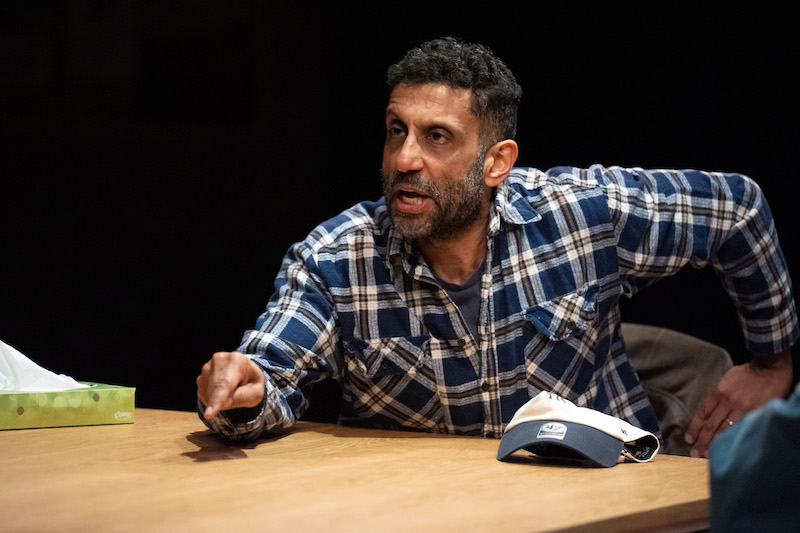
Director Carrie Cracknell navigates the tonal shifts of the dialogue with care, capturing how conversations around such trauma can pivot in an instant. Jay, played by Adeel Akhtar, is particularly compelling with his restrained anger that simmers beneath the surface before erupting into a heartbreakingly understandable outburst.
In contrast, Monica Dolan’s Linda arrives visibly nervous, offering Gail flowers in an awkward gesture of goodwill. Dolan brings a quiet empathy to the role, shaping not only Linda’s emotional journey but also how she connects with those around her. This sensitivity feeds into one of the production’s most affecting moments, as the two mothers find solace in each other. Lyndsey Marshal lends Gail a quiet strength and openness, while Paul Hilton’s Richard is more guarded, pushing back when confronted with the most difficult questions.
Fran Kranz’s writing refuses easy answers and instead sits in the uncomfortable grey areas of parental responsibility. The play probes the impossibility of tracing the origins of violence, the anguish of perceived negligence and the tension between unconditional love and the consequences of a child’s actions. At its best, Mass is a mesmerising fusion of incisive writing and extraordinary performances. Yet the overly protracted opening and a slightly underwhelming conclusion dilute some of its overall impact.
Runs until 6 June 2026
