

Writer and Director: Emma Bailey
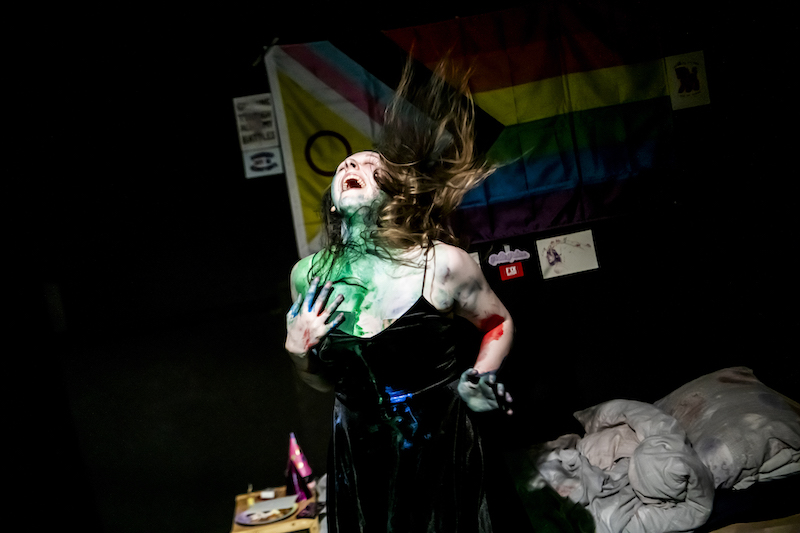
Emma is as much of a mess as her bedroom when we first meet them. On the morning of their 23rd birthday, we witness them struggle to get out of bed, dress, undress and dress again in anticipation of the party they’ll be hosting, and hand out party hats to the first rows of the audience.
As a queer, non-binary autistic performer, writer/director Emma Bailey is clearly playing a version of themselves. They are also aiming for extreme verisimilitude – much of their party prep involves no narration and just a series of mutterings that anyone might make to themselves. While accurate, it also keeps the audience at bay, so when Bailey expresses slight disdain that the audience may not be fully engaging, the muted reaction feels somewhat deserved.
And so, when an attempt at audience participation becomes ever more cringeworthy, the prospect of an audience member calling out the whole piece as self-indulgent seems inevitable. It is staged, though, with Ismael Akram emerging as the only friend of Bailey’s who has turned up for their party.
The same sense of self-indulgence does not let up, keeping the (genuine) audience out. The friends’ awkward-but-comfortable silences are sweet, but watching Bailey and Akram play some rounds of the card game Exploding Kittens is not as much fun for us as it seems to be for Bailey.
There are hints of some interesting issues, as when opening a birthday card from their mother addressed to her “darling daughter”, triggering Bailey’s anxieties about the rejection of their non-binary trans identity. A karaoke session that culminates in Bailey performing a version of Gnarls Barkley’s Crazy, and a couple of rage-fuelled dance segments, provides glimpses of much-needed insight into the fragility of their state of mind.
Elsewhere, though, that sense of self-indulgence, deliberately called out as part of the fake-out with Akram as an audience member, remains throughout. That does seem to be partly the point, with Bailey questioning some of the conventional mechanisms of theatre. Pity Party started out as part of Bailey’s dissertation at Rose Bruford College, and one can see the virtues in an exploration of what an autobiographical piece of theatre can be.
But it feels like there needs to be some additional layers for Pity Party to work outside that purely academic context. If a play starts out as a parody of self-indulgent student projects and then calls itself out as such, we need to see that initial form peel back to reveal something more profound beneath. Instead, all we get is more of the same. That makes the whole piece feel less like a challenge to theatrical norms and more like something Bailey is making purely for themselves. As a motive that’s okay, but in shutting the audience out, Pity Party never really gets to tell it what it really wants to say.
Runs until 30 April 2026
