

Writer: Bertolt Brecht
Translator: Stephen Sharkey
Director: Seán Linnen
Brecht wrote The Resistible Rise of Arturo Ui in 1941 while he was in Finland waiting for a visa to enter the United States, having fled Nazi Germany eight years earlier. It was only a year since Charlie Chaplin had brought out his own parody of Hitler’s rise, The Great Dictator, and it is hard not to make the connection. Having lived and worked in the US for six years, and several times met Chaplin, in 1947 he was subpoenaed by the House Un-American Activities Committee for suspected communist sympathies, and left the country the next day.
He never saw a production of the play in his lifetime, but its chilling message has retained its force and seems as potent as ever in the current political climate. The closing lines of the Epilogue: Although the world stood up and defeated the bastard,/The bitch that bore him is in heat again leave a disturbing effect, and Seán Linnen’s first production for the RSC gives it full power.
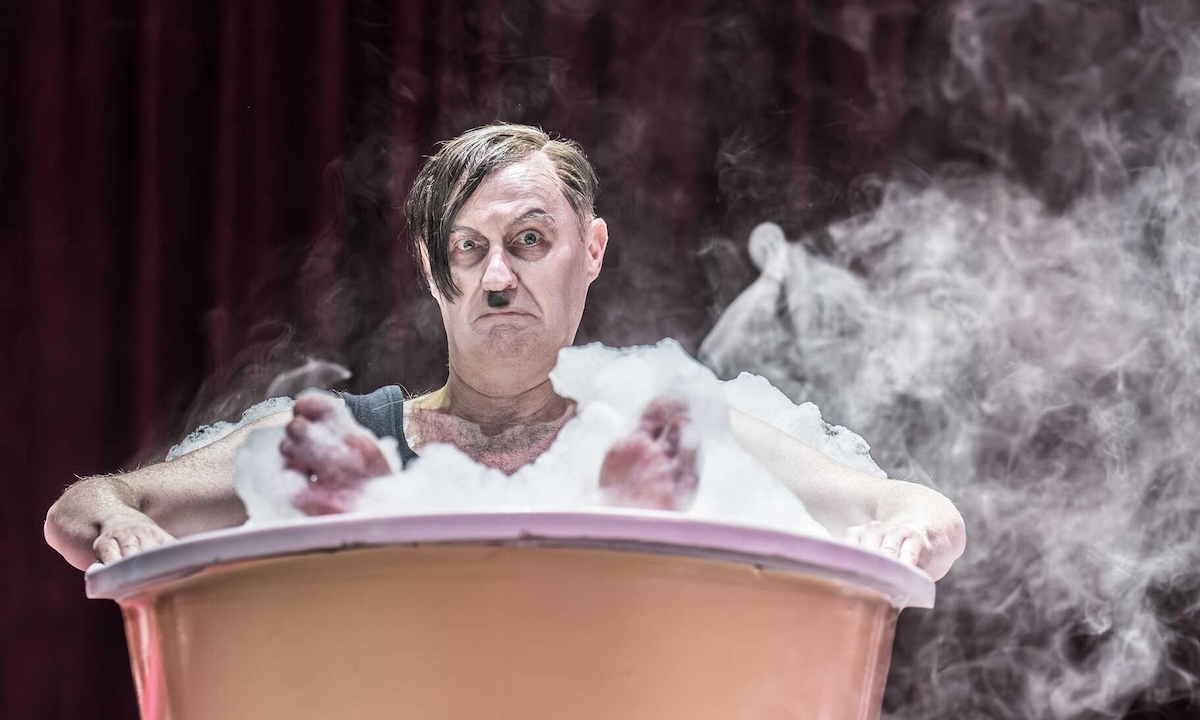
The satire, set in 1930s Chicago, casts Hitler as Arturo Ui, a mobster who moves in on the local greengrocers and hijacks the Cauliflower Trust. Georgia Lowe’s design sets it in a nightclub with a neon-framed proscenium with a band, Placebo, on top, who provide intermittent harsh or threatening accompaniment to the action.
It is consistently engaging to watch, from the outset. Establishing the Brechtian alienation effect, Mawaan Rizwan addresses the audience as one of the theatre ushers and introduces the main players before the action begins. He then becomes Giri (Hermann Goering), Ui’s henchman, and gives an electric performance, vivid in facial expression and movement, and dangerous in attitude. Accompanied by LJ Parkinson’s Givola (Goebbels), he creates a sense of a pair of hunting dogs snapping at the heels of their victims.
Christopher Godwin is excellent as Dogsborough, Brecht’s version of the doomed Hindenburg, and Janie Dee is just as strong as the counsel for the defence attempting to face down the gangsters. Godwin also gives us a winning turn as the actor who coaches Ui in his walk and posture and delivery – and highlights the Shakespearean parallels with Richard III, Macbeth and Julius Caesar, which Brecht suggests.
But it is Mark Gatiss’s Ui that holds the whole production together. Tall and stooping, with an ugly set of false teeth (which he tellingly removes to deliver the epilogue) and a lank draping of smoothed down hair, he constantly plays with the single strand that hangs down over his right eye. He is mesmerising to watch (and could not be more different from the elegance of his recent Gielgud in The Motive and the Cue).
Linnen has harnessed a full range of theatrical effects to bring Brecht’s parable to life, and this is a thoroughly promising debut at Stratford.
Runs until 30 May 2026
The Reviews Hub Star Rating
-
8
