

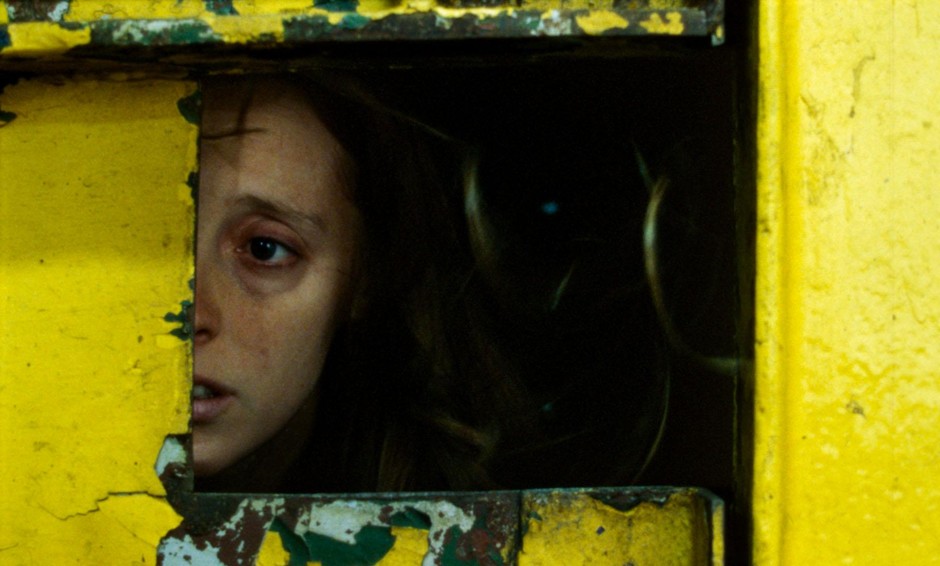
Writer and Director: Sofía Petersen
Depending on your mood, you may find Sofía Petersen’s Olivia a profound reflection on human loneliness and isolation or an overly indulgent and frustrating piece that struggles for momentum. Set in a remote cabin in rural Argentina shared by an elderly father who works in an abattoir and his adult daughter who tends to the home, the first 30-minutes of Olivia barely gets going, focused on a series of limited meals made largely of baked potatoes and the title characters obsession with the little beetles and moths that run freely through their permanently dark home. What little dialogue there is is often slightly surreal, reflecting Olivier’s non-lucid state of mind.
Petersen’s camera focuses on the small things, the laying of the table for a meagre repast, the ritual and routine of Olivia’s day shaped by the director’s fascinating with time and precision as plates, pots and cutlery lay exactly as the hands of the clock move on but also with decay as rotting food and dead animals are shown explicitly. Olivia is largely a vacant character in this, someone whose inner life only periodically rises to the surface for these moments of anchor in the real world while the rest of her time is spent talking to the bugs, lost on thoughts the audience are not invited to share.
There are graphic scenes of cows being led through the slaughter house, a metal, urban but degraded place devoid of humans and the resultant bloodstained pipes and drains which will be upsetting to some viewers, but these are all presented in a strange, almost poetic style by Petersen that sits somewhere between realism and Olivia’s heightened perspective, the film searching for meaning in every life however small or limited. But with limited plot, Olivia’s two-hour running time overstays its welcome, a film that is all technique, a short perhaps extended far beyond its capacity.
And it is frustratingly dark to the point where the viewer can barely see through the permanent gloom or outright blackness of night, And perhaps that is the world the characters live in but it doesn’t make for an engaging viewing experience as you peer at the screen trying to make out scene after scene. In the second hour, Olivia finally ends up at the abattoir herself with a cut that is sewn together without anaesthetic while tracing the history of her father’s time at the operation, but again this is all presented through music and filming techniques with a conscious profundity that the plot and characterisation hasn’t earned. Even its stark commentary on death and the grislier truth about nature never really land.
Olivia shows odd moments of promise and makes use of real slaughterhouse workers to add grit to the more straightforward segments, but it is bafflingly long and shapeless, the kind of film that festivals love but regular cinema goers may struggle to sit through.
Olivia is in cinemas from 24 April.
